Strength-based exercise programme is being tested to see if it affects telomere length in schizophrenia patients
Effect of strength-based physical exercise on telomere length as a marker of premature ageing in patients with schizophrenia: study protocol for a pilot randomised controlled trial
Pragmatic, randomised controlled trialUnclear result
Does strength-based physical exercise affect telomere length in patients with schizophrenia?
Who
40
Patients aged 18 years or older with schizophrenia · Psychosocial Rehabilitation Centre in Salamanca, Spain
Compared
treatment-as-usual group
intervention group
Main outcome
telomere length
Bottom line: This pilot trial aims to investigate if strength-based exercise affects telomere length in schizophrenia patients.
BJPsych Open · 2024-09-26Download image
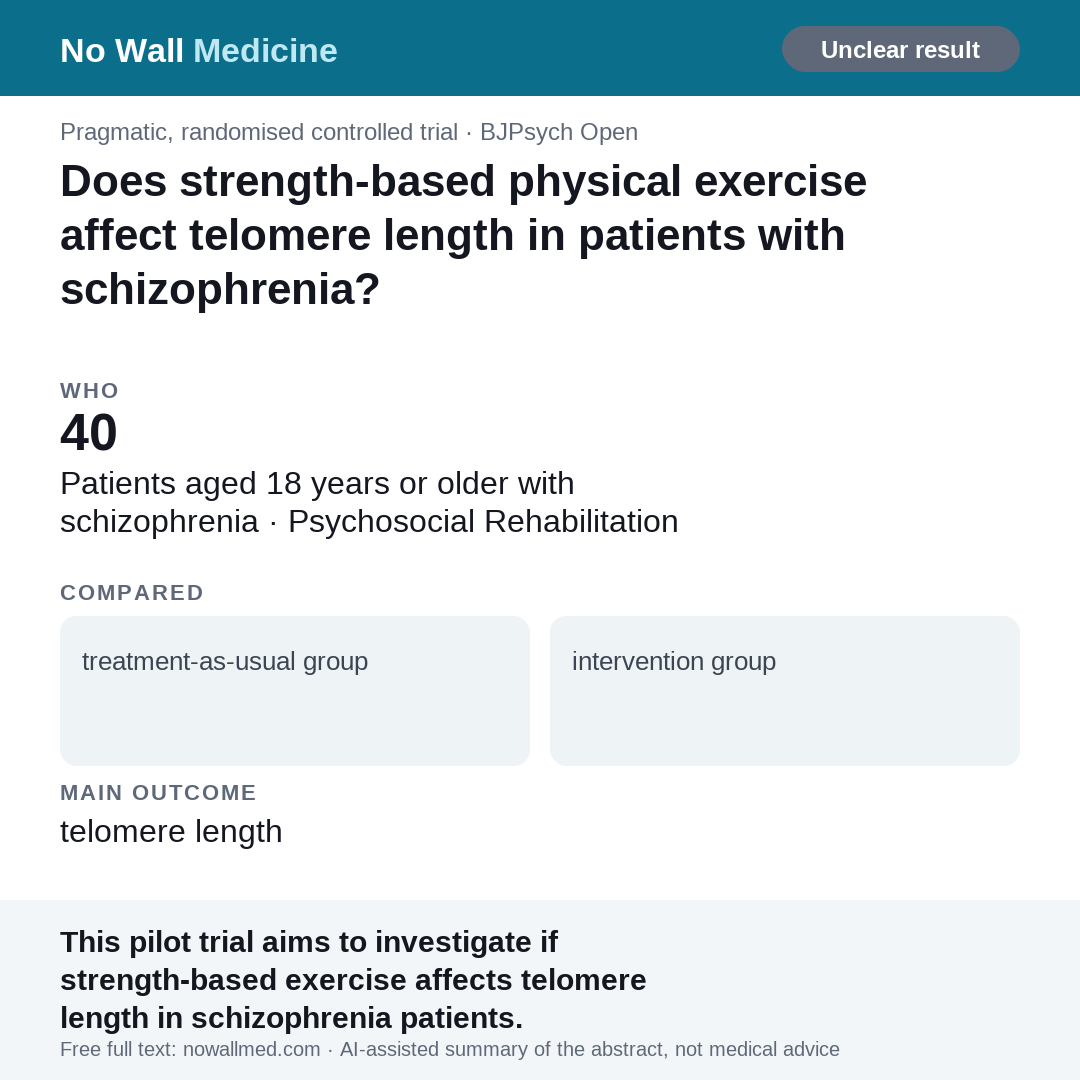
Clinical question: Does strength-based physical exercise affect telomere length in patients with schizophrenia?
Why it matters: It is unknown if strength-based physical exercise can modify telomere length in individuals living with schizophrenia.
Key points
- The study protocol describes a randomized controlled trial involving 40 patients aged ≥18 years with a stable diagnosis of schizophrenia.
- Participants will be assigned to either usual treatment or usual treatment plus twice weekly sessions of a strength-based training exercise programme for 12 weeks.
- The primary outcome being measured is the effect on telomere length, which is a marker of premature ageing.
Headline and key points written with AI from the paper’s abstract, with every number checked against it. Read the paper before relying on them.
Cite this article
Sánchez-González JL, Juárez-Vela R, Dutil Muñoz de la Torre V, Andrés-Olivera MDP, Martín-Vallejo J, Morán-Bayón Á. Effect of strength-based physical exercise on telomere length as a marker of premature ageing in patients with schizophrenia: study protocol for a pilot randomised controlled trial. BJPsych Open. 2024. doi:10.1192/bjo.2024.753
Spotted a mistake? Suggest a correction
Top studies every Monday
The week’s key trials and guidelines in your specialties, plus any topics you follow. By email, free.
Get the weekly digest