Tailoring intestinal limb length during gastric bypass surgery showed no difference in weight loss at one year
Effect of tailoring biliopancreatic limb length based on total small bowel length versus standard limb length in one anastomosis gastric bypass: 1-year outcomes of the TAILOR randomized clinical superiority trial
Double-blind, single-centre randomized clinical trialNo clear difference
Does tailoring biliopancreatic limb length based on total small bowel length improve outcomes?
Who
212
Patients scheduled for primary one anastomosis gastric bypass surgery · Single-centre
Compared
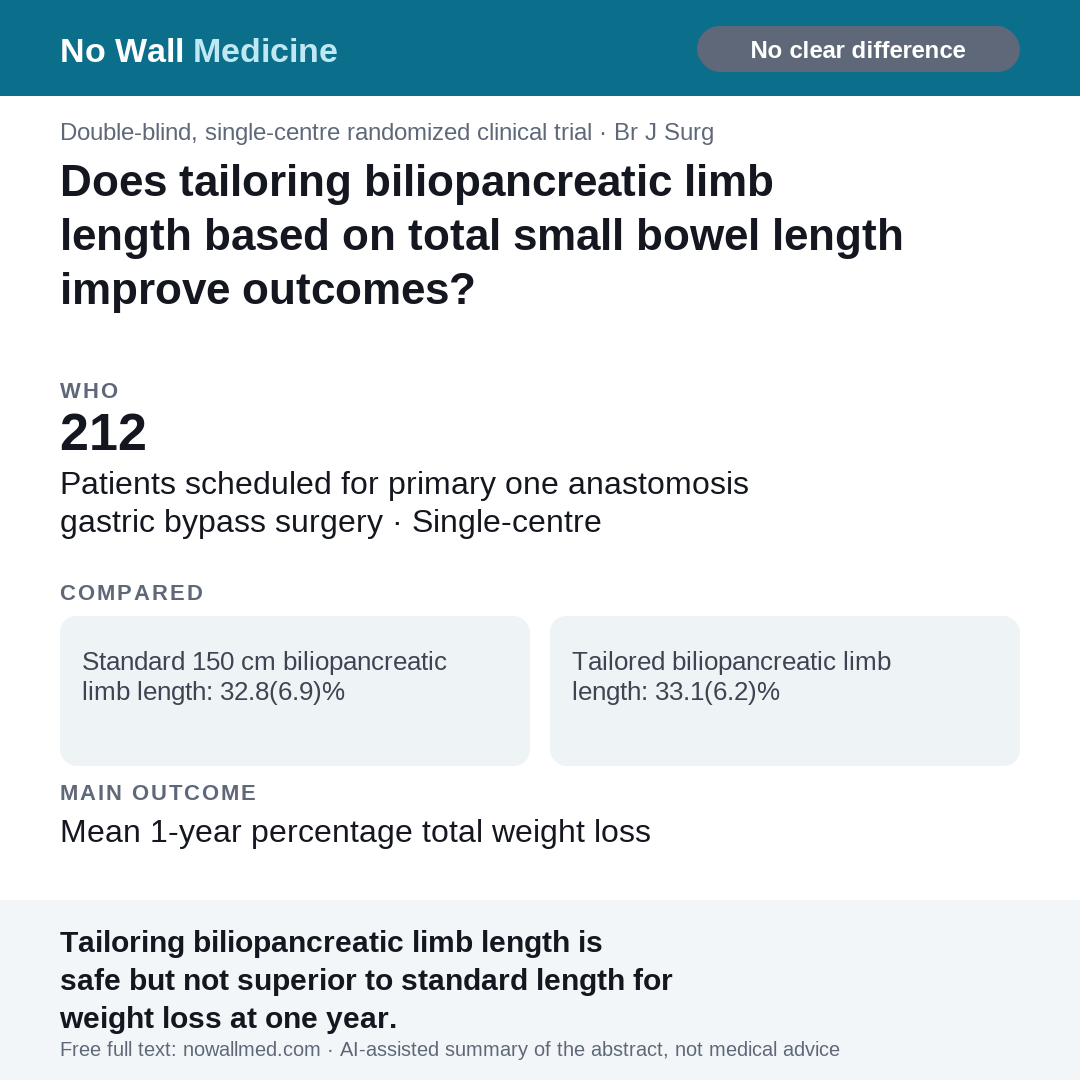
Standard 150 cm biliopancreatic limb length: 32.8(6.9)%
Tailored biliopancreatic limb length: 33.1(6.2)%
Main outcome
Mean 1-year percentage total weight loss
Result: P = 0.787
Bottom line: Tailoring biliopancreatic limb length is safe but not superior to standard length for weight loss at one year.
Br J Surg · 2024-08-31Download image
Clinical question: Does tailoring biliopancreatic limb length based on total small bowel length improve outcomes?
Why it matters: It is unknown whether adjusting the length of the biliopancreatic limb based on a patient's total small bowel length provides better outcomes than using a fixed length.
Key points
- Researchers randomized 212 patients to receive either a standard 150 cm biliopancreatic limb length or a length tailored to their total small bowel length during one anastomosis gastric bypass.
- The mean 1-year percentage total weight loss was 32.8(6.9)% in the standard group and 33.1(6.2)% in the tailored group, which was not a statistically significant difference.
- There were no significant differences between the two groups regarding nutritional deficiencies or short-term complications.
Headline and key points written with AI from the paper’s abstract, with every number checked against it. Read the paper before relying on them.
Was this summary helpful?
Subject terms
Cite this article
Slagter N, van der Laan L, de Heide LJM, Jutte EH, Kaijser MA, Damen SL. Effect of tailoring biliopancreatic limb length based on total small bowel length versus standard limb length in one anastomosis gastric bypass: 1-year outcomes of the TAILOR randomized clinical superiority trial. Br J Surg. 2024. doi:10.1093/bjs/znae219
Spotted a mistake? Suggest a correction
Top studies every Monday
The week’s key trials and guidelines in your specialties, plus any topics you follow. By email, free.
Get the weekly digest