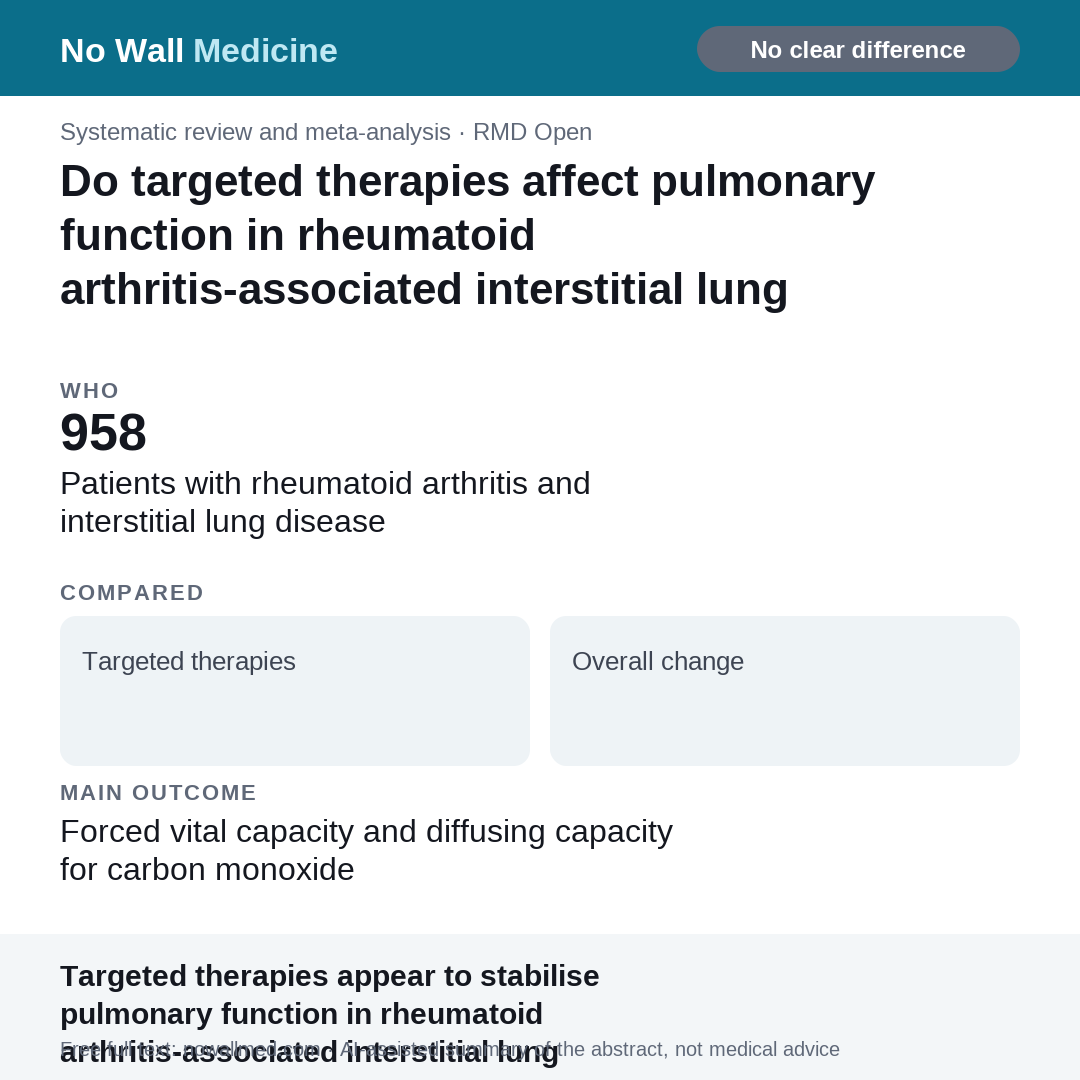
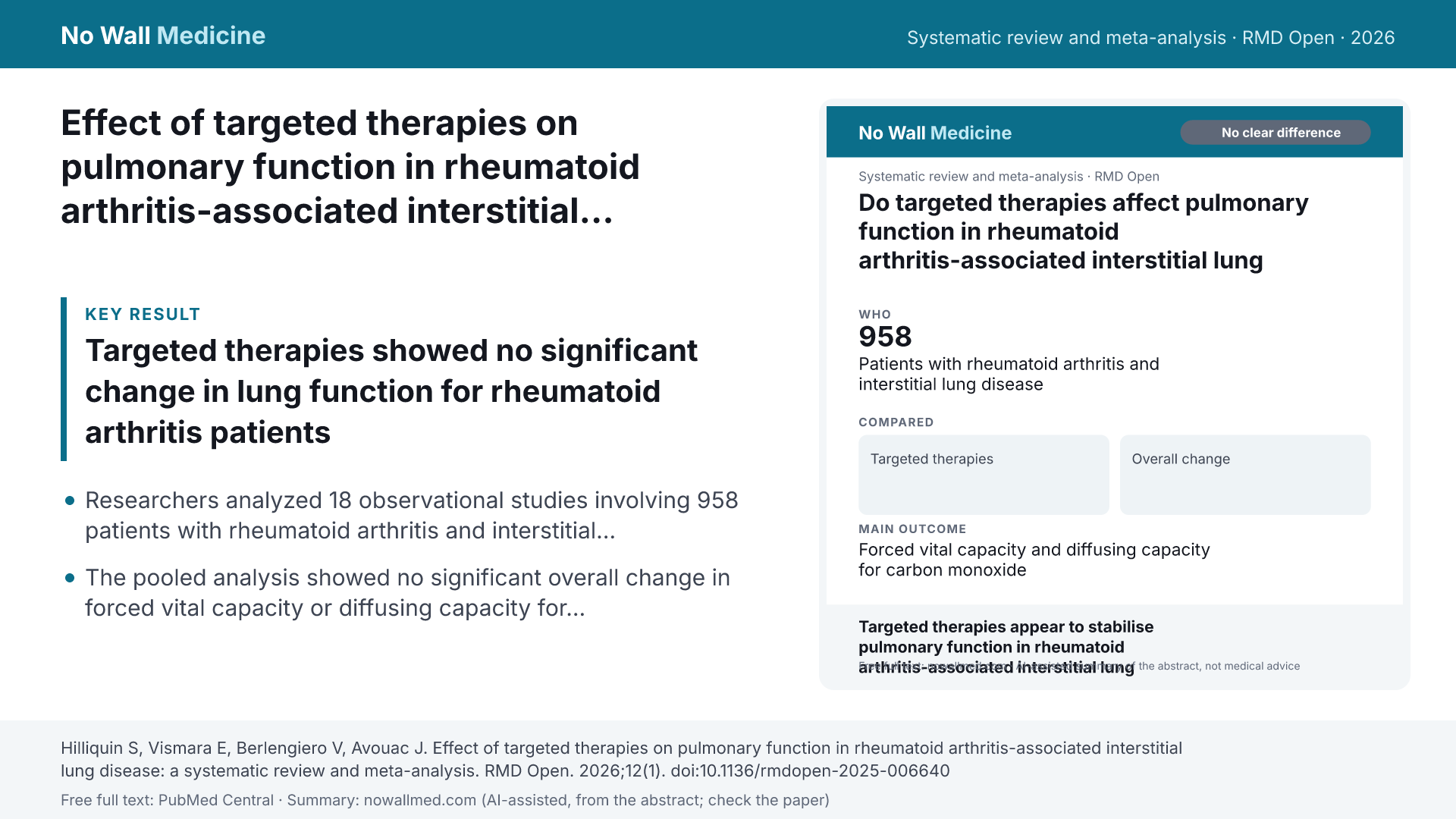
Targeted therapies showed no significant change in lung function for rheumatoid arthritis patients
Effect of targeted therapies on pulmonary function in rheumatoid arthritis-associated interstitial lung disease: a systematic review and meta-analysis
Systematic review and meta-analysisNo clear difference
Do targeted therapies affect pulmonary function in rheumatoid arthritis-associated interstitial lung disease?
Who
958
Patients with rheumatoid arthritis and interstitial lung disease
Compared
Targeted therapies
Overall change
Main outcome
Forced vital capacity and diffusing capacity for carbon monoxide
Result: mean difference -0.85%, 95% CI -2.40 to 0.71 for FVC; +0.79, 95% CI -0.30 to 1.88 for DLCO
Bottom line: Targeted therapies appear to stabilise pulmonary function in rheumatoid arthritis-associated interstitial lung disease without significant changes in lung function tests.
RMD Open · 2026-03-19Download image
Clinical question: Do targeted therapies affect pulmonary function in rheumatoid arthritis-associated interstitial lung disease?
Why it matters: The pulmonary safety of biologic and targeted synthetic disease-modifying anti-rheumatic drugs in patients with rheumatoid arthritis-associated interstitial lung disease remains uncertain.
Key points
- Researchers analyzed 18 observational studies involving 958 patients with rheumatoid arthritis and interstitial lung disease.
- The pooled analysis showed no significant overall change in forced vital capacity or diffusing capacity for carbon monoxide.
- The most common lung disease patterns identified in the studied patients were usual interstitial pneumonia and nonspecific interstitial pneumonia.
Limitation the authors note: The authors state that further prospective studies integrating pulmonary function tests and high-resolution computed tomography are needed.
Headline and key points written with AI from the paper’s abstract, with every number checked against it. Read the paper before relying on them.
Was this summary helpful?
Abstract
Introduction
Interstitial lung disease (ILD) is a serious extra-articular manifestation of rheumatoid arthritis (RA) associated with increased morbidity and mortality. The pulmonary safety of biologic Disease-Modifying Anti-Rheumatic Drugs (bDMARDs) and targeted synthetic DMARDs (tsDMARDs) in RA-associated ILD (RA-ILD) remains uncertain. This systematic review and meta-analysis aimed to assess the effect of bDMARDs and tsDMARDs on ILD progression in RA, focusing on pulmonary function test (PFT) parameters-forced vital capacity (FVC) and diffusing capacity for carbon monoxide (DLCO)-and, when available, high-resolution computed tomography (HRCT) outcomes. Methods
PubMed and Cochrane databases were searched up to 2025 for controlled trials and observational studies, including patients with RA fulfilling the 1987 ACR or 2010 ACR/EULAR criteria. Studies reporting longitudinal changes in PFTs or HRCT after bDMARD or tsDMARD treatment were included. Meta-analyses were conducted using the inverse variance method (RevMan V.5.4.1) for pooled estimates of FVC and DLCO. Results
18 observational studies including 958 patients (mean age 65 years; 57% female) were analysed. The most frequent ILD patterns were usual interstitial pneumonia (48%) and nonspecific interstitial pneumonia (40%). Data were available for rituximab (six studies), abatacept (4), JAK inhibitors (4), tumour necrosis factor (TNF) inhibitors (1) and tocilizumab (1). Pooled analysis showed no significant overall change in FVC (mean difference -0.85%, 95% CI -2.40 to 0.71; p=0.29) or DLCO (+0.79, 95% CI -0.30 to 1.88; p=0.16). Conclusion
bDMARDs and tsDMARDs appear to stabilise pulmonary function in RA-ILD, without significant differences between agents. Further prospective studies integrating PFT and HRCT endpoints are needed to better define their pulmonary safety and long-term effects.
Abstract reproduced under the article’s CC BY NC licence.
Subject terms
Cite this article
Hilliquin S, Vismara E, Berlengiero V, Avouac J. Effect of targeted therapies on pulmonary function in rheumatoid arthritis-associated interstitial lung disease: a systematic review and meta-analysis. RMD Open. 2026. doi:10.1136/rmdopen-2025-006640
Spotted a mistake? Suggest a correction