Force feedback hand rehabilitation robots improved finger grasping function in stroke patients with hemiplegia
Effect of task-oriented training assisted by force feedback hand rehabilitation robot on finger grasping function in stroke patients with hemiplegia: a randomised controlled trial
Single-blinded randomised controlled trialBenefit found
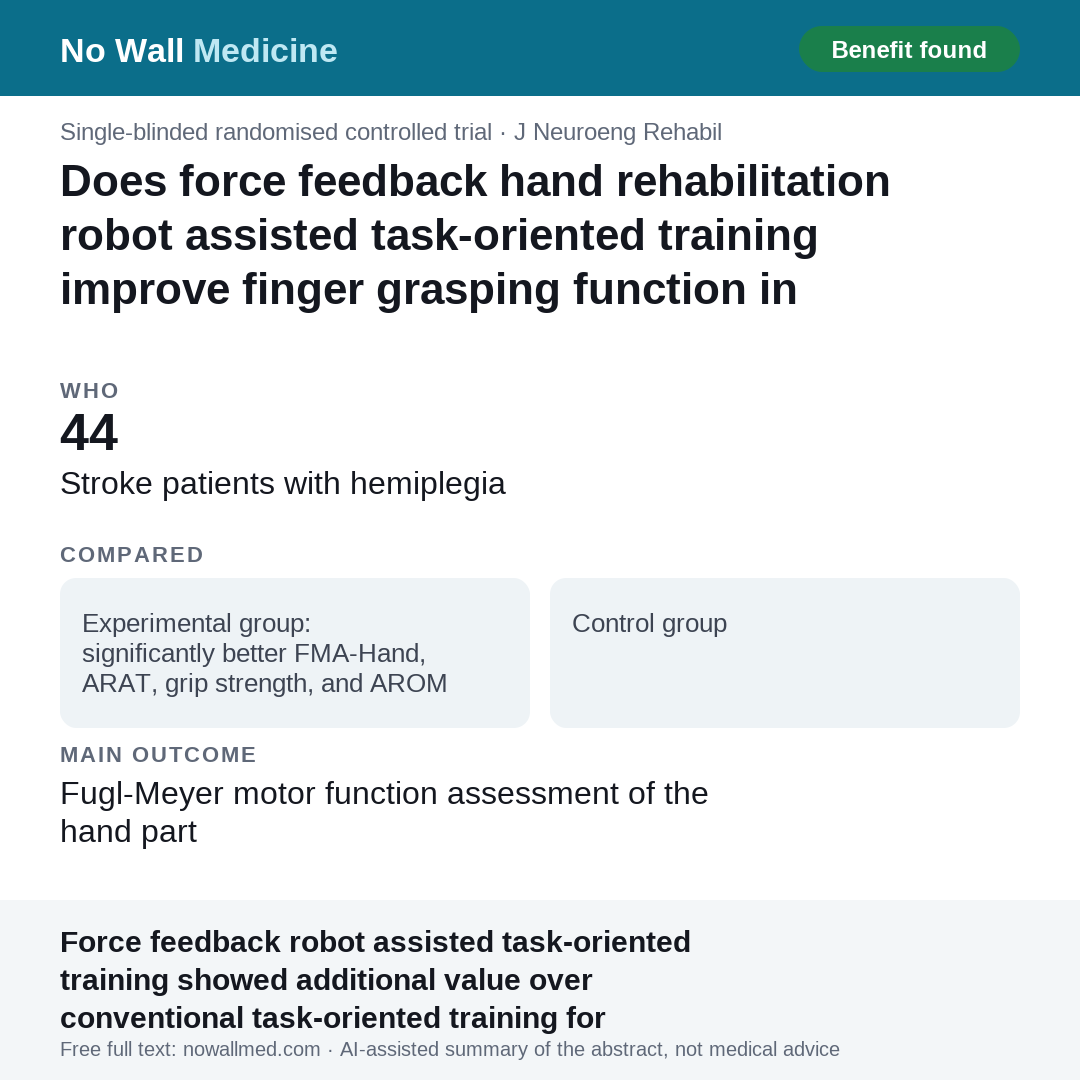
Does force feedback hand rehabilitation robot assisted task-oriented training improve finger grasping function in stroke patients?
Who
44
Stroke patients with hemiplegia
Compared
Experimental group: significantly better FMA-Hand, ARAT, grip strength, and AROM
Control group
Main outcome
Fugl-Meyer motor function assessment of the hand part
Bottom line: Force feedback robot assisted task-oriented training showed additional value over conventional task-oriented training for stroke patients.
J Neuroeng Rehabil · 2024-05-14Download image
Clinical question: Does force feedback hand rehabilitation robot assisted task-oriented training improve finger grasping function in stroke patients?
Why it matters: It was unknown if a hand rehabilitation robot providing sensory force feedback offers clinical efficacy for stroke patients compared to conventional task-oriented training.
Key points
- Researchers studied 44 stroke patients with hemiplegia, comparing 20 minutes of robot-assisted training to 20 minutes of therapist-assisted training daily for 4 weeks.
- The robot group showed significantly better scores in the Fugl-Meyer motor function assessment of the hand, Action Research Arm Test, grip strength, and range of motion.
- No statistically significant differences were found between groups for muscle spasticity, Brunnstrom recovery stages, or the Barthel Index for daily living activities.
Headline and key points written with AI from the paper’s abstract, with every number checked against it. Read the paper before relying on them.
Was this summary helpful?
Subject terms
Cite this article
Li Y, Lian Y, Chen X, Zhang H, Xu G, Duan H. Effect of task-oriented training assisted by force feedback hand rehabilitation robot on finger grasping function in stroke patients with hemiplegia: a randomised controlled trial. J Neuroeng Rehabil. 2024. doi:10.1186/s12984-024-01372-3
Spotted a mistake? Suggest a correction
Top studies every Monday
The week’s key trials and guidelines in your specialties, plus any topics you follow. By email, free.
Get the weekly digest