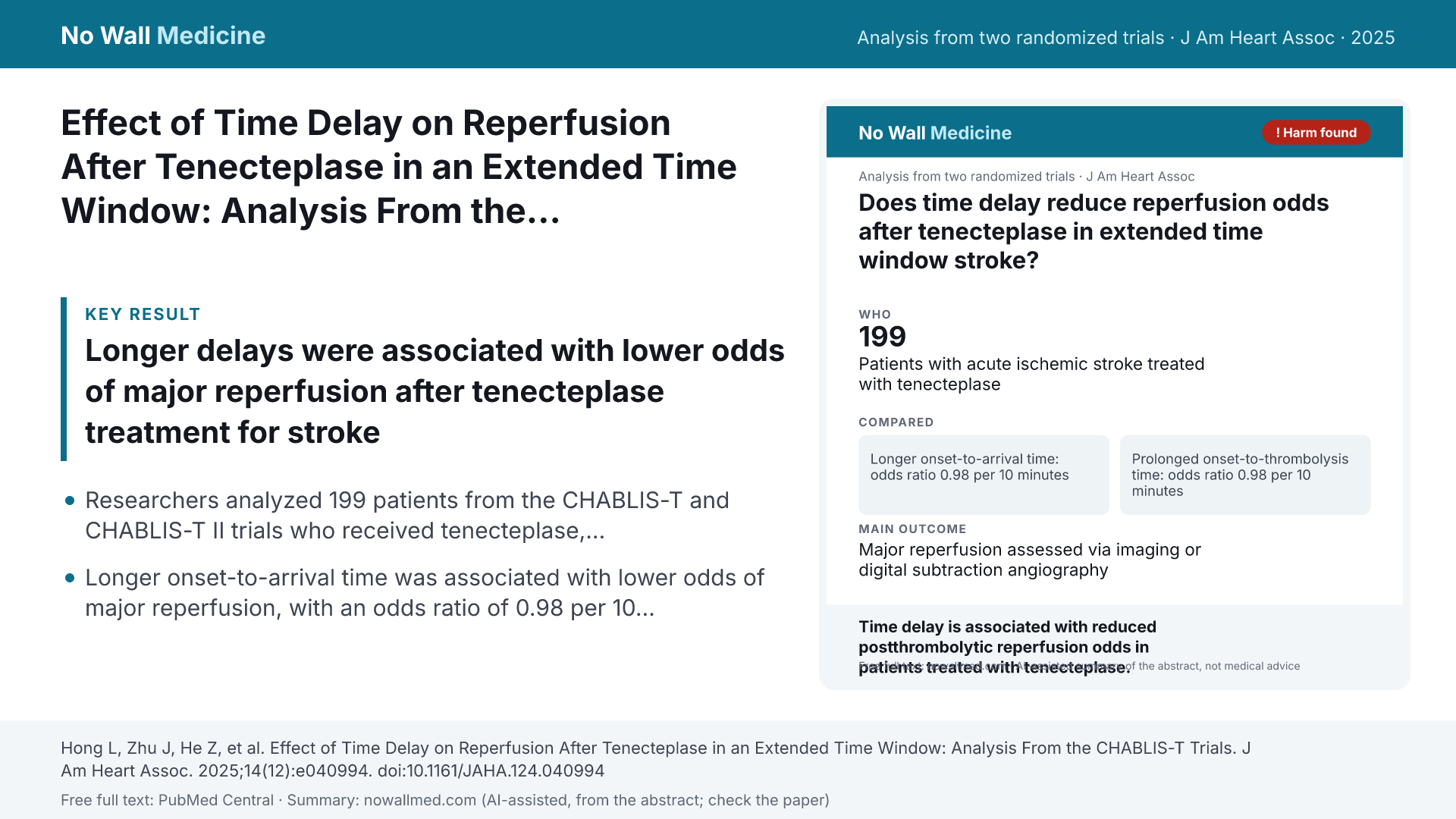
Effect of Time Delay on Reperfusion After Tenecteplase in an Extended Time Window: Analysis From the CHABLIS-T Trials
Key result: Longer delays were associated with lower odds of major reperfusion after tenecteplase treatment for stroke
Analysis from two randomized trialsHarm found
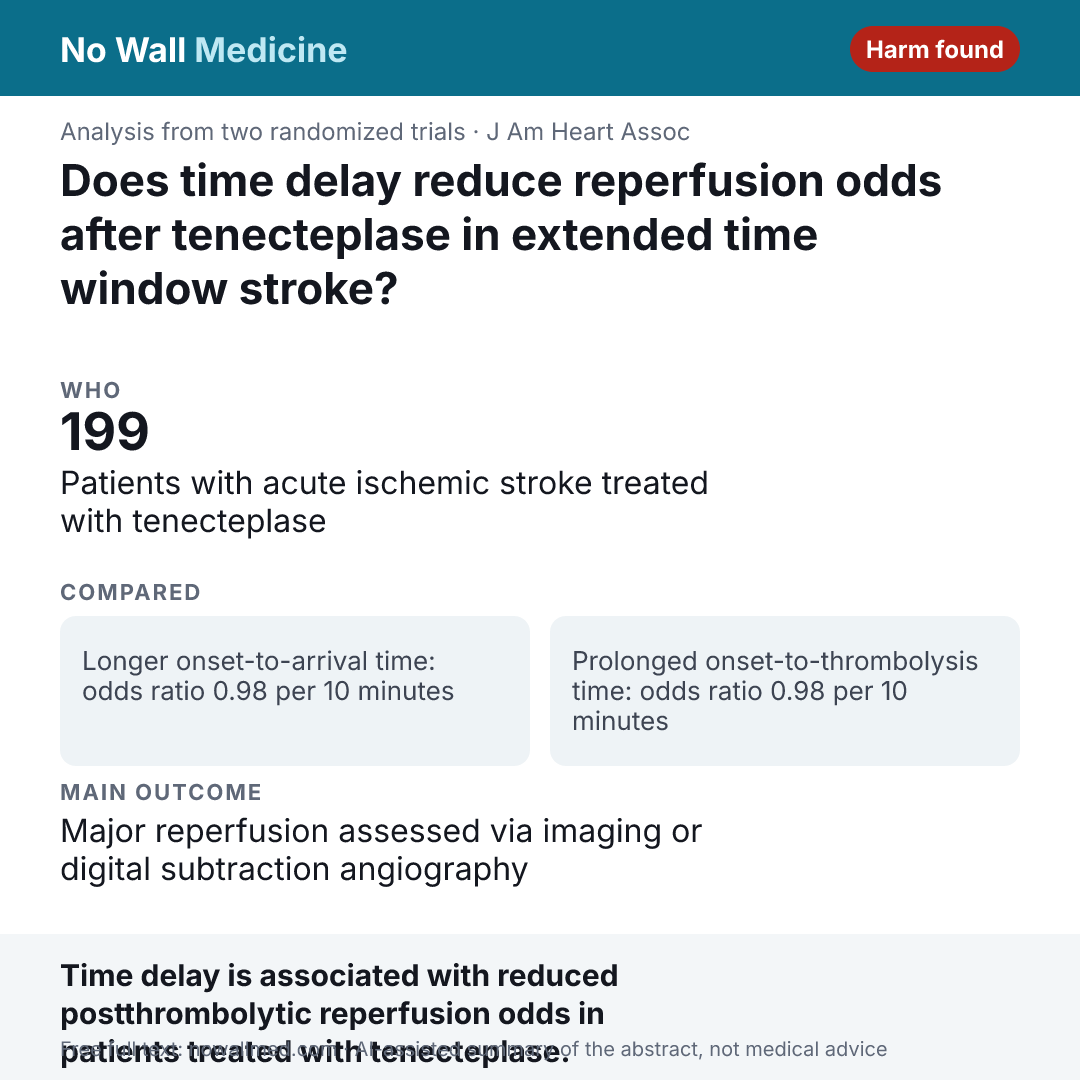
Does time delay reduce reperfusion odds after tenecteplase in extended time window stroke?
Who
199
Patients with acute ischemic stroke treated with tenecteplase
Compared
Longer onset-to-arrival time: odds ratio 0.98 per 10 minutes
Prolonged onset-to-thrombolysis time: odds ratio 0.98 per 10 minutes
Main outcome
Major reperfusion assessed via imaging or digital subtraction angiography
Result: odds ratio 0.98 per 10 minutes (P=0.004)
Bottom line: Time delay is associated with reduced postthrombolytic reperfusion odds in patients treated with tenecteplase.
J Am Heart Assoc · 2025-06-11 · Save PNG
Key points
- Researchers analyzed 199 patients from the CHABLIS-T and CHABLIS-T II trials who received tenecteplase, a clot-dissolving medication, for acute ischemic stroke.
- Longer onset-to-arrival time was associated with lower odds of major reperfusion, with an odds ratio of 0.98 per 10 minutes (P=0.004).
- Prolonged onset-to-thrombolysis time was associated with a decreased probability of reperfusion, showing an odds ratio of 0.98 per 10 minutes (P=0.01).
Why it matters: The association between time delay and reperfusion in the 4.5- to 24-hour time window for patients treated with tenecteplase remains unexplored.
Discussion prompts
- Would these patients look like yours? Who was left out?
- Is the main outcome one that matters to patients?
- Is the difference large enough to change what you do?
Cite: Hong L, Zhu J, He Z, et al. Effect of Time Delay on Reperfusion After Tenecteplase in an Extended Time Window: Analysis From the CHABLIS-T Trials. J Am Heart Assoc. 2025;14(12):e040994. doi:10.1161/JAHA.124.040994
Free full text: PubMed Central · Summary and visual abstract: nowallmed.com/a/effect-of-time-delay-on-reperfusion-after-tenecteplase-in-an-extended-gh571h/ (AI-assisted from the abstract; check the paper before relying on it).