Endometrial receptivity testing did not increase live birth rates during frozen embryo transfer
Effect of Timing by Endometrial Receptivity Testing vs Standard Timing of Frozen Embryo Transfer on Live Birth in Patients Undergoing In Vitro Fertilization: A Randomized Clinical Trial
Double-blind, randomized clinical trialNo clear difference
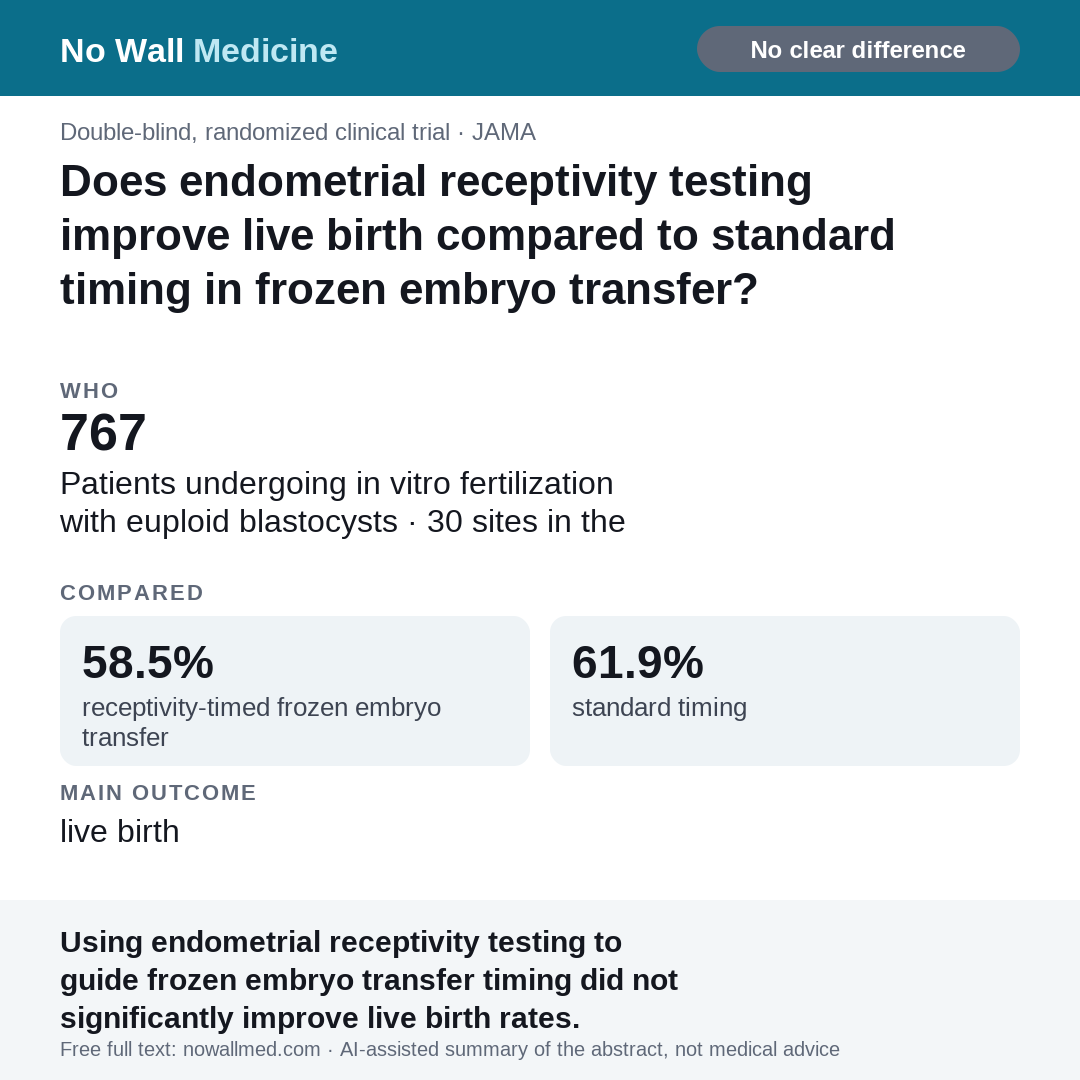
Does endometrial receptivity testing improve live birth compared to standard timing in frozen embryo transfer?
Who
767
Patients undergoing in vitro fertilization with euploid blastocysts · 30 sites in the Eastern United States
Compared
58.5%receptivity-timed frozen embryo transfer (223/381)
61.9%standard timing (239/386)
Main outcome
live birth
Result: rate ratio 0.95 (95% CI 0.79 to 1.13)
Bottom line: Using endometrial receptivity testing to guide frozen embryo transfer timing did not significantly improve live birth rates.
JAMA · 2022-12-06Download image
Clinical question: Does endometrial receptivity testing improve live birth compared to standard timing in frozen embryo transfer?
Why it matters: Data are conflicting regarding whether endometrial receptivity testing improves live birth rates by identifying the optimal embryo transfer time for individual patients.
Key points
- Researchers studied 767 patients undergoing in vitro fertilization to compare timing based on endometrial receptivity testing against standardized timing.
- The live birth rate was 58.5% in the receptivity-timed group compared to 61.9% in the standard timing group.
- No significant differences were found for biochemical pregnancy rates of 77.2% versus 79.5% or clinical pregnancy rates of 68.8% versus 72.8%.
Headline and key points written with AI from the paper’s abstract, with every number checked against it. Read the paper before relying on them.
Was this summary helpful?
Subject terms
Cite this article
Doyle N, Jahandideh S, Hill MJ, Widra EA, Levy M, Devine K. Effect of Timing by Endometrial Receptivity Testing vs Standard Timing of Frozen Embryo Transfer on Live Birth in Patients Undergoing In Vitro Fertilization: A Randomized Clinical Trial. JAMA. 2022. doi:10.1001/jama.2022.20438
Spotted a mistake? Suggest a correction
Top studies every Monday
The week’s key trials and guidelines in your specialties, plus any topics you follow. By email, free.
Get the weekly digest