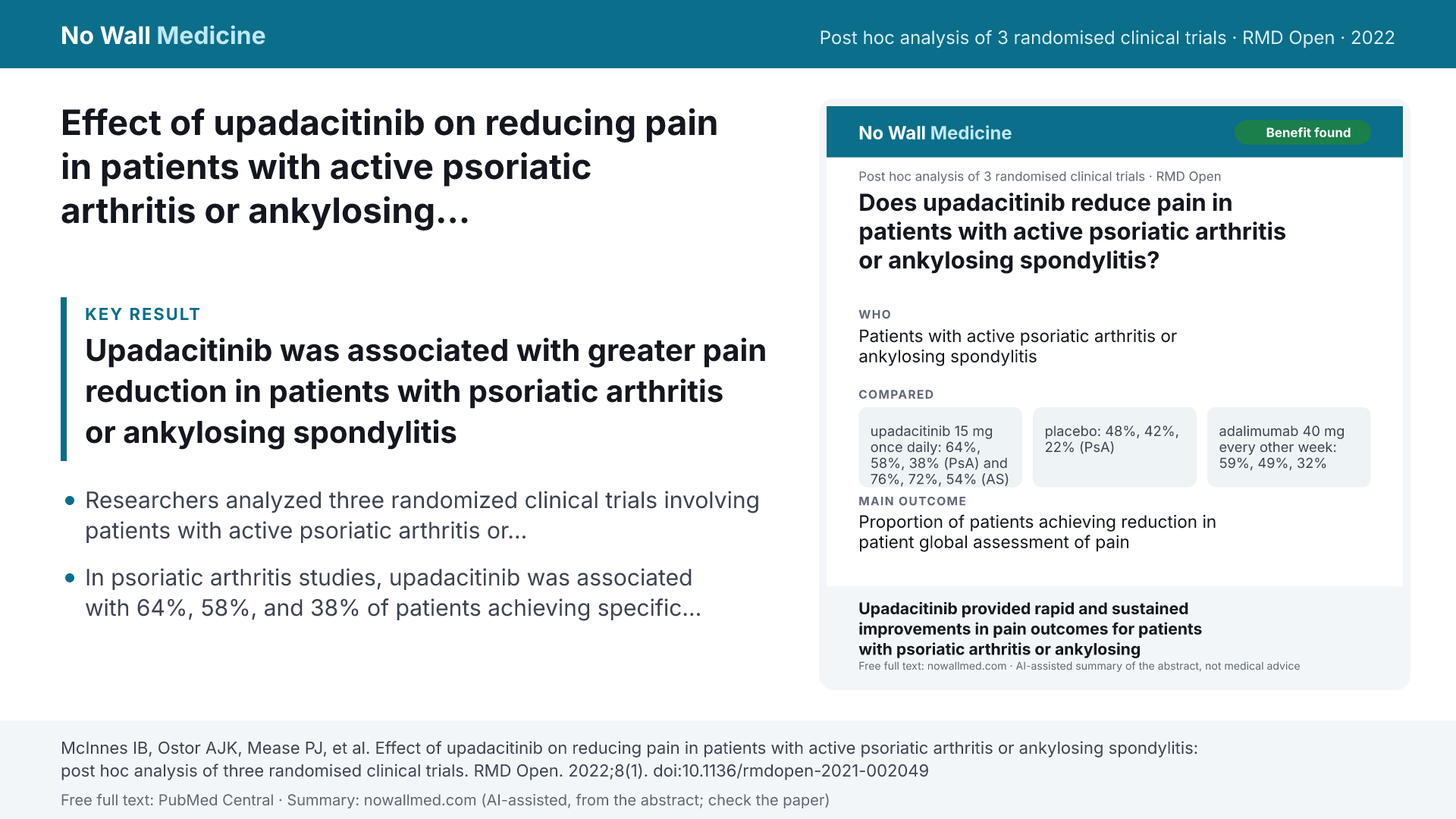
Upadacitinib was associated with greater pain reduction in patients with psoriatic arthritis or ankylosing spondylitis
Effect of upadacitinib on reducing pain in patients with active psoriatic arthritis or ankylosing spondylitis: post hoc analysis of three randomised clinical trials
Post hoc analysis of 3 randomised clinical trialsBenefit found
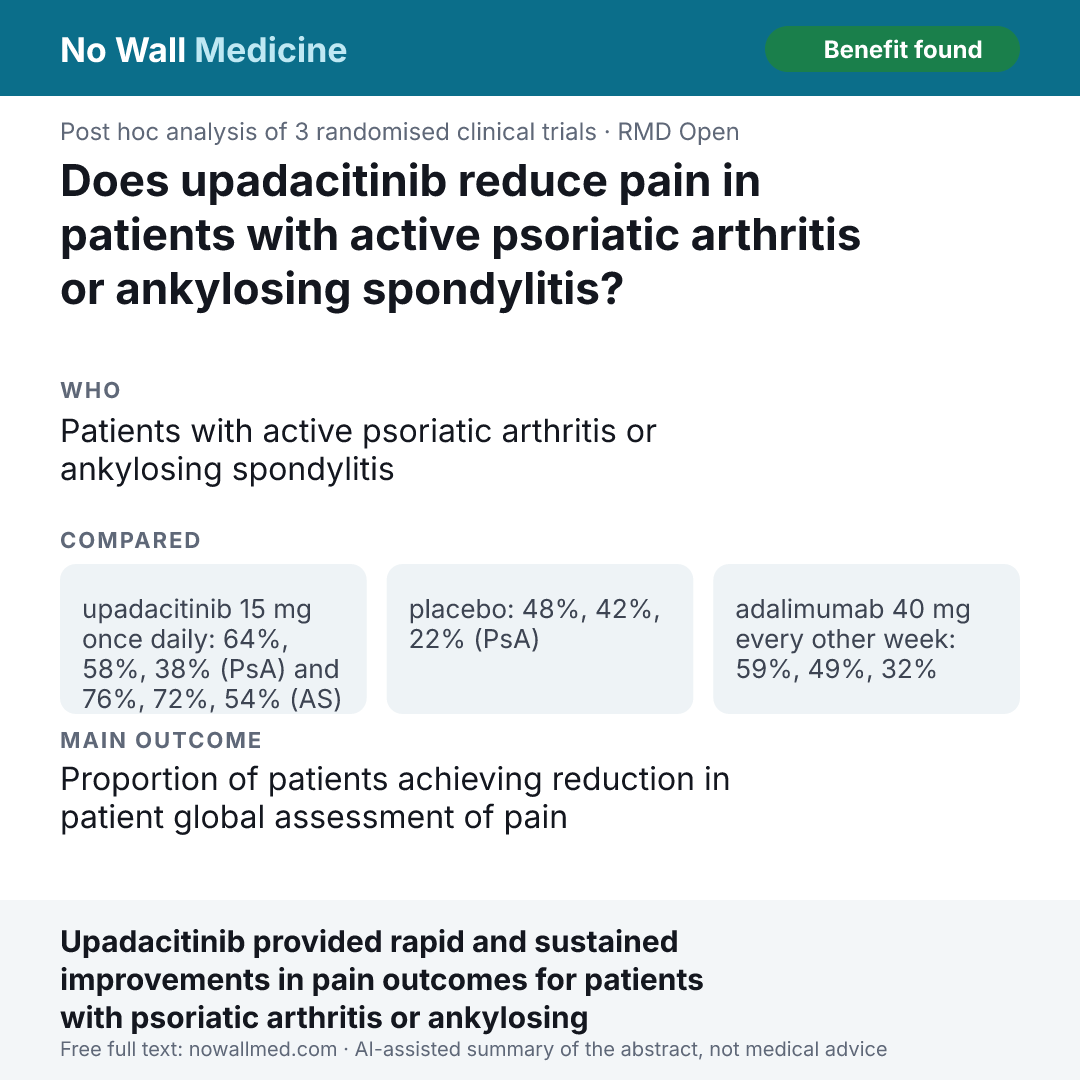
Does upadacitinib reduce pain in patients with active psoriatic arthritis or ankylosing spondylitis?
Who
Patients with active psoriatic arthritis or ankylosing spondylitis
Compared
upadacitinib 15 mg once daily: 64%, 58%, 38% (PsA) and 76%, 72%, 54% (AS)
placebo: 48%, 42%, 22% (PsA)
adalimumab 40 mg every other week: 59%, 49%, 32%
Main outcome
Proportion of patients achieving reduction in patient global assessment of pain
Bottom line: Upadacitinib provided rapid and sustained improvements in pain outcomes for patients with psoriatic arthritis or ankylosing spondylitis.
RMD Open · 2022-03-25 · Save PNG
Clinical question: Does upadacitinib reduce pain in patients with active psoriatic arthritis or ankylosing spondylitis?
Why it matters: The specific effects of upadacitinib on various pain reduction thresholds in patients with psoriatic arthritis or ankylosing spondylitis were not fully detailed across these trials.
Key points
- Researchers analyzed three randomized clinical trials involving patients with active psoriatic arthritis or ankylosing spondylitis treated with upadacitinib, placebo, or adalimumab.
- In psoriatic arthritis studies, upadacitinib was associated with 64%, 58%, and 38% of patients achieving specific pain reduction thresholds compared to 48%, 42%, and 22% for placebo.
- In the ankylosing spondylitis study, 76%, 72%, and 54% of patients receiving upadacitinib achieved the measured pain reduction end points.
Headline and key points written with AI from the paper’s abstract, with every number checked against it. Read the paper before relying on them.
Was this summary helpful?
Abstract
Objective
Evaluate the effect of upadacitinib on pain outcomes in patients with active psoriatic arthritis (PsA) or ankylosing spondylitis (AS) across 3 randomised trials (SELECT-PsA 1 and 2 for PsA; SELECT-AXIS 1 for AS). Methods
Patients were randomised to upadacitinib 15 mg once daily or placebo (all 3 studies), or adalimumab 40 mg every other week (SELECT-PsA 1 only). Pain outcomes included proportion of patients achieving ≥30%, ≥50% and ≥70% reduction from baseline in patient global assessment of pain and other end points. Results
A higher proportion of patients receiving upadacitinib versus placebo achieved ≥30%, ≥50% and ≥70% reduction in pain end points as early as week 2; these improvements with upadacitinib were generally sustained or increased through year 1 (PsA 1/2 studies: 64%/48%, 58%/42% and 38%/22%, respectively; SELECT-AXIS 1 study: 76%, 72% and 54%). Results were similar with adalimumab in PsA 1 (59%, 49% and 32%). Patients who switched from placebo to upadacitinib 15 mg were able to reach a similar level of improvement as the continuous upadacitinib groups by year 1 (PsA 1/2 studies: 46%-60%, 35%-49% and 15%-34%; AS study: 83%, 72% and 46%). Results were similar with other pain end points. Conclusion
Rapid and sustained improvements in pain outcomes across several end points were consistently shown with upadacitinib over 1 year in patients with active PsA or AS who had either inadequate response to prior non-biologic or biologic disease-modifying antirheumatic drugs (PsA studies) or were biologic-naïve with inadequate response to non-steroidal anti-inflammatory drugs (AS study).
Abstract reproduced under the article’s CC BY NC licence.
Subject terms
Headline, design, result, key points, caveat and citation as plain text.
Cite this article
McInnes IB, Ostor AJK, Mease PJ, et al. Effect of upadacitinib on reducing pain in patients with active psoriatic arthritis or ankylosing spondylitis: post hoc analysis of three randomised clinical trials. RMD Open. 2022;8(1). doi:10.1136/rmdopen-2021-002049
Spotted a mistake? Suggest a correction