Effect of Urate-Elevating Inosine on Early Parkinson Disease Progression: The SURE-PD3 Randomized Clinical Trial
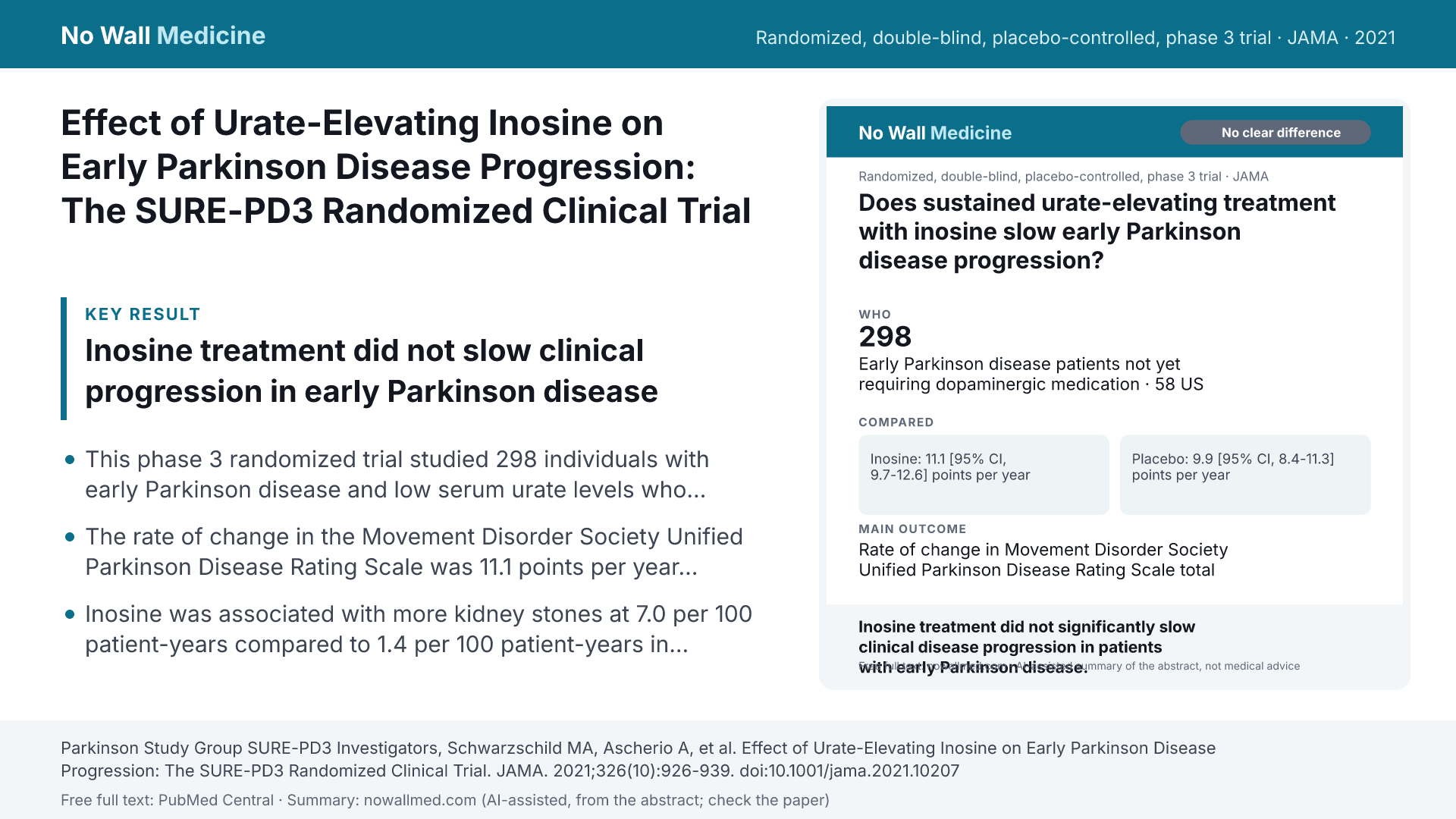
Key result: Inosine treatment did not slow clinical progression in early Parkinson disease
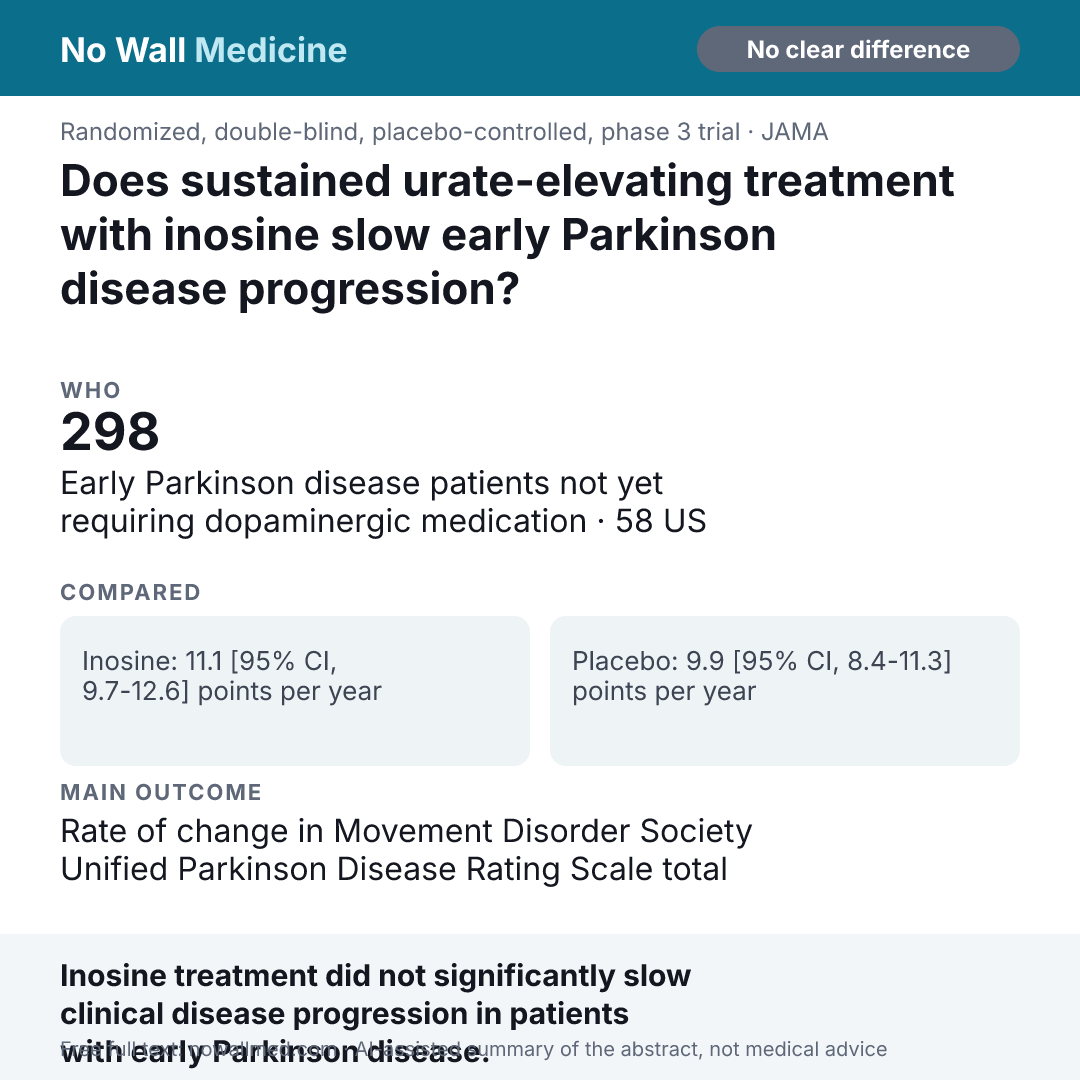
Randomized, double-blind, placebo-controlled, phase 3 trialNo clear difference
Does sustained urate-elevating treatment with inosine slow early Parkinson disease progression?
Who
298
Early Parkinson disease patients not yet requiring dopaminergic medication · 58 US sites
Compared
Inosine: 11.1 [95% CI, 9.7-12.6] points per year
Placebo: 9.9 [95% CI, 8.4-11.3] points per year
Main outcome
Rate of change in Movement Disorder Society Unified Parkinson Disease Rating Scale total score
Result: difference, 1.26 [95% CI, -0.59 to 3.11] points per year
Bottom line: Inosine treatment did not significantly slow clinical disease progression in patients with early Parkinson disease.
JAMA · 2021-09-14 · Save PNG
Key points
- This phase 3 randomized trial studied 298 individuals with early Parkinson disease and low serum urate levels who were assigned to inosine or a placebo.
- The rate of change in the Movement Disorder Society Unified Parkinson Disease Rating Scale was 11.1 points per year for inosine and 9.9 points per year for placebo.
- Inosine was associated with more kidney stones at 7.0 per 100 patient-years compared to 1.4 per 100 patient-years in the placebo group.
Discussion prompts
- Would these patients look like yours? Who was left out?
- Is the main outcome one that matters to patients?
- Is the difference large enough to change what you do?
Cite: Parkinson Study Group SURE-PD3 Investigators, Schwarzschild MA, Ascherio A, et al. Effect of Urate-Elevating Inosine on Early Parkinson Disease Progression: The SURE-PD3 Randomized Clinical Trial. JAMA. 2021;326(10):926-939. doi:10.1001/jama.2021.10207
Free full text: PubMed Central · Summary and visual abstract: nowallmed.com/a/effect-of-urate-elevating-inosine-on-early-parkinson-disease-izpmhx/ (AI-assisted from the abstract; check the paper before relying on it).