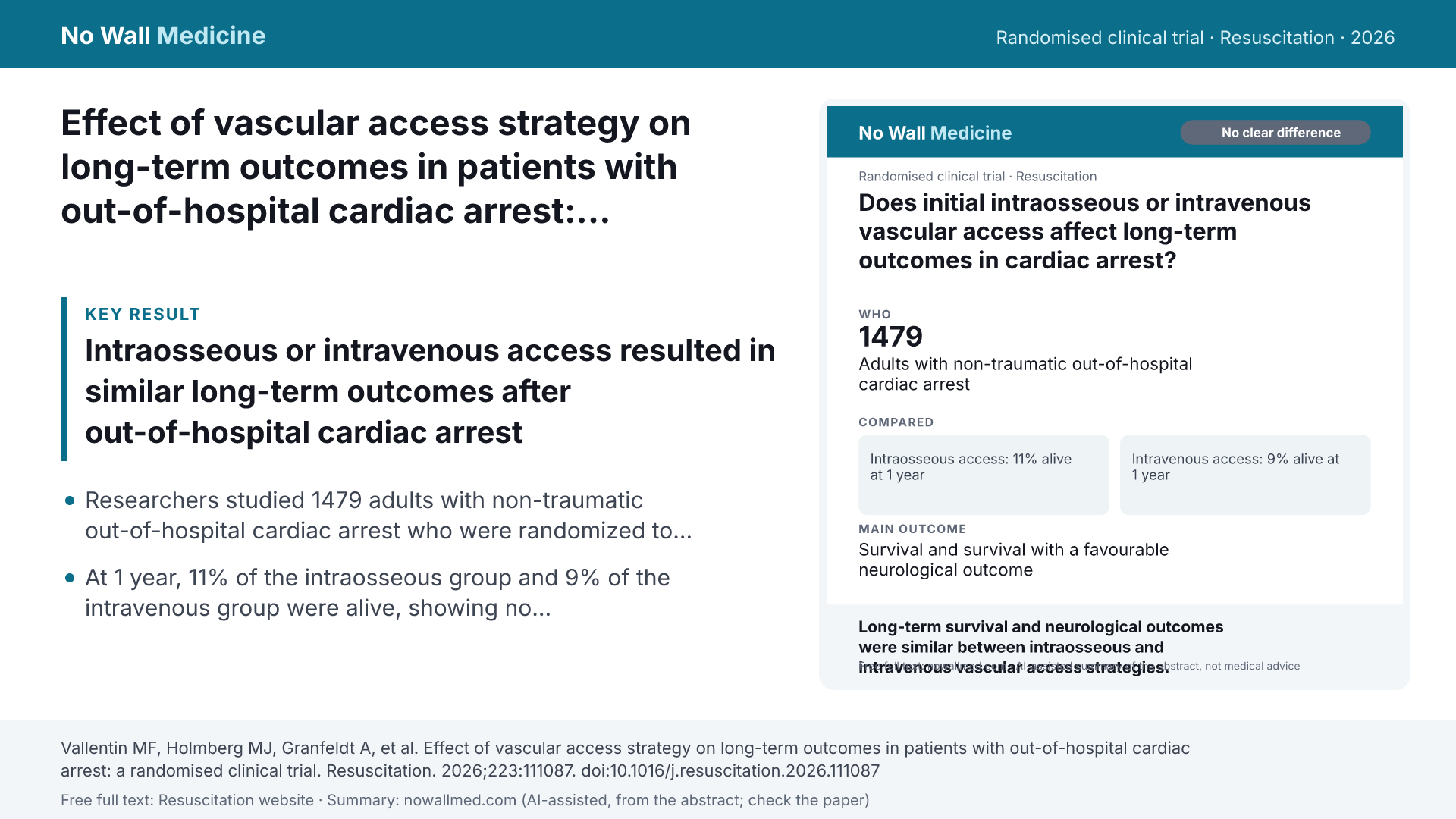
Intraosseous or intravenous access resulted in similar long-term outcomes after out-of-hospital cardiac arrest
Effect of vascular access strategy on long-term outcomes in patients with out-of-hospital cardiac arrest: a randomised clinical trial
Randomised clinical trialNo clear difference
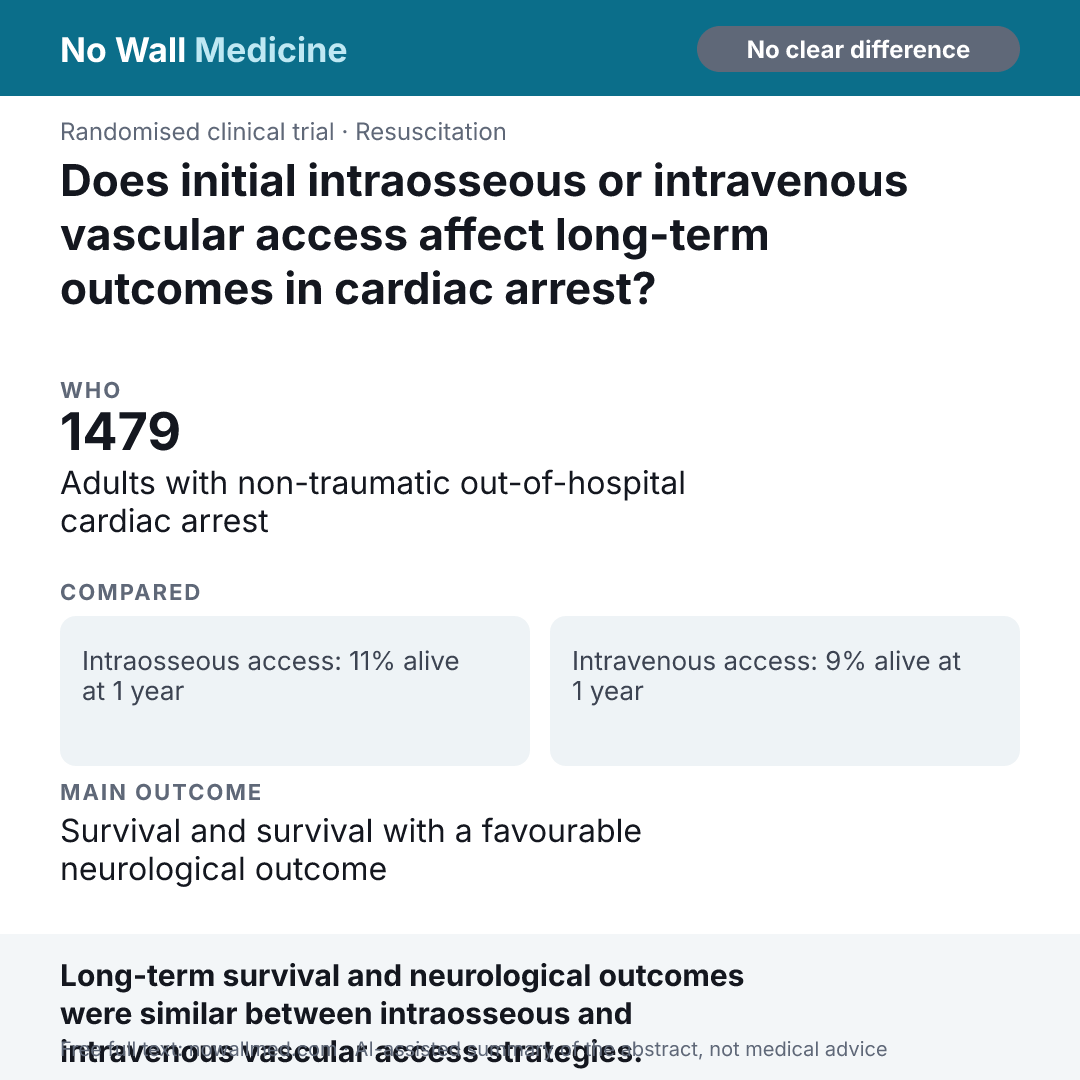
Does initial intraosseous or intravenous vascular access affect long-term outcomes in cardiac arrest?
Who
1479
Adults with non-traumatic out-of-hospital cardiac arrest
Compared
Intraosseous access: 11% alive at 1 year
Intravenous access: 9% alive at 1 year
Main outcome
Survival and survival with a favourable neurological outcome
Result: risk ratio 1.24 (95% confidence interval 0.91-1.67)
Bottom line: Long-term survival and neurological outcomes were similar between intraosseous and intravenous vascular access strategies.
Resuscitation · 2026-04-10 · Save PNG
Same trial (NCT05205031)
Papers we list that report this registered trial, oldest first. Read a secondary analysis alongside the main results.
- Secondary analysis No clear difference
Intraosseous and intravenous access showed no strong evidence of difference in cardiac arrest outcomes Resuscitation 2025-05 - Longer follow-up No clear difference
This paper Resuscitation 2026-04
Clinical question: Does initial intraosseous or intravenous vascular access affect long-term outcomes in cardiac arrest?
Key points
- Researchers studied 1479 adults with non-traumatic out-of-hospital cardiac arrest who were randomized to receive either intraosseous access or intravenous access.
- At 1 year, 11% of the intraosseous group and 9% of the intravenous group were alive, showing no statistically significant difference in survival.
- Survival with a favorable neurological outcome was 10% in the intraosseous group and 8% in the intravenous group.
Headline and key points written with AI from the paper’s abstract, with every number checked against it. Read the paper before relying on them.
Was this summary helpful?
Subject terms
Headline, design, result, key points, caveat and citation as plain text.
Cite this article
Vallentin MF, Holmberg MJ, Granfeldt A, et al. Effect of vascular access strategy on long-term outcomes in patients with out-of-hospital cardiac arrest: a randomised clinical trial. Resuscitation. 2026;223:111087. doi:10.1016/j.resuscitation.2026.111087
Spotted a mistake? Suggest a correction