Noninvasive ventilation improves exercise endurance and reduces breathlessness in patients with COPD
Effect of ventilatory support pressure during exercise on endurance time in patients with COPD: a systematic review
Systematic review and meta-analysisBenefit found
Does noninvasive ventilation during exercise improve endurance time in patients with COPD?
Who
285
Patients with chronic obstructive pulmonary disease
Compared
Noninvasive ventilation
Control conditions
Main outcome
Endurance time
Result: standardised mean difference 0.47 (95% CI 0.20 to 0.73)
Bottom line: Noninvasive ventilation during exercise improves endurance time and reduces dyspnoea in patients with COPD.
Limitation: Further standardised studies are needed to optimise pressure titration during exercise.
ERJ Open Res · 2026-09-28Download image
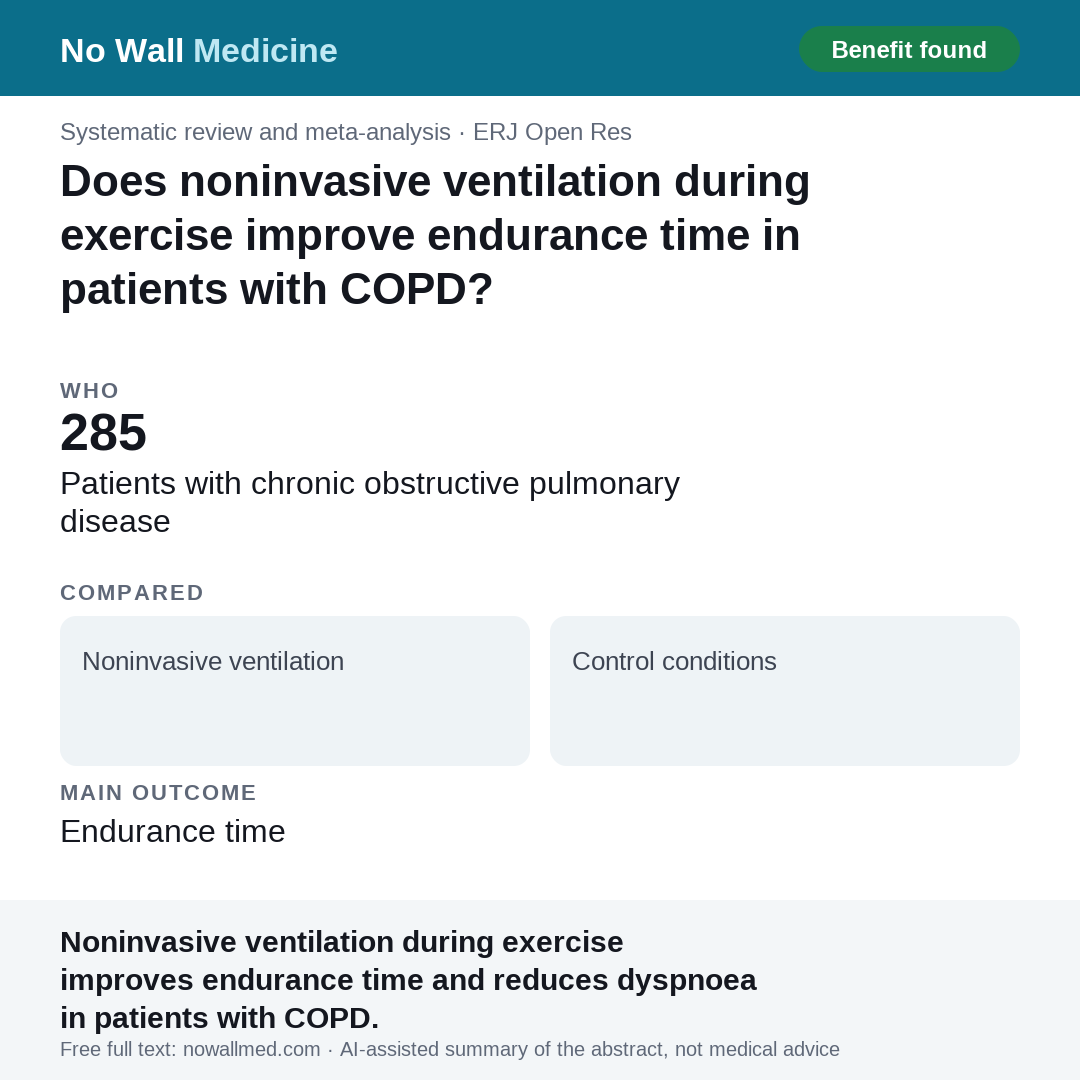
Clinical question: Does noninvasive ventilation during exercise improve endurance time in patients with COPD?
Why it matters: The influence of fixed pressure support intensity on exercise performance and physiological responses in patients with chronic obstructive pulmonary disease remains insufficiently clarified.
Key points
- Researchers analyzed 15 studies involving 285 participants to evaluate how fixed pressure support from noninvasive ventilation affects exercise performance in people with chronic obstructive pulmonary disease.
- Noninvasive ventilation significantly improved endurance time (SMD 0.47, 95% CI 0.20 to 0.73) and reduced breathlessness (SMD -0.50, 95% CI -0.92 to -0.08).
- While carbon dioxide levels were significantly reduced, the specific intensity of the pressure support was not significantly associated with changes in endurance time.
Headline and key points written with AI from the paper’s abstract, with every number checked against it. Read the paper before relying on them.
Spotted a mistake? Suggest a correction