Six months of walnut consumption did not change neuropsychological development in healthy adolescents
Effect of walnut consumption on neuropsychological development in healthy adolescents: a multi-school randomised controlled trial
Multi-school randomised controlled nutrition intervention trialNo clear difference
Does walnut consumption affect neuropsychological and behavioural development in healthy adolescents?
Who
771
771 healthy teenagers aged 11-16 years · Twelve high schools in Barcelona, Spain
Compared
Intervention group: no statistically significant changes for all primary endpoints
Control group: no statistically significant changes for all primary endpoints
Main outcome
neuropsychological and behavioural development
Bottom line: Six months of walnut consumption did not improve neuropsychological function in an intention-to-treat analysis of healthy adolescents.
Funded by: Instituto de Salud Carlos III and California Walnut Commission
eClinicalMedicine · 2023-04-06Download image
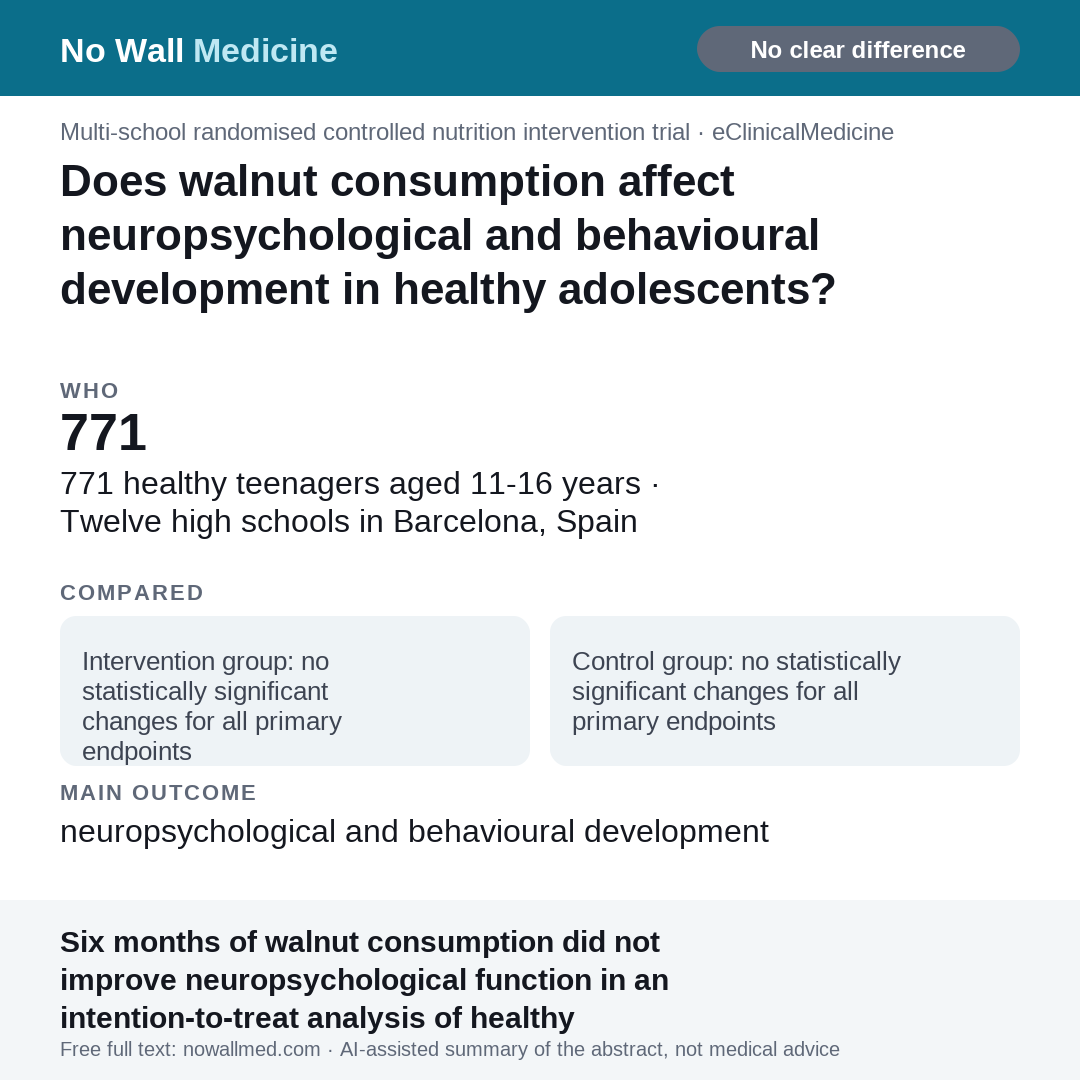
Clinical question: Does walnut consumption affect neuropsychological and behavioural development in healthy adolescents?
Why it matters: It is unclear if consuming walnuts, which contain the omega-3 fatty acid alpha-linolenic acid, affects the brain development of adolescents.
Key points
- Researchers randomized 771 healthy teenagers aged 11-16 into two groups to compare 30 g/day of raw walnut kernels against a control group for 6 months.
- In the main intention-to-treat analysis, there were no statistically significant changes between the groups for any primary neuropsychological or behavioral endpoints.
- Among participants who adhered to the diet, attention score, fluid intelligence, and ADHD symptom scores showed different results compared to the control group.
Headline and key points written with AI from the paper’s abstract, with every number checked against it. Read the paper before relying on them.
Was this summary helpful?
Cite this article
Pinar-Martí A, Gignac F, Fernández-Barrés S, Romaguera D, Sala-Vila A, Lázaro I. Effect of walnut consumption on neuropsychological development in healthy adolescents: a multi-school randomised controlled trial. eClinicalMedicine. 2023. doi:10.1016/j.eclinm.2023.101954
Spotted a mistake? Suggest a correction
Top studies every Monday
The week’s key trials and guidelines in your specialties, plus any topics you follow. By email, free.
Get the weekly digest