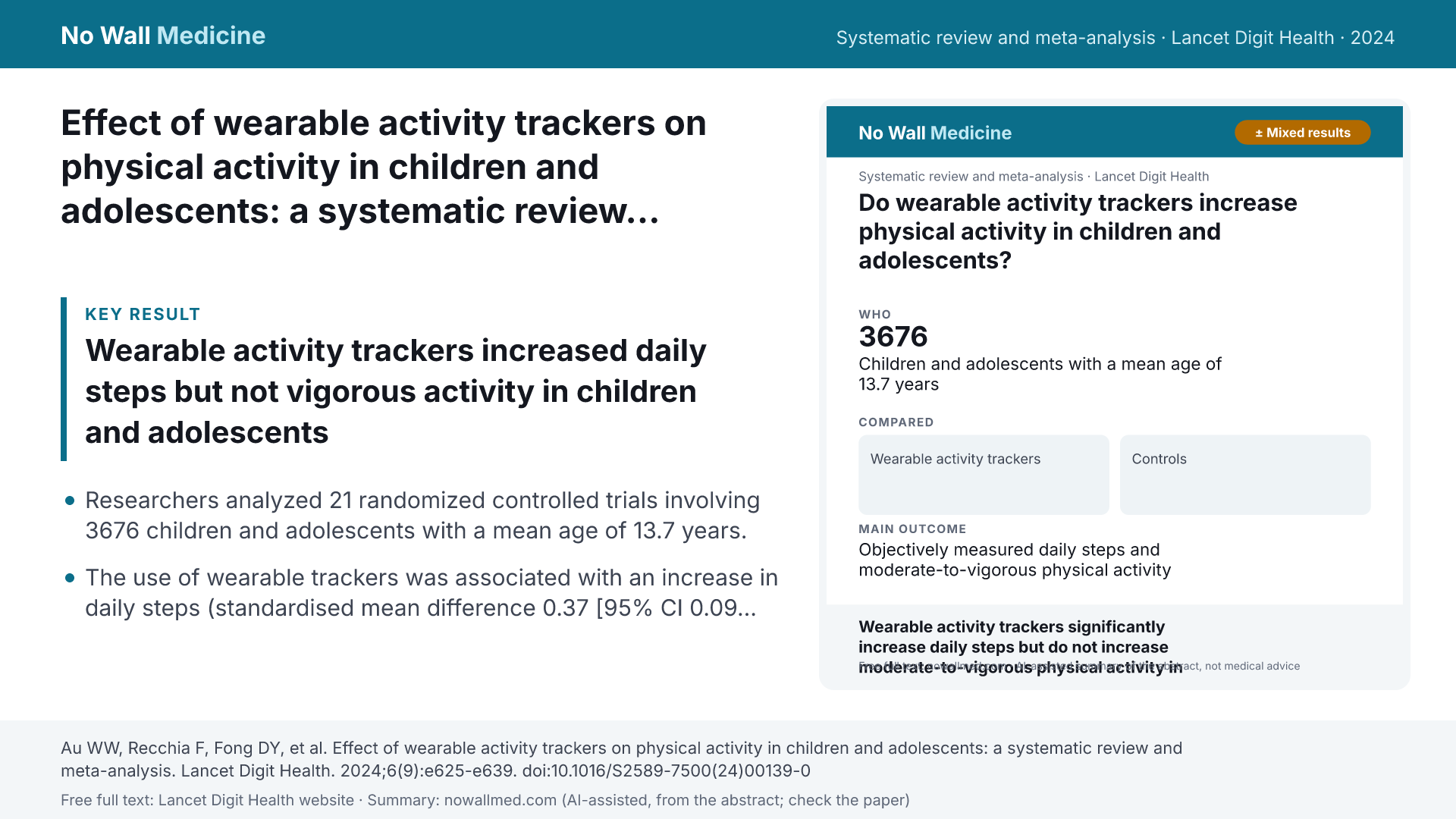
Wearable activity trackers increased daily steps but not vigorous activity in children and adolescents
Effect of wearable activity trackers on physical activity in children and adolescents: a systematic review and meta-analysis
Systematic review and meta-analysisMixed results
Do wearable activity trackers increase physical activity in children and adolescents?
Who
3676
Children and adolescents with a mean age of 13.7 years
Compared
Wearable activity trackers
Controls
Main outcome
Objectively measured daily steps and moderate-to-vigorous physical activity
Result: standardised mean difference 0.37 (95% CI 0.09 to 0.65) for steps
Bottom line: Wearable activity trackers significantly increase daily steps but do not increase moderate-to-vigorous physical activity in children and adolescents.
Limitation: More rigorously designed trials that minimise missing data are warranted.
Funded by: Hong Kong University Grants Committee and University of Hong Kong
Lancet Digit Health · 2024-08-06 · Save PNG
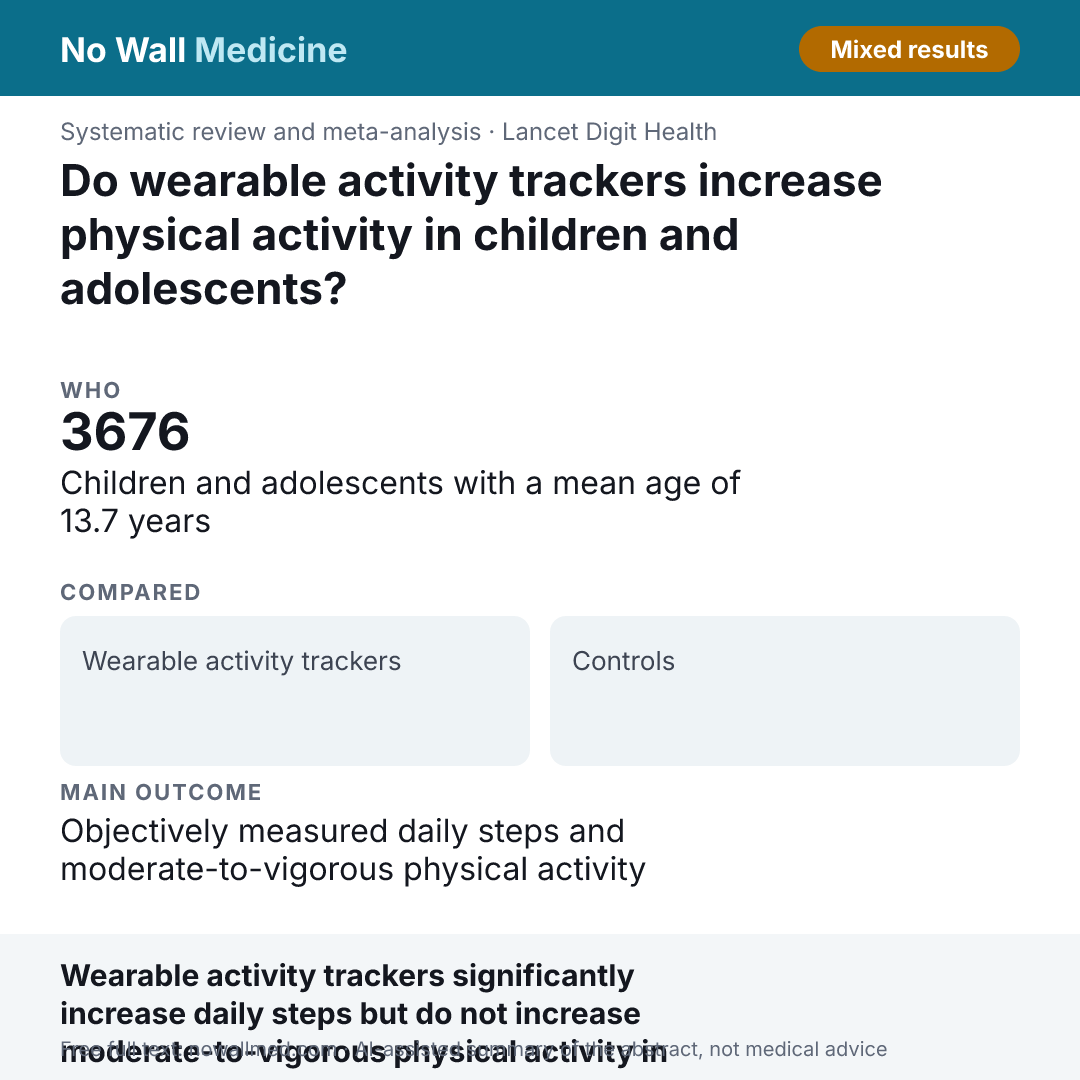
Clinical question: Do wearable activity trackers increase physical activity in children and adolescents?
Key points
- Researchers analyzed 21 randomized controlled trials involving 3676 children and adolescents with a mean age of 13.7 years.
- The use of wearable trackers was associated with an increase in daily steps (standardised mean difference 0.37 [95% CI 0.09 to 0.65; p=0.013]).
- No significant difference was found for moderate-to-vigorous physical activity (-0.08 [-0.18 to 0.02; p=0.11]).
Limitation the authors note: The authors state that more rigorously designed trials that minimise missing data are warranted to validate findings and explore long-term effects.
Headline and key points written with AI from the paper’s abstract, with every number checked against it. Read the paper before relying on them.
Was this summary helpful?
Abstract
Background
Physical inactivity in children and adolescents has become a pressing public health concern. Wearable activity trackers can allow self-monitoring of physical activity behaviour and promote autonomous motivation for exercise. However, the effects of wearable trackers on physical activity in young populations remain uncertain. Methods
In this systematic review and meta-analysis, we searched PubMed, Embase, SPORTDiscus, and Web of Science for publications from database inception up to Aug 30, 2023, without restrictions on language. Studies were eligible if they were randomised controlled trials or clustered randomised controlled trials that examined the use of wearable activity trackers to promote physical activity, reduce sedentary behaviours, or promote overall health in participants with a mean age of 19 years or younger, with no restrictions on health condition or study settings. Studies were excluded if children or adolescents were not the primary intervention cohort, or wearable activity trackers were not worn on users' bodies to objectively track users' physical activity levels. Two independent reviewers (WWA and FR) assessed eligibility of studies and contacted authors of studies if more information was needed to assess eligibility. We also searched reference lists from relevant systematic reviews and meta-analyses. Systematic review software Covidence was used for study screening and data extraction. Study characteristics including study setting, participant characteristics, intervention characteristics, comparator, and outcome measurements were extracted from eligible studies. The two primary outcomes were objectively measured daily steps and moderate-to-vigorous physical activity. We used a random-effects model with Hartung-Knapp adjustments to calculate standardised mean differences. Between-study heterogeneity was examined using Higgins I2 and Cochran Q statistic. Publication bias was assessed using Egger's regression test. This systematic review was registered with PROSPERO, CRD42023397248. Findings
We identified 9619 studies from our database research and 174 studies from searching relevant systematic reviews and meta-analyses, of which 105 were subjected to full text screening. We included 21 eligible studies, involving 3676 children and adolescents (1618 [44%] were female and 2058 [56%] were male, mean age was 13·7 years [SD 2·7]) in our systematic review and meta-analysis. Ten studies were included in the estimation of the effect of wearable activity trackers on objectively measured daily steps and 11 were included for objectively measured moderate-to-vigorous physical activity. Compared with controls, we found a significant increase in objectively measured daily steps (standardised mean difference 0·37 [95% CI 0·09 to 0·65; p=0·013]; Q 47·60 [p<0·0001]; I2 72·7% [95% CI 53·4 to 84·0]), but not for moderate-to-vigorous physical activity (-0·08 [-0·18 to 0·02; p=0·11]; Q 10·26 [p=0·74]; I2 0·0% [0·0 to 53·6]). Interpretation
Wearable activity trackers might increase daily steps in young cohorts of various health statuses, but not moderate-to-vigorous physical activity, highlighting the potential of wearable trackers for motivating physical activity in children and adolescents. More rigorously designed trials that minimise missing data are warranted to validate our positive findings on steps and to explore possible long-term effects. Funding
The Hong Kong University Grants Committee and Seed Fund for Basic Research of the University of Hong Kong.
Abstract reproduced under the article’s CC BY NC licence.
Subject terms
Headline, design, result, key points, caveat and citation as plain text.
Cite this article
Au WW, Recchia F, Fong DY, et al. Effect of wearable activity trackers on physical activity in children and adolescents: a systematic review and meta-analysis. Lancet Digit Health. 2024;6(9):e625-e639. doi:10.1016/S2589-7500(24)00139-0
Spotted a mistake? Suggest a correction