Weight-adjusted or fixed-dose blood thinners showed no significant difference in preventing blood clots in COVID-19 patients
Effect of weight-adjusted intermediate-dose versus fixed-dose prophylactic anticoagulation with low-molecular-weight heparin on venous thromboembolism among noncritically and critically ill patients with COVID-19: the COVI-DOSE trial, a multicenter, randomised, open-label, phase 4 trial
Multicenter, randomised, open-label, phase 4, superiority trialNo clear difference
Does weight-adjusted intermediate-dose versus fixed-dose low-molecular-weight heparin decrease venous thromboembolism risk?
Who
1000
Adult patients hospitalised with acute respiratory SARS-CoV-2 · 20 French centers
Compared
1.2%weight-adjusted intermediate dose
2.1%fixed-dose
Main outcome
symptomatic deep-vein thrombosis or pulmonary embolism
Result: subdistribution hazard ratio 0.59 (95% CI 0.22-1.63)
Bottom line: Weight-adjusted intermediate-dose versus fixed-dose heparin showed no significant difference in venous thromboembolism risk.
Funded by: French Ministry of Health, CAPNET, Grand-Est Region, Grand-Nancy Métropole
eClinicalMedicine · 2023-06-09Download image
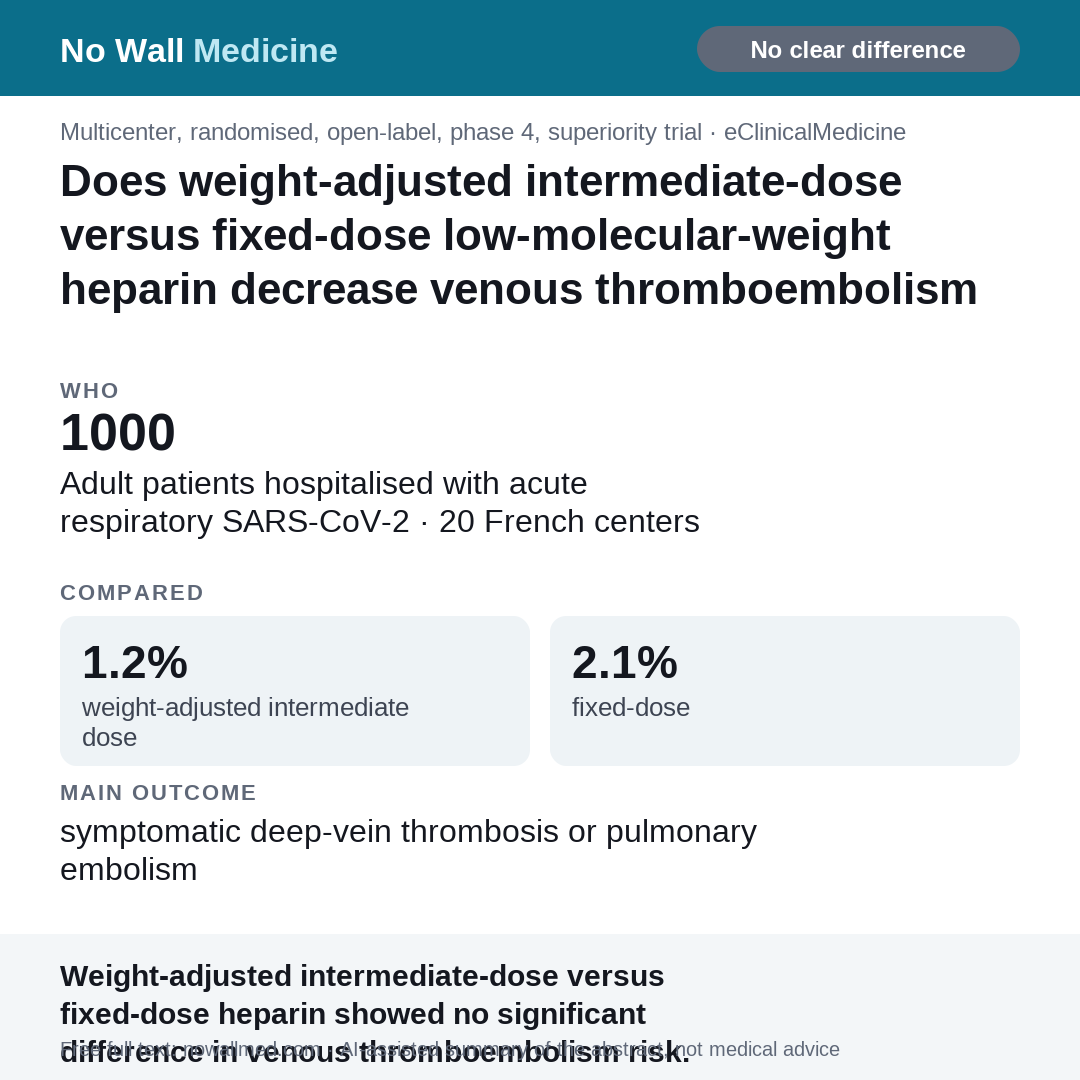
Clinical question: Does weight-adjusted intermediate-dose versus fixed-dose low-molecular-weight heparin decrease venous thromboembolism risk?
Why it matters: It was unknown whether a weight-adjusted intermediate dose of low-molecular-weight heparin is more effective than a fixed dose for preventing blood clots in COVID-19 patients.
Key points
- Researchers studied 1000 hospitalized adults with COVID-19, comparing weight-adjusted intermediate doses of low-molecular-weight heparin to fixed doses of the same medication.
- Symptomatic venous thromboembolism, such as blood clots in the veins or lungs, occurred in 1.2% of the weight-adjusted group and 2.1% of the fixed-dose group.
- The weight-adjusted dose group had a twofold increased risk of major or clinically relevant nonmajor bleeding at 5.9% compared to 3.1% in the fixed-dose group.
Headline and key points written with AI from the paper’s abstract, with every number checked against it. Read the paper before relying on them.
Was this summary helpful?
Cite this article
Zuily S, Lefèvre B, Sanchez O, Empis de Vendin O, de Ciancio G, Arlet JB. Effect of weight-adjusted intermediate-dose versus fixed-dose prophylactic anticoagulation with low-molecular-weight heparin on venous thromboembolism among noncritically and critically ill patients with COVID-19: the COVI-DOSE trial, a multicenter, randomised, open-label, phase 4 trial. eClinicalMedicine. 2023. doi:10.1016/j.eclinm.2023.102031
Spotted a mistake? Suggest a correction
Top studies every Monday
The week’s key trials and guidelines in your specialties, plus any topics you follow. By email, free.
Get the weekly digest