Exercise targeting balance and strength is associated with successful fall prevention in residential aged care
Effective fall prevention exercise in residential aged care: an intervention component analysis from an updated systematic review
Intervention component analysis of randomized controlled trialsMixed results
What features make fall prevention exercise programs effective in residential aged care?
Who
3960
Residents in residential aged care aged 65 or older · Residential aged care
Compared
Effective exercise features
Ineffective exercise features
Main outcome
Fall outcomes
Bottom line: Effective fall prevention requires tailored balance and strength exercises delivered with sufficient resources and supervision.
Br J Sports Med · 2024-05-31Download image
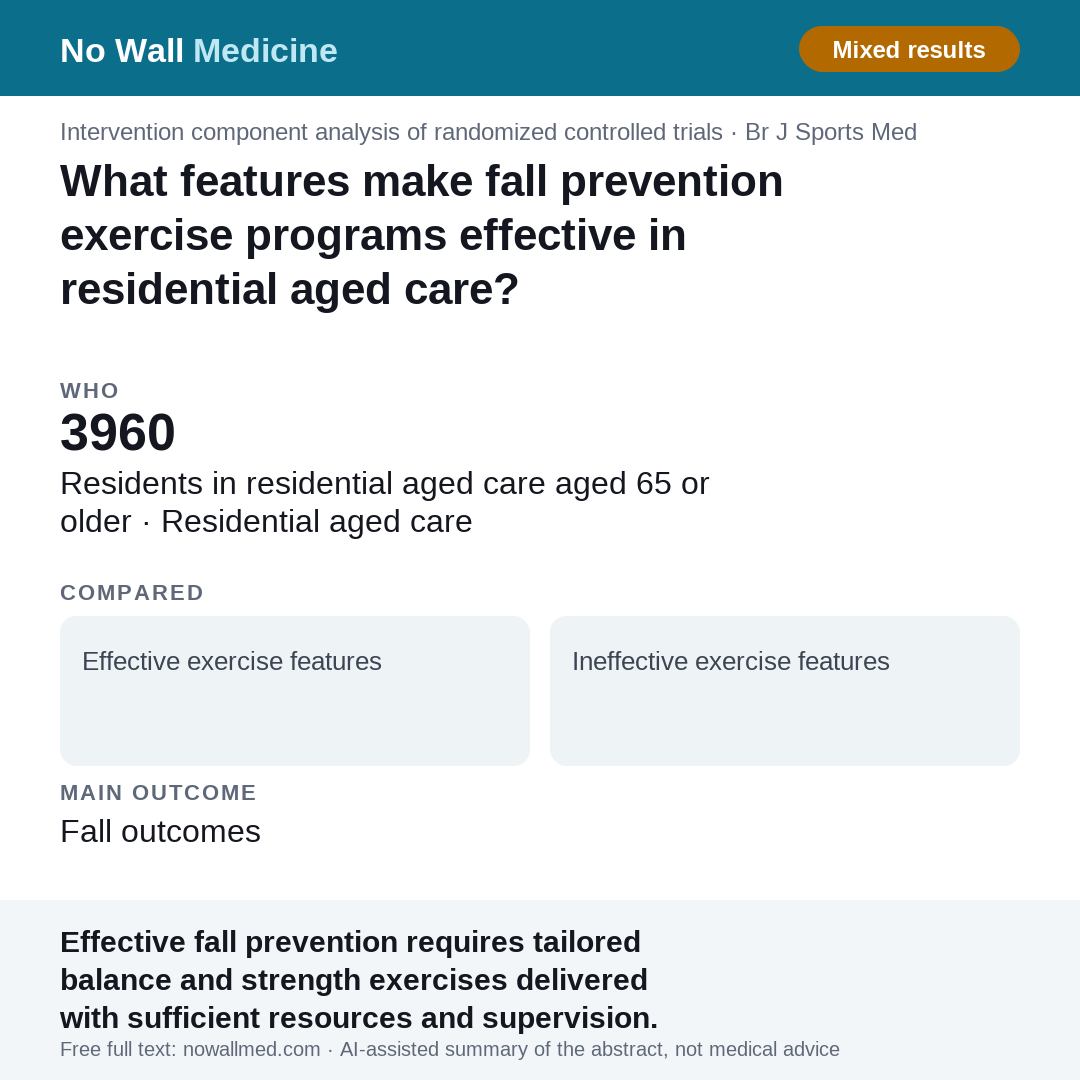
Clinical question: What features make fall prevention exercise programs effective in residential aged care?
Why it matters: The effect of specific exercise components on preventing falls in residential aged care settings is uncertain.
Key points
- Researchers analyzed 32 randomized controlled trials involving 3960 residents, including 57% with cognitive impairments and 41% with mobility impairments.
- An analysis of 17 eligible trials suggested that effective programs target balance and strength through simple, moderate intensity exercises tailored to the individual.
- Successful implementation was linked to having sufficient resources to provide structured and supervised exercise at an adequate dose.
Headline and key points written with AI from the paper’s abstract, with every number checked against it. Read the paper before relying on them.
Was this summary helpful?
Abstract
Objective
The effect of fall prevention exercise programmes in residential aged care (RAC) is uncertain. This paper reports on an intervention component analysis (ICA) of randomised controlled trials (RCTs), from an update of a Cochrane review, to develop a theory of features of successful fall prevention exercise in RAC. Methods
Trial characteristics were extracted from RCTs testing exercise interventions in RAC identified from an update of a Cochrane review to December 2022 (n=32). Eligible trials included RCTs or cluster RCTs in RAC, focusing on participants aged 65 or older, assessing fall outcomes with stand-alone exercise interventions. ICA was conducted on trials with >30 participants per treatment arm compared with control (n=17). Two authors coded trialists' perceptions on intervention features that may have contributed to the observed effect on falls. Inductive thematic analysis was used to identify the key differences between the trials which might account for positive and negative outcomes. Results
32 RCTs involving 3960 residents including people with cognitive (57%) and mobility (41%) impairments were included. ICA on the 17 eligible RCTs informed the development of a theory that (1) effective fall prevention exercise delivers the right exercise by specifically targeting balance and strength, tailored to the individual and delivered simply at a moderate intensity and (2) successful implementation needs to be sufficiently resourced to deliver structured and supervised exercise at an adequate dose. Conclusions
This analysis suggests that delivering the right exercise, sufficiently resourced, is important for preventing falls in RAC. This clinical guidance requires confirmation in larger trials.
Abstract reproduced under the article’s CC BY NC licence.
Subject terms
Cite this article
Dawson R, Suen J, Sherrington C, Kwok W, Pinheiro MB, Haynes A. Effective fall prevention exercise in residential aged care: an intervention component analysis from an updated systematic review. Br J Sports Med. 2024. doi:10.1136/bjsports-2023-107505
Spotted a mistake? Suggest a correction
Top studies every Monday
The week’s key trials and guidelines in your specialties, plus any topics you follow. By email, free.
Get the weekly digest