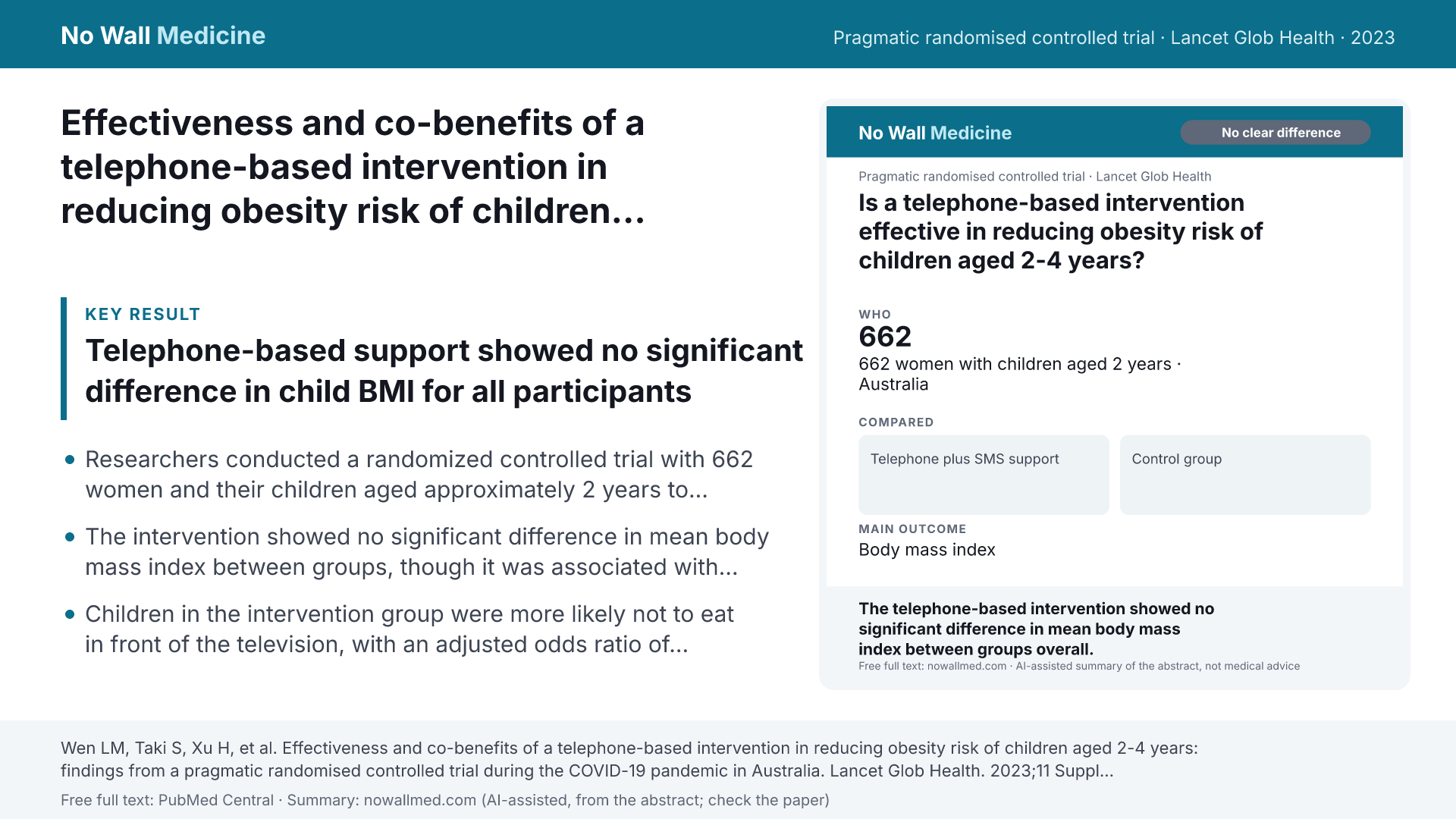
Telephone-based support showed no significant difference in child BMI for all participants
Effectiveness and co-benefits of a telephone-based intervention in reducing obesity risk of children aged 2-4 years: findings from a pragmatic randomised controlled trial during the COVID-19 pandemic in Australia
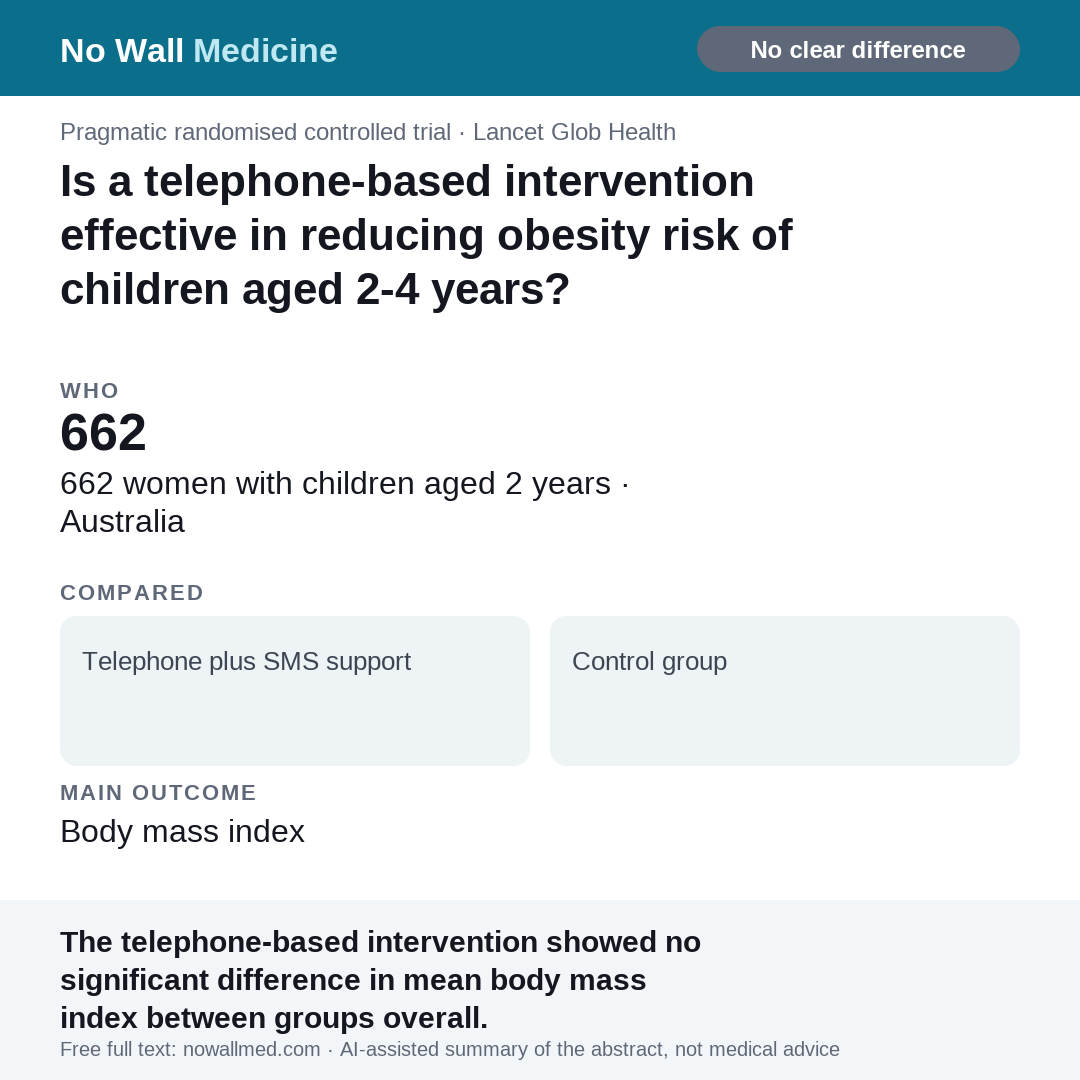
Pragmatic randomised controlled trialNo clear difference
Is a telephone-based intervention effective in reducing obesity risk of children aged 2-4 years?
Who
662
662 women with children aged 2 years · Australia
Compared
Telephone plus SMS support
Control group
Main outcome
Body mass index
Bottom line: The telephone-based intervention showed no significant difference in mean body mass index between groups overall.
Funded by: NSW Health and National Health and Medical Research Council
Lancet Glob Health · 2023-03-03Download image
Clinical question: Is a telephone-based intervention effective in reducing obesity risk of children aged 2-4 years?
Why it matters: Effective early childhood obesity prevention methods are scarce, and face-to-face programs were reduced globally due to the COVID-19 pandemic.
Key points
- Researchers conducted a randomized controlled trial with 662 women and their children aged approximately 2 years to test telephone and text message support.
- The intervention showed no significant difference in mean body mass index between groups, though it was associated with a lower mean body mass index of 16.26 kg/m2 in low-income families compared to 16.84 kg/m2 in the control group.
- Children in the intervention group were more likely not to eat in front of the television, with an adjusted odds ratio of 2.00 at 3 years and 2.50 at 4 years.
Headline and key points written with AI from the paper’s abstract, with every number checked against it. Read the paper before relying on them.
Was this summary helpful?
Abstract
Background
Evidence of effective early childhood obesity prevention is scarce and mainly derived from face-to-face interventions. However, the COVID-19 pandemic drastically reduced face-to-face health programmes globally. This study assessed effectiveness of a telephone-based intervention in reducing obesity risk of young children. Methods
We adapted a study protocol (developed before the pandemic) and conducted a pragmatic randomised controlled trial of 662 women with children aged 2 years (mean age 24·06 months [SD 0·69]) during March, 2019, and October, 2021, extending the original planned intervention of 12 months to 24 months. The adapted intervention comprised five telephone-based support sessions plus text messages over a 24-month period (at child ages 24-26 months, 28-30 months, 32-34 months, 36-38 months, and 42-44 months). The intervention group (n=331) received staged telephone plus SMS support regarding healthy eating, physical activity, and information about COVID-19. The control group (n=331) received four staged mail-outs on information not related to the obesity prevention intervention, such as toilet training, language development, and sibling relationships, as a retention strategy. The intervention effects on BMI (primary outcome) and eating habits (secondary outcome), and perceived co-benefits, were evaluated using surveys and qualitative telephone interviews at 12 months and 24 months after baseline (age 2 years). The trial is registered with the Australian Clinical Trial Registry, ACTRN12618001571268. Findings
Of 662 mothers, 537 (81%) completed the follow-up assessments at 3 years, and 491 (74%) completed the follow-up assessment at 4 years. Multiple imputation analysis showed no significant difference in mean BMI between the groups. Among low-income families (ie, annual household income <AU$80 000) at age 3 years, the intervention was significantly associated with a lower mean BMI (16·26 kg/m2 [SD 2·22]) in the intervention group than in the control group (16·84 kg/m2 [2·37]; p=0·040), a difference of -0·59 (95% CI -1·15 to -0·03; p=0·040). Children in the intervention group were more likely not to eat in front of the television than the control group, with an adjusted odds ratio (aOR) of 2·00 (95% CI 1·33 to 2·99) at 3 years and an aOR of 2·50 (1·63 to 3·83) at 4 years. Qualitative interviews with 28 mothers revealed that the intervention increased their awareness, confidence, and motivation to implement healthy feeding practices, particularly for families from culturally diverse backgrounds (ie, speaking a language other than English at home). Interpretation
A telephone-based intervention was well received by the mothers who participated in the study. The intervention could reduce children's BMI from low-income families. Telephone-based support targeted at low-income families and families from culturally diverse backgrounds could reduce current inequalities in childhood obesity. Funding
The trial was funded under the NSW Health Translational Research Grant Scheme 2016 (number TRGS 200) and also by a National Health and Medical Research Council Partnership grant (number 1169823).
Abstract reproduced under the article’s CC BY licence.
Subject terms
Headline, design, result, key points, caveat and citation as plain text.
Cite this article
Wen LM, Taki S, Xu H, et al. Effectiveness and co-benefits of a telephone-based intervention in reducing obesity risk of children aged 2-4 years: findings from a pragmatic randomised controlled trial during the COVID-19 pandemic in Australia. Lancet Glob Health. 2023;11 Suppl 1:S13. doi:10.1016/S2214-109X(23)00096-7
Spotted a mistake? Suggest a correction