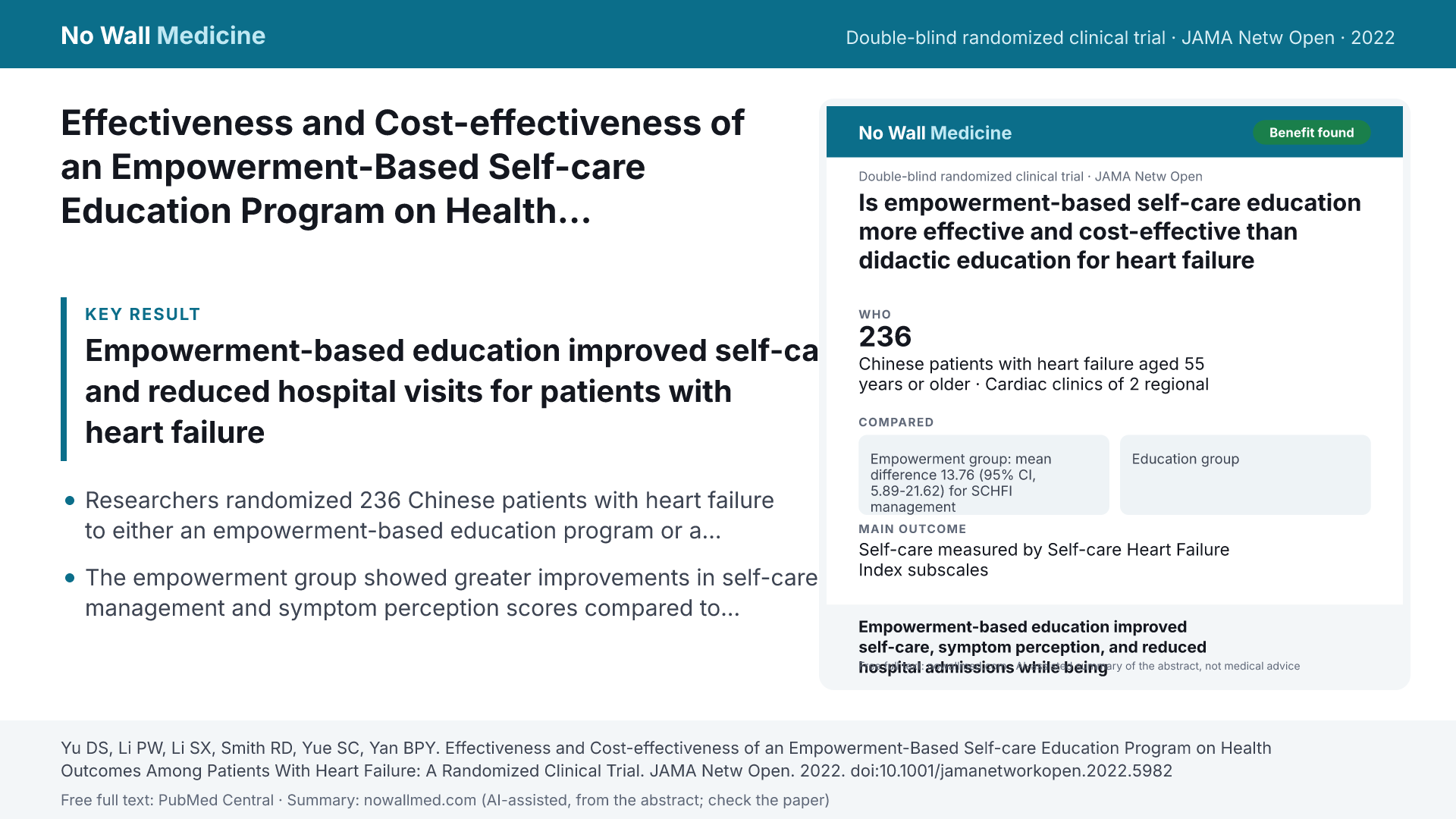
Effectiveness and Cost-effectiveness of an Empowerment-Based Self-care Education Program on Health Outcomes Among Patients With Heart Failure: A Randomized Clinical Trial
Key result: Empowerment-based education improved self-care and reduced hospital visits for patients with heart failure
Key points
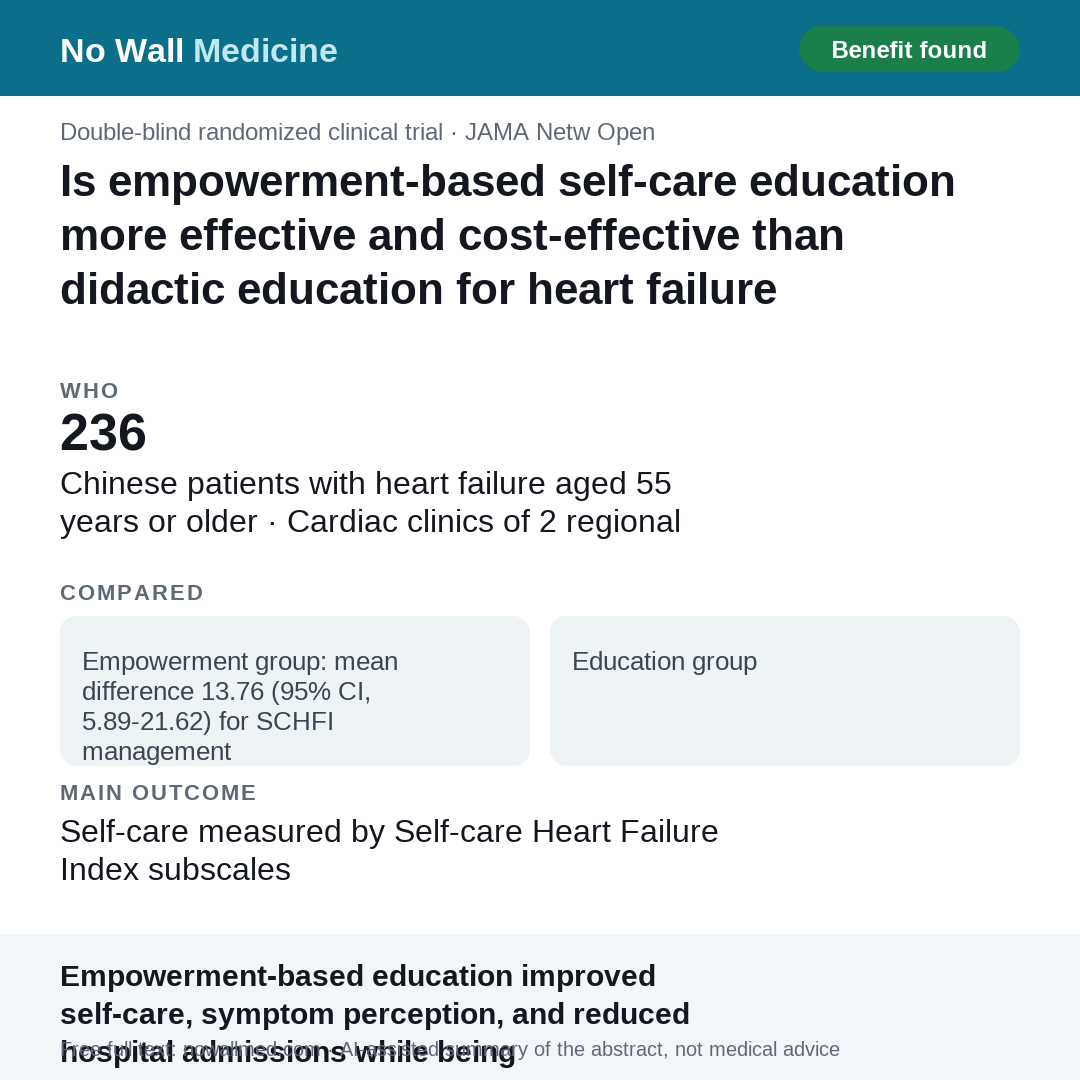
- Researchers randomized 236 Chinese patients with heart failure to either an empowerment-based education program or a standard didactic education program.
- The empowerment group showed greater improvements in self-care management and symptom perception scores compared to the didactic education group.
- Patients in the empowerment group had lower risks of emergency department attendance and hospital admission, and the program was found to be cost-effective.
Why it matters: It was unknown whether an empowerment-based approach is more effective or cost-effective than standard didactic education for improving self-care and health outcomes in heart failure patients.
Discussion prompts
- Would these patients look like yours? Who was left out?
- Is the main outcome one that matters to patients?
- Is the difference large enough to change what you do?
Cite: Yu DS, Li PW, Li SX, Smith RD, Yue SC, Yan BPY. Effectiveness and Cost-effectiveness of an Empowerment-Based Self-care Education Program on Health Outcomes Among Patients With Heart Failure: A Randomized Clinical Trial. JAMA Netw Open. 2022. doi:10.1001/jamanetworkopen.2022.5982
Free full text: PubMed Central · Summary and visual abstract: nowallmed.com/a/effectiveness-and-cost-effectiveness-of-an-empowerment-based-self-u05zae/ (AI-assisted from the abstract; check the paper before relying on it).