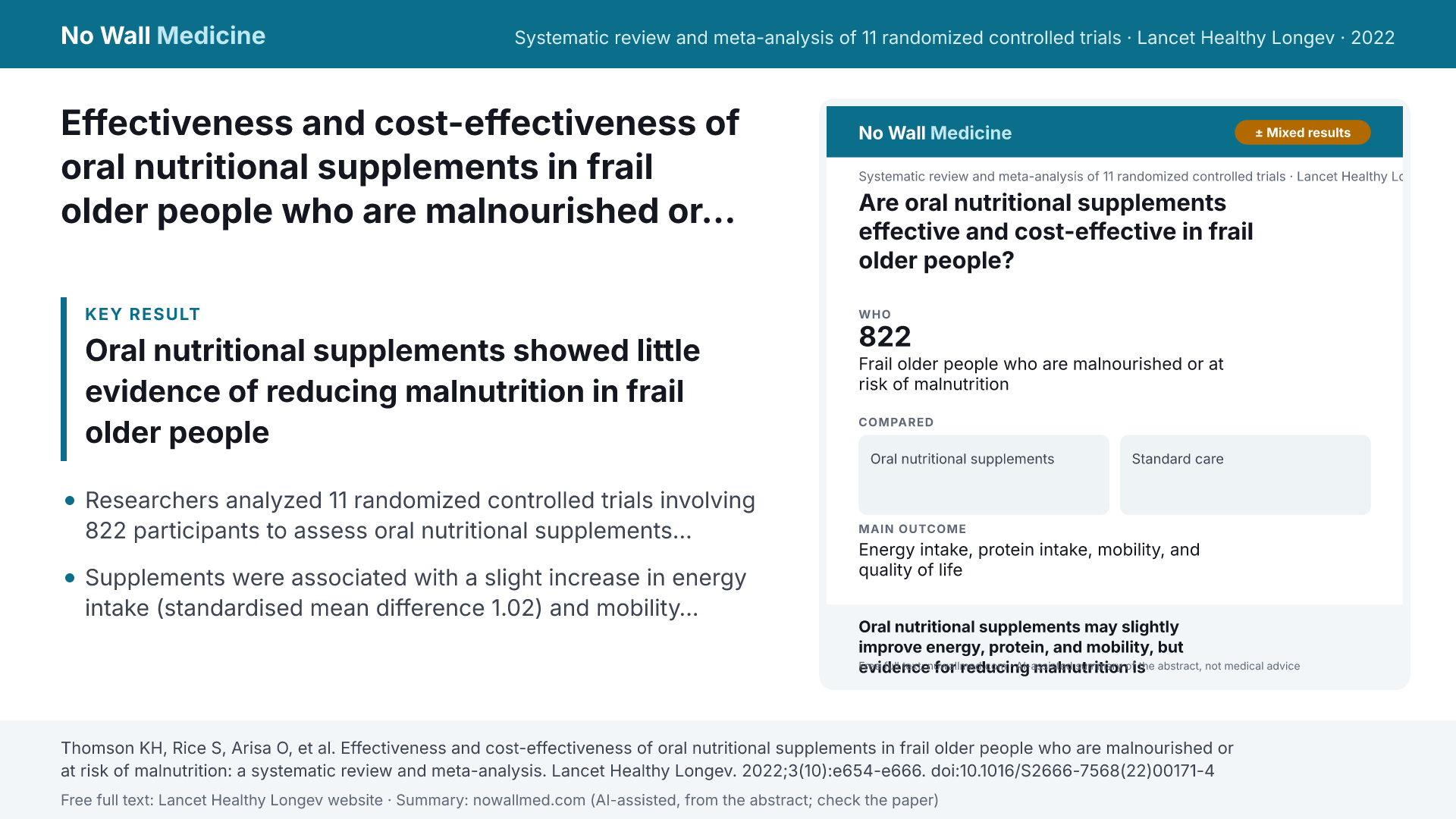
Oral nutritional supplements showed little evidence of reducing malnutrition in frail older people
Effectiveness and cost-effectiveness of oral nutritional supplements in frail older people who are malnourished or at risk of malnutrition: a systematic review and meta-analysis
Systematic review and meta-analysis of 11 randomized controlled trialsMixed results
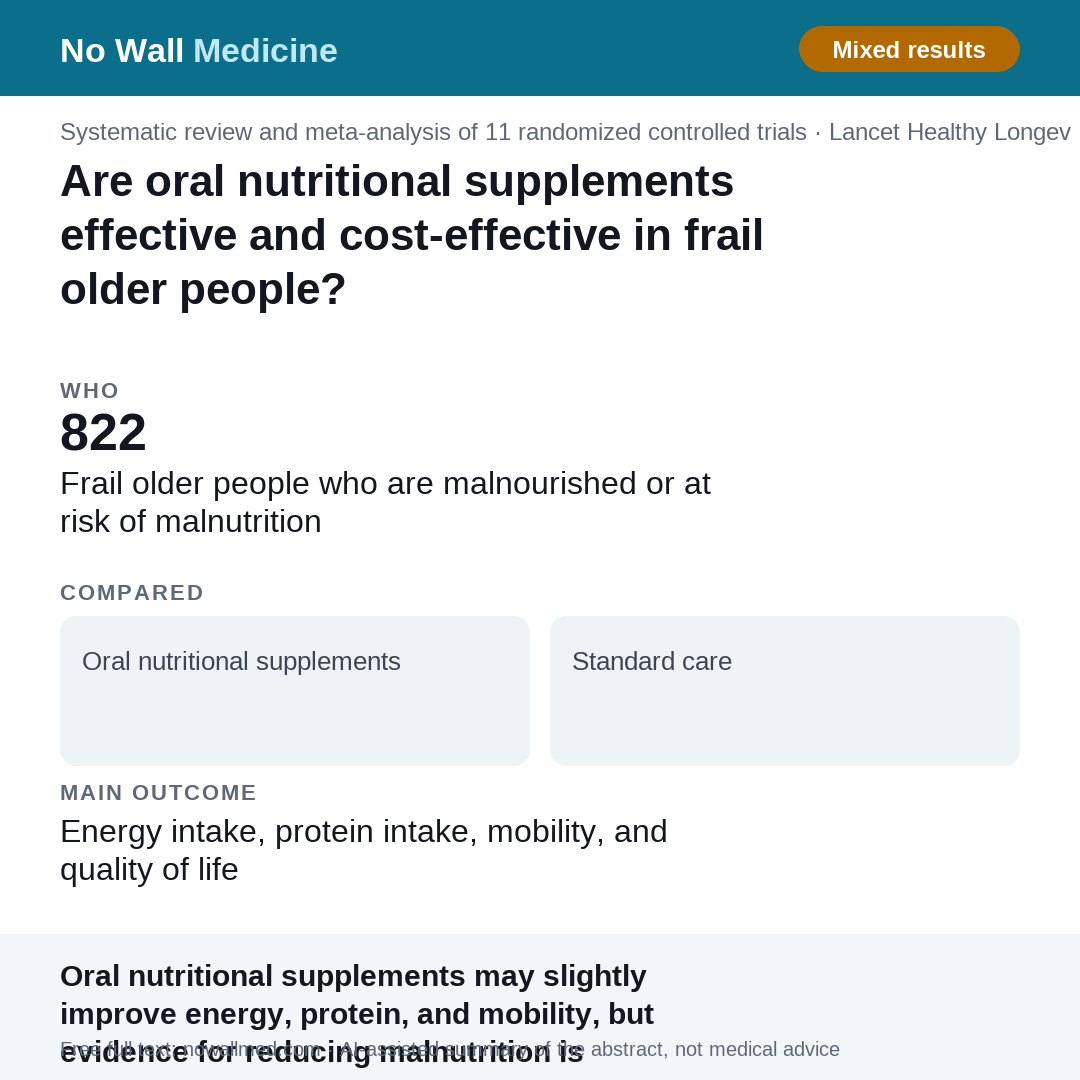
Are oral nutritional supplements effective and cost-effective in frail older people?
Who
822
Frail older people who are malnourished or at risk of malnutrition
Compared
Oral nutritional supplements
Standard care
Main outcome
Energy intake, protein intake, mobility, and quality of life
Result: standardised mean difference 1·02 [95% CI 0·15 to 1·88] for energy intake
Bottom line: Oral nutritional supplements may slightly improve energy, protein, and mobility, but evidence for reducing malnutrition is limited.
Limitation: Evidence was of very low certainty for the majority of outcomes.
Funded by: UK National Institute of Health and Care Research
Lancet Healthy Longev · 2022-09-15Download image
Clinical question: Are oral nutritional supplements effective and cost-effective in frail older people?
Why it matters: It is uncertain whether oral nutritional supplements are effective for older people aged 65 years or older who are frail and malnourished or at risk of malnutrition.
Key points
- Researchers analyzed 11 randomized controlled trials involving 822 participants to assess oral nutritional supplements in frail older adults.
- Supplements were associated with a slight increase in energy intake (standardised mean difference 1.02) and mobility (mean difference 0.03) compared to standard care.
- The evidence for most outcomes was rated as very low certainty by the Grading of Recommendations, Assessment, Development, and Evaluation system.
Limitation the authors note: The authors noted that the evidence was of very low certainty for the majority of outcomes and that high-quality, adequately powered studies are needed.
Headline and key points written with AI from the paper’s abstract, with every number checked against it. Read the paper before relying on them.
Was this summary helpful?
Abstract
Background
Current management of malnutrition can include prescribed oral nutritional supplements (ONS); however, there is uncertainty whether these supplements are effective in people who are older (≥65 years) and frail. We assessed the effectiveness, cost-effectiveness, and adherence and acceptability of ONS in frail older people who are malnourished or at risk of malnutrition. Methods
In this systematic review and meta-analysis, five bibliographic databases (MEDLINE, EMBASE, Cochrane Library, Scopus, and CINAHL) and grey literature sources were searched from inception to Sept 13, 2021, to identify studies assessing the effectiveness and cost-effectiveness of ONS (with or without other dietary interventions) in frail older people who are malnourished or at risk of malnutrition. Multiple reviewers independently did study screening, data extraction, and risk of bias assessment. Quality was assessed using version 1.0 of the Cochrane risk of bias tool for randomised controlled trials (RCTs), and the BMJ Drummond checklist was used to assess the quality of the included cost-effectiveness study. A meta-analysis was done for the effectiveness review; for the other reviews, a narrative synthesis approach was used. This systematic review and meta-analysis was registered on PROSPERO, CRD42020170906. Findings
Of 8492 records retrieved and screened, we included 11 RCTs involving 822 participants, six of which were fully or partly funded by industry. For the majority of the outcomes for which meta-analyses were possible (11/12), Grading of Recommendations, Assessment, Development, and Evaluation (GRADE) assessments suggested that the evidence was of very low certainty. Results suggested that ONS might have a slightly positive effect on energy (kcal) intake (standardised mean difference 1·02 [95% CI 0·15 to 1·88]; I2=87%; four studies), protein intake (standardised mean difference 1·67 [-0·03 to 3·37; I2=97%; four studies), and mobility (mean difference 0·03 [0·02 to 0·04]; I2=0%; four studies), compared with standard care. Narrative syntheses suggested that the effect of ONS on quality of life, compared with standard care, was mixed. In the identified studies, there was very little information related to active components, determinants, or acceptability of interventions. One economic evaluation, done in a care home setting, showed that ONS could be cost-effective. Interpretation
We found little evidence of ONS reducing malnutrition or its associated adverse outcomes in older people who are frail. High-quality, non-industry-funded, adequately powered studies reporting on short-term and long-term health outcomes, determinants, and participant characteristics are needed. Funding
UK National Institute of Health and Care Research (NIHR) Health Technology Assessment (NIHR128729).
Abstract reproduced under the article’s CC BY licence.
Subject terms
Cite this article
Thomson KH, Rice S, Arisa O, Johnson E, Tanner L, Marshall C. Effectiveness and cost-effectiveness of oral nutritional supplements in frail older people who are malnourished or at risk of malnutrition: a systematic review and meta-analysis. Lancet Healthy Longev. 2022. doi:10.1016/S2666-7568(22)00171-4
Spotted a mistake? Suggest a correction
Top studies every Monday
The week’s key trials and guidelines in your specialties, plus any topics you follow. By email, free.
Get the weekly digest