Digital exercise programme improved balance and showed cost-effectiveness in older adults at risk of falls
Effectiveness and cost-effectiveness of the Keep-On-Keep-Up digital falls prevention programme in community-dwelling older adults: results of a randomised controlled trial
Two-arm, parallel group randomised controlled trialBenefit found
Is the Keep-On-Keep-Up digital programme effective for improving balance in older adults?
Who
202
Community-dwelling older adults aged 60 years or older
Compared
Keep-On-Keep-Up and standard care
Standard care alone
Main outcome
Berg Balance Score at 12 weeks
Result: mean difference: 6.35 (95% CI 4.48 to 8.22)
Bottom line: The Keep-On-Keep-Up digital programme significantly improves balance and shows preliminary evidence of cost-effectiveness in older adults.
Age Ageing · 2026-09-24Download image
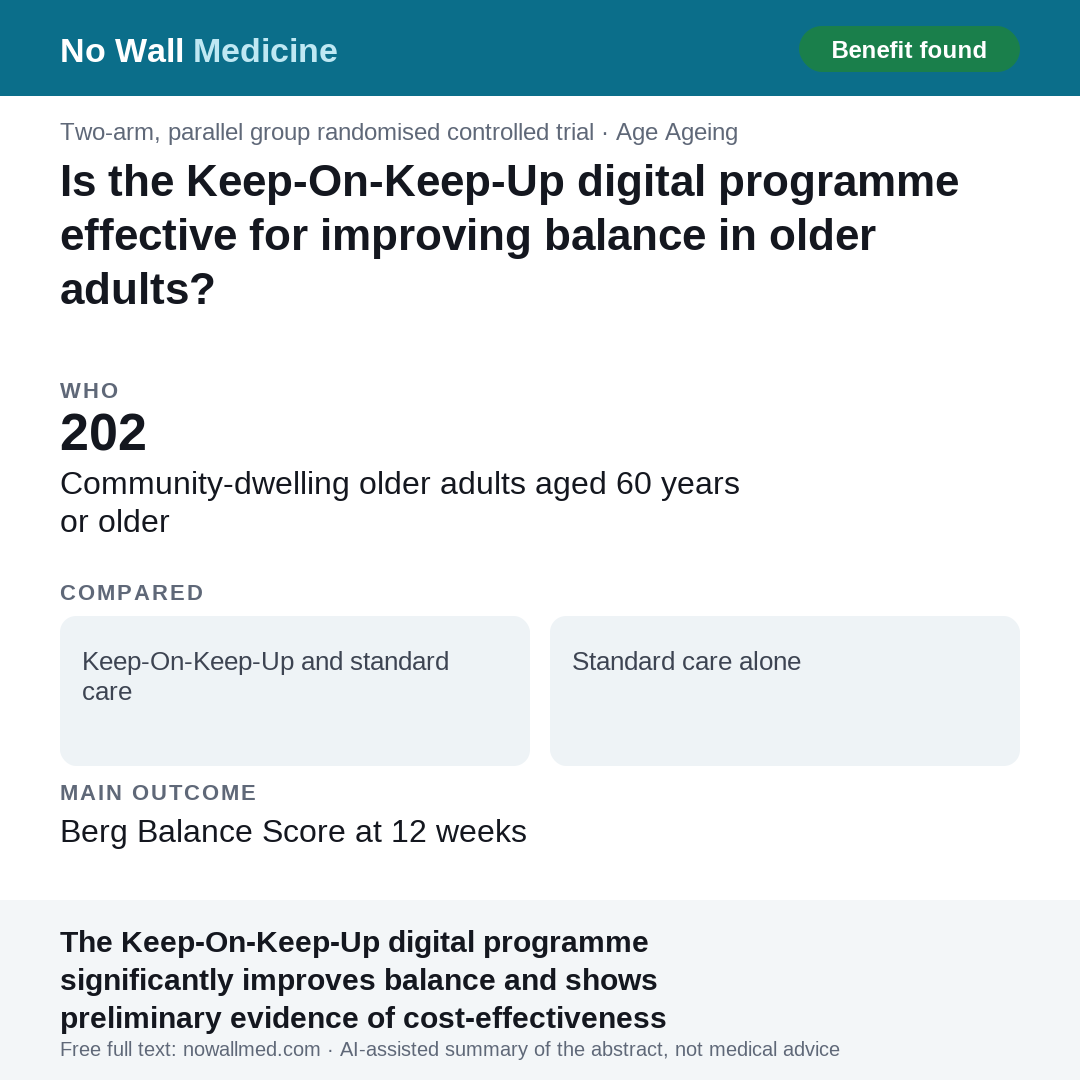
Clinical question: Is the Keep-On-Keep-Up digital programme effective for improving balance in older adults?
Why it matters: Falls are a leading cause of injury-related hospital admissions among older adults and place a substantial burden on health and social care systems.
Key points
- Researchers conducted a trial with 202 community-dwelling adults aged 60 years or older, comparing a digital exercise programme to standard care.
- The digital programme significantly improved balance function at 12 weeks with a mean difference of 6.35 on the Berg Balance Score.
- The intervention was associated with a quality-adjusted life year gain of 0.020 and lower mean falls-related costs.
Headline and key points written with AI from the paper’s abstract, with every number checked against it. Read the paper before relying on them.
Topics
Spotted a mistake? Suggest a correction