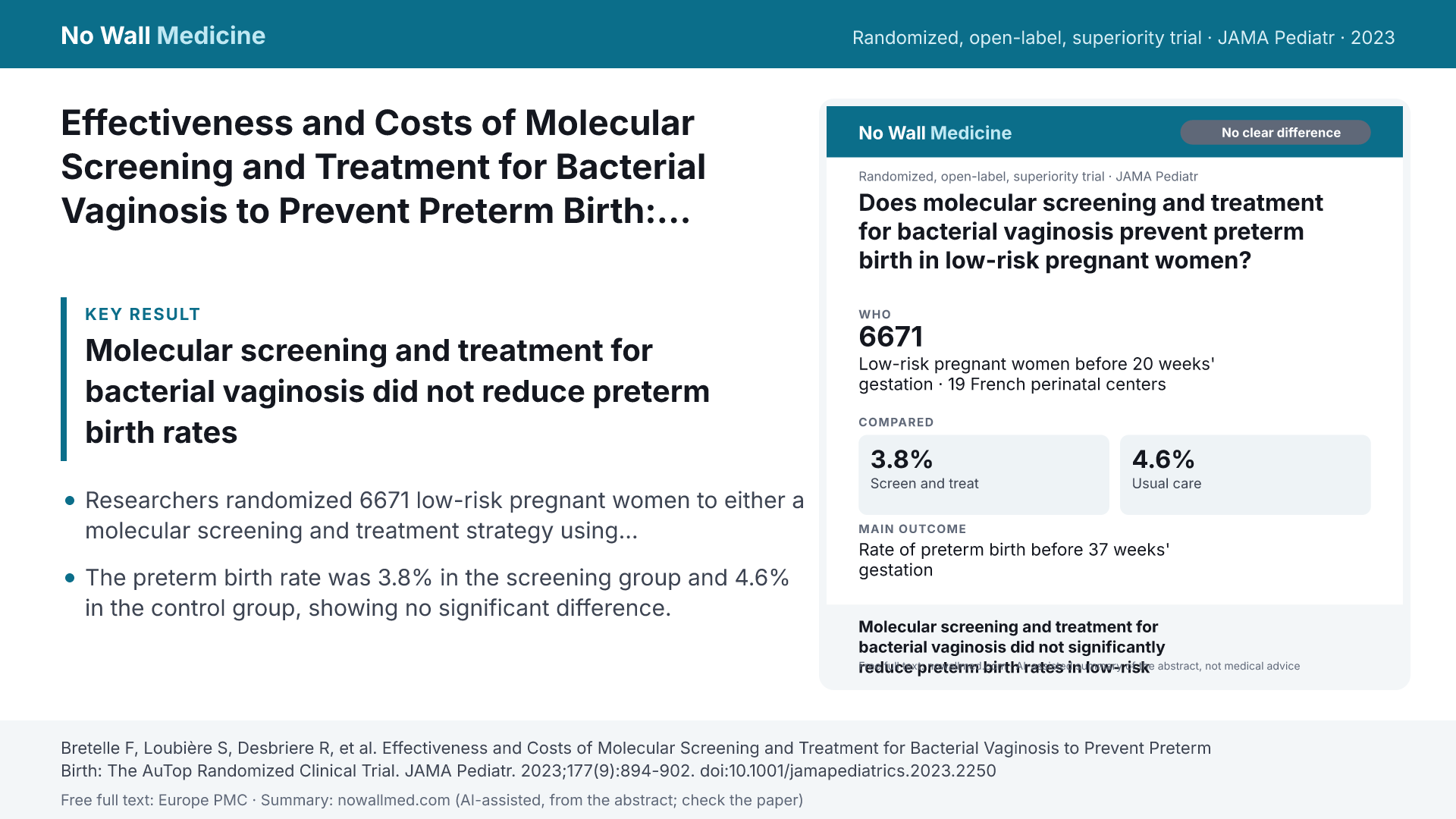
Molecular screening and treatment for bacterial vaginosis did not reduce preterm birth rates
Effectiveness and Costs of Molecular Screening and Treatment for Bacterial Vaginosis to Prevent Preterm Birth: The AuTop Randomized Clinical Trial
Randomized, open-label, superiority trialNo clear difference
Does molecular screening and treatment for bacterial vaginosis prevent preterm birth in low-risk pregnant women?
Who
6671
Low-risk pregnant women before 20 weeks' gestation · 19 French perinatal centers
Compared
3.8%Screen and treat (127/3333)
4.6%Usual care (153/3338)
Main outcome
Rate of preterm birth before 37 weeks' gestation
Result: risk ratio 0.83 (95% CI, 0.66-1.05)
Bottom line: Molecular screening and treatment for bacterial vaginosis did not significantly reduce preterm birth rates in low-risk pregnant women.
JAMA Pediatr · 2023-07-17 · Save PNG
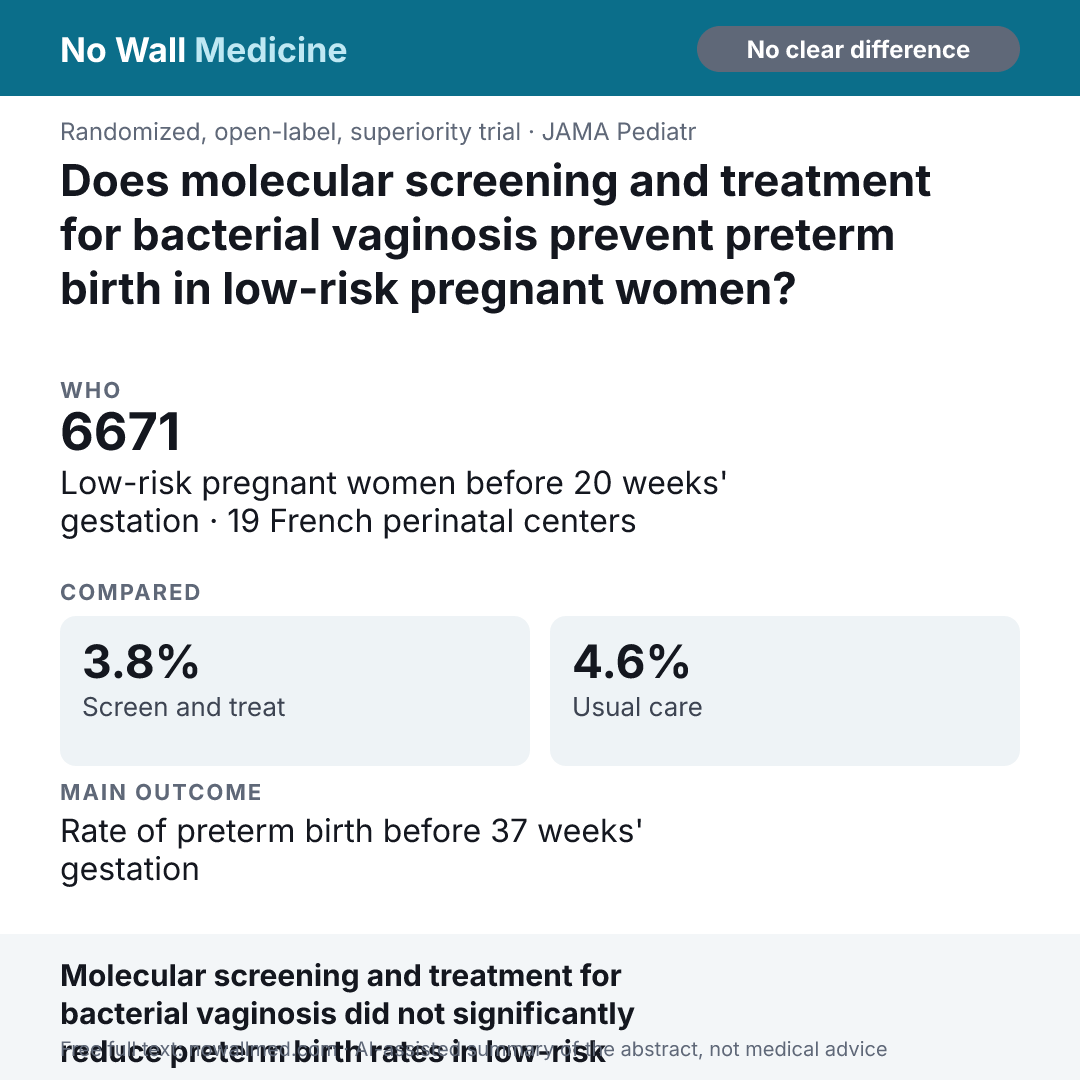
Clinical question: Does molecular screening and treatment for bacterial vaginosis prevent preterm birth in low-risk pregnant women?
Key points
- Researchers randomized 6671 low-risk pregnant women to either a molecular screening and treatment strategy using self-collected swabs or usual care.
- The preterm birth rate was 3.8% in the screening group and 4.6% in the control group, showing no significant difference.
- Total average costs were €3344.3 in the screening group compared to €3272.9 in the control group, with no significant difference observed.
Headline and key points written with AI from the paper’s abstract, with every number checked against it. Read the paper before relying on them.
Was this summary helpful?
Abstract
Importance
Bacterial vaginosis (BV) is a well-known risk factor for preterm birth. Molecular diagnosis of BV is now available. Its impact in the screening and treatment of BV during pregnancy on preterm births has not been evaluated to date.Objective
To evaluate the clinical and economic effects of point-of-care quantitative real-time polymerase chain reaction screen and treat for BV in low-risk pregnant women on preterm birth.Design, setting, and participants
The AuTop trial was a prospective, multicenter, parallel, individually randomized, open-label, superiority trial conducted in 19 French perinatal centers between March 9, 2015, and December 18, 2017. Low-risk pregnant women before 20 weeks' gestation without previous preterm births or late miscarriages were enrolled. Data were analyzed from October 2021 to November 2022.Interventions
Participants were randomized 1:1 to BV screen and treat using self-collected vaginal swabs (n = 3333) or usual care (n = 3338). BV was defined as Atopobium vaginae (Fannyhessea vaginae) load of 108 copies/mL or greater and/or Gardnerella vaginalis load of 109 copies/mL or greater, using point-of-care quantitative real-time polymerase chain reaction assays. The control group received usual care with no screening of BV.Main outcomes and measures
Overall rate of preterm birth before 37 weeks' gestation and total costs were calculated in both groups. Secondary outcomes were related to treatment success as well as maternal and neonate health. Post hoc subgroup analyses were conducted.Results
Among 6671 randomized women (mean [SD] age, 30.6 [5.0] years; mean [SD] gestational age, 15.5 [2.8] weeks), the intention-to-treat analysis of the primary clinical and economic outcomes showed no evidence of a reduction in the rate of preterm birth and total costs with the screen and treat strategy compared with usual care. The rate of preterm birth was 3.8% (127 of 3333) in the screen and treat group and 4.6% (153 of 3338) in the control group (risk ratio [RR], 0.83; 95% CI, 0.66-1.05; P = .12). On average, the cost of the intervention was €203.6 (US $218.0) per participant, and the total average cost was €3344.3 (US $3580.5) in the screen and treat group vs €3272.9 (US $3504.1) in the control group, with no significant differences being observed. In the subgroup of nulliparous women (n = 3438), screen and treat was significantly more effective than usual care (RR, 0.62; 95% CI, 0.45-0.84; P for interaction = .003), whereas no statistical difference was found in multiparous (RR, 1.30; 95% CI, 0.90-1.87).Conclusion and relevance
In this clinical trial of pregnant women at low risk of preterm birth, molecular screening and treatment for BV based on A vaginae (F vaginae) and/or G vaginalis quantification did not significantly reduce preterm birth rates. Post hoc analysis suggests a benefit of screen and treat in low-risk nulliparous women, warranting further evaluation in this group.Trial registration
ClinicalTrials.gov Identifier: NCT02288832.
Abstract reproduced under the article’s CC BY licence.
Subject terms
Headline, design, result, key points, caveat and citation as plain text.
Cite this article
Bretelle F, Loubière S, Desbriere R, et al. Effectiveness and Costs of Molecular Screening and Treatment for Bacterial Vaginosis to Prevent Preterm Birth: The AuTop Randomized Clinical Trial. JAMA Pediatr. 2023;177(9):894-902. doi:10.1001/jamapediatrics.2023.2250
Spotted a mistake? Suggest a correction