Healthcare provider education and electronic alerts were associated with increased hepatitis B testing uptake
Effectiveness and implementation of decentralized, community- and primary care-based strategies in promoting hepatitis B testing uptake: a systematic review and meta-analysis
Systematic review and meta-analysisBenefit found
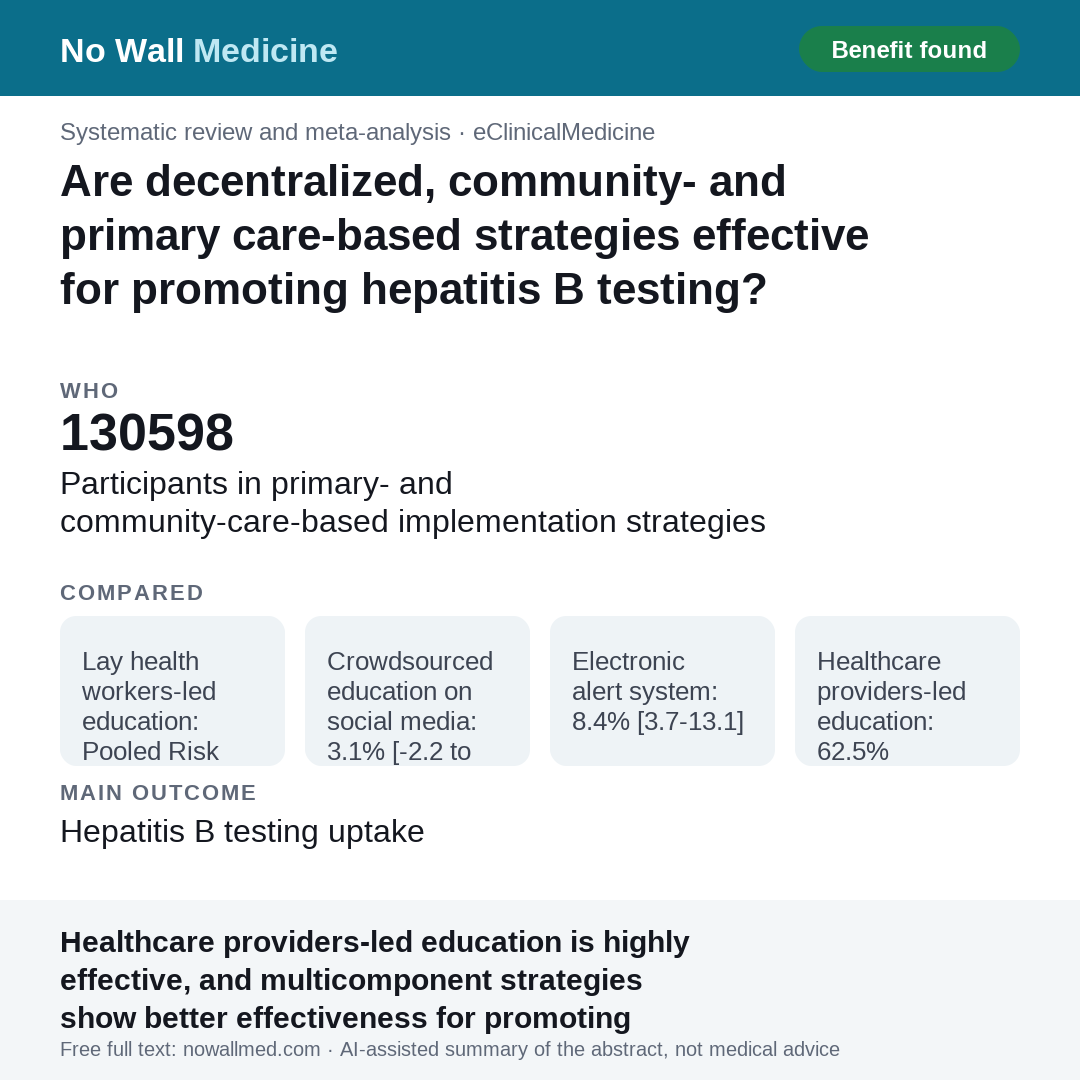
Are decentralized, community- and primary care-based strategies effective for promoting hepatitis B testing?
Who
130598
Participants in primary- and community-care-based implementation strategies
Compared
Lay health workers-led education: Pooled Risk Difference = 27.9% [95% Confidence Interval = 3.4-52.4]
Crowdsourced education on social media: 3.1% [-2.2 to 8.4]
Electronic alert system: 8.4% [3.7-13.1]
Healthcare providers-led education: 62.5% [53.1-71.9]
Main outcome
Hepatitis B testing uptake
Bottom line: Healthcare providers-led education is highly effective, and multicomponent strategies show better effectiveness for promoting hepatitis B testing.
Limitation: No studies were conducted in low-and-middle-income countries.
Funded by: Johns Hopkins University School of Medicine
eClinicalMedicine · 2024-09-12Download image
Clinical question: Are decentralized, community- and primary care-based strategies effective for promoting hepatitis B testing?
Why it matters: It is unknown which specific community or primary care implementation strategies are most effective for increasing hepatitis B testing rates.
Key points
- Researchers analyzed 25 studies involving 130,598 participants to evaluate community and primary care strategies for hepatitis B testing.
- Healthcare provider-led education was associated with a 62.5% pooled risk difference, while electronic alert systems showed an 8.4% difference.
- Lay health worker-led education was associated with a 27.9% pooled risk difference, but crowdsourced social media education was not statistically significant.
Limitation the authors note: No studies included participants from low-and-middle-income countries.
Headline and key points written with AI from the paper’s abstract, with every number checked against it. Read the paper before relying on them.
Cite this article
Kim TV, Pham TND, Phan P, Le MHN, Le Q, Nguyen PT. Effectiveness and implementation of decentralized, community- and primary care-based strategies in promoting hepatitis B testing uptake: a systematic review and meta-analysis. eClinicalMedicine. 2024. doi:10.1016/j.eclinm.2024.102818
Spotted a mistake? Suggest a correction
Top studies every Monday
The week’s key trials and guidelines in your specialties, by email. Free.
Get the weekly digest