Researchers plan systematic review of tuberculosis preventive treatments for children and adolescents
Effectiveness and safety of available preventive tuberculosis treatment regimens for children and adolescents: protocol for a systematic review and network meta-analysis
Systematic review and network meta-analysisUnclear result
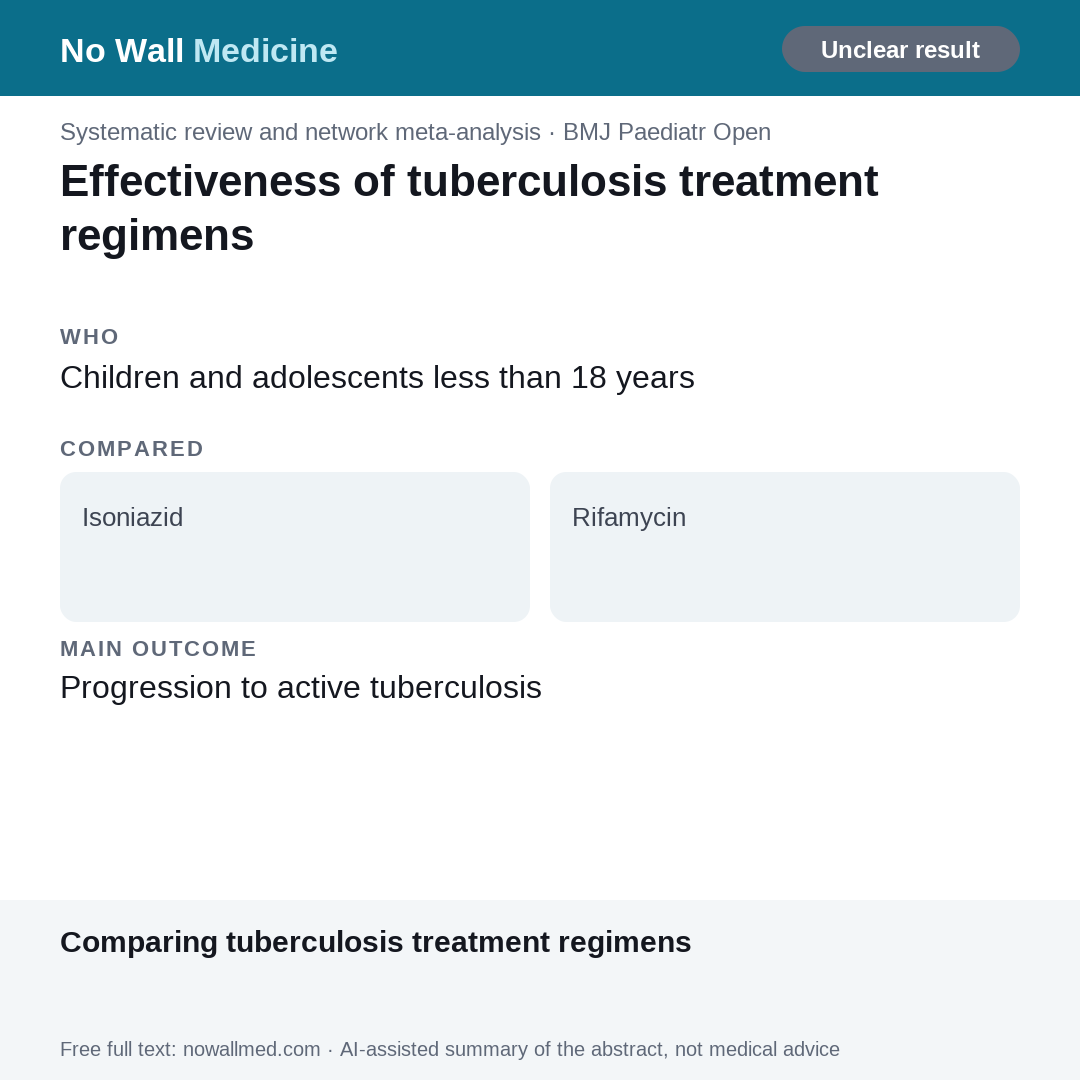
Effectiveness of tuberculosis treatment regimens
Who
Children and adolescents less than 18 years
Compared
Isoniazid
Rifamycin
Main outcome
Progression to active tuberculosis
Bottom line: Comparing tuberculosis treatment regimens
BMJ Paediatr Open · 2022-09-02Download image
Why it matters: It is unknown which preventive tuberculosis regimens are most effective and safe for children and adolescents compared to long-term isoniazid treatment.
Key points
- The protocol describes a planned systematic review and network meta-analysis of randomized controlled trials for children and adolescents under 18 years of age.
- The review will compare the effectiveness and safety of different regimens for treating latent tuberculosis infection in contacts of drug-susceptible tuberculosis without HIV infection.
Headline and key points written with AI from the paper’s abstract, with every number checked against it. Read the paper before relying on them.
Was this summary helpful?
Abstract
Introduction
Approximately 5%-10% of individuals with untreated latent tuberculosis infection (LTBI) will progress to active tuberculosis (TB). Children are at a higher risk for progression to TB disease than adults. Isoniazid prophylaxis treatment period is long and can cause liver damage. Alternatives to isoniazid, such as rifamycin containing regimens, should be considered for prophylaxis. Previous systematic reviews, with different study designs and data combining results on children and adults, have evaluated the comparative efficacy and harms of LTBI treatment regimens. We aim to determine the effectiveness and safety of all the different regimens available for the treatment of LTBI for children and adolescents less than 18 years of age, contacts of drug-susceptible TB, without HIV infection. Methods and analysis
MEDLINE, Embase and Cochrane Central Register of Controlled Trials will be systematically searched for randomised controlled trials without any language or publication date restriction. Screening and extraction will be performed in duplicate. Risk of bias will be performed in duplicate with Cochrane Risk of Bias tool V.2. Pairwise meta-analysis of direct comparisons and network meta-analyses (NMAs) will be performed. Heterogeneity will be assessed using I2 and Cochrane thresholds. Direct and indirect estimates in an NMA will be combined if justifiable. Subgroups analyses will be performed in different mean age and study year groups. Sensitivity analysis based on the risk of bias will be conducted. Publication bias will be investigated using funnel plots and Egger's regression test. Grading of Recommendations Assessment, Development and Evaluation (GRADE) criteria will assess certainty of the evidence for the direct comparisons. GRADE approach for NMA will assess the quality of the evidence from the indirect and NMA. Ethics and dissemination
Ethical approval is not required as no primary data are collected. This systematic review will be disseminated in a peer-reviewed journal. Prospero registration number
CRD42021271512.
Abstract reproduced under the article’s CC BY NC licence.
Subject terms
Cite this article
Sabella-Jiménez V, Hoyos Mendez Y, Benjumea-Bedoya D, Estupiñán-Bohorquez AF, Acosta-Reyes J, Florez ID. Effectiveness and safety of available preventive tuberculosis treatment regimens for children and adolescents: protocol for a systematic review and network meta-analysis. BMJ Paediatr Open. 2022. doi:10.1136/bmjpo-2022-001551
Spotted a mistake? Suggest a correction
Top studies every Monday
The week’s key trials and guidelines in your specialties, plus any topics you follow. By email, free.
Get the weekly digest