Short course tuberculosis preventive treatments may be more effective and better tolerated than nine months of isoniazid
Effectiveness and safety of the available preventive tuberculosis treatment regimens for children and adolescents: systematic review and network meta-analysis
Systematic review and network meta-analysisBenefit found
What are the effectiveness and safety of preventive tuberculosis treatment regimens for children and adolescents?
Who
Children and adolescents under 18 years with tuberculosis infection
Compared
4 months isoniazid and rifampicin: RR 0.49 (95% CI 0.32 to 0.76)
9 months isoniazid
Main outcome
Number of active tuberculosis cases
Result: RR 0.49 (95% CI 0.32 to 0.76)
Bottom line: Short course regimens may have higher adherence and reduce active tuberculosis incidence compared to nine months of isoniazid.
Limitation: High variability was found in the reporting of adverse reactions.
BMJ Paediatr Open · 2026-09-30Download image
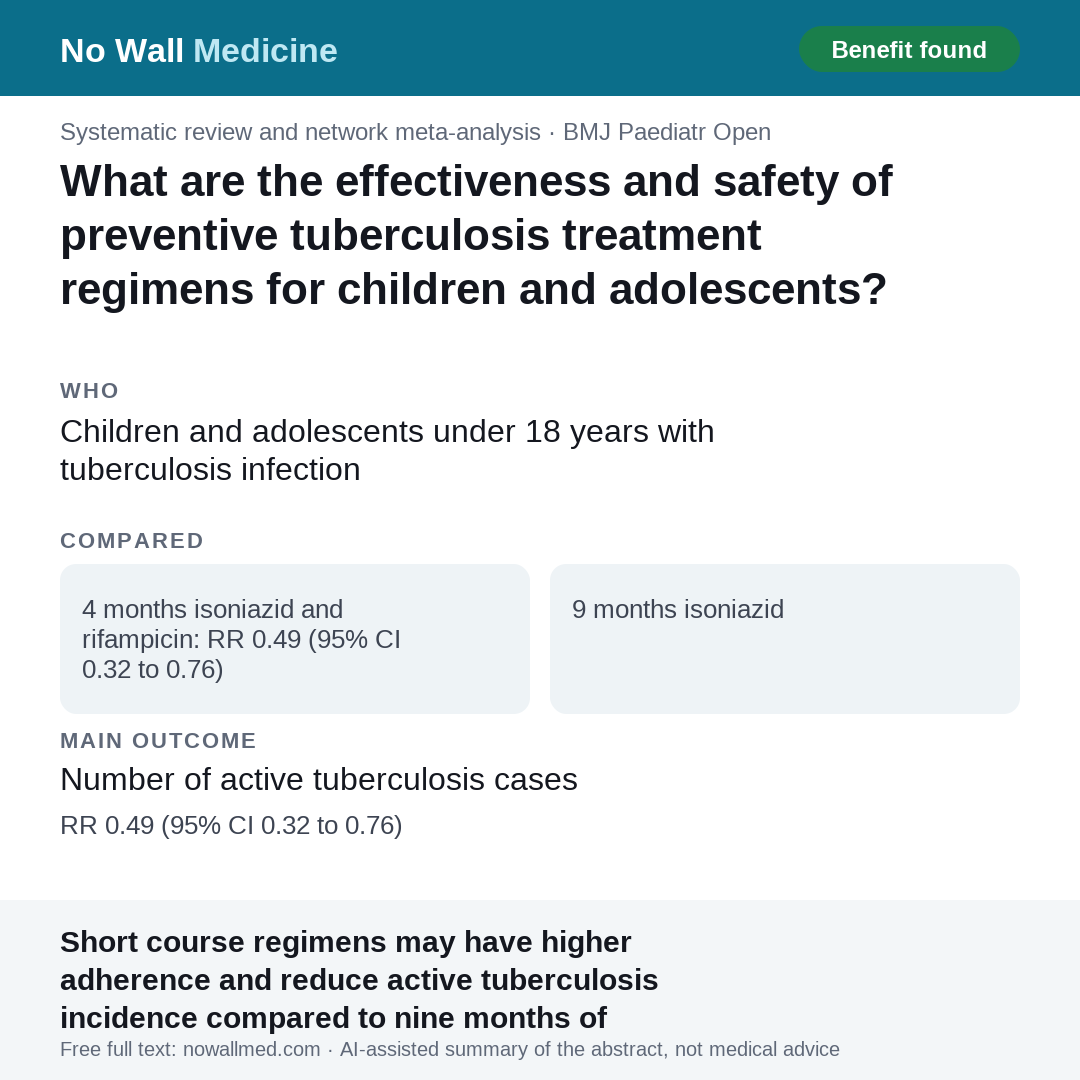
Clinical question: What are the effectiveness and safety of preventive tuberculosis treatment regimens for children and adolescents?
Why it matters: Most research and publications regarding tuberculosis management have focused on adults rather than children and adolescents.
Key points
- Researchers analyzed eleven studies involving children and adolescents under 18 years old with tuberculosis infection who were not living with HIV.
- Four months of isoniazid and rifampicin reduced active tuberculosis cases at 1, 2, and 5 years compared to nine months of isoniazid (RR 0.49 (95% CI 0.32 to 0.76)).
- The 3HP, 4HR, and 4R regimens showed higher treatment adherence than nine months of isoniazid, though 3HP had more adverse reactions than 4HR (OR 4.56 (95% CI 1.22 to 16.96)).
Limitation the authors note: High variability was found in the reporting of adverse reactions.
Headline and key points written with AI from the paper’s abstract, with every number checked against it. Read the paper before relying on them.
Abstract
Background
Although children are at a higher risk of progressing to tuberculosis (TB) disease compared with adults, research and publications addressing TB management have mostly emphasised adult disease. Methods
MEDLINE, Embase, CENTRAL and grey literature were searched from inception to 3 May 2021, and updated on 12 December 2024 for the systematic review and network meta-analysis (NMA). Randomised controlled trials of children and/or adolescents under 18 years with TB infection, contacts of drug-susceptible TB, without HIV, evaluating the effectiveness and safety of available regimens for the treatment of TB were included. Meta-analysis was conducted using a random effects model. Risk of bias was assessed using the Cochrane RoB tool 2. Effect estimates (RR and OR) are presented with 95% CIs. Certainty of evidence was evaluated using the Grading of Recommendations, Assessment, Development and Evaluation (GRADE) approach. Results
Eleven studies were obtained. All network geometries had open and disconnected loops, except adverse reactions for which we conducted a full NMA. We found that 4 months of isoniazid and rifampicin (4HR) reduces the number of active TB cases at 1 year, 2 years and 5 years of follow-up (RR 0.49 (95% CI 0.32 to 0.76)) compared with isoniazid for 9 months (9H). The isoniazid + rifapentine for 3 months (3HP) regimen (RR 1.09 (95% CI 1.03 to 1.15)), 4HR (RR 1.07 (95% CI 1.01 to 1.14)) and rifampicin for 4 months (4R) (RR 1.12 (95% CI 1.05 to 1.20)) regimens have higher treatment adherence compared with 9H. High variability was found in the reporting of adverse reactions, which were more likely to occur with 3HP compared with 4HR (OR 4.56 (95% CI 1.22 to 16.96)) and 4R (OR 6.37 (95% CI 2.11 to 19.19)). Adverse reactions occur less frequently with 4R (OR 0.34 (95% CI 0.20 to 0.58)) compared with 9H. Conclusions
This study synthesised available data on paediatric short and long-course regimens. Short course regimens may have higher adherence (3HP, 4HR, 4R) and may reduce active TB incidence (isoniazid + rifampicin for 3 months (3HR) and 4HR) compared with 9H. Prospero registration number
CRD42021271512.
Abstract reproduced under the article’s CC BY NC licence.
Topics
Cite this article
Sabella-Jiménez V, Benjumea-Bedoya D, Hoyos-Mendez Y, Estupiñán-Bohorquez AF, Acosta-Reyes J, Florez ID. Effectiveness and safety of the available preventive tuberculosis treatment regimens for children and adolescents: systematic review and network meta-analysis. BMJ Paediatr Open. 2026. doi:10.1136/bmjpo-2026-004610
Spotted a mistake? Suggest a correction