Effectiveness, feasibility, and acceptability of behaviour change tools used by family doctors: a global systematic review
Global systematic reviewBenefit found
How effective, feasible, and acceptable are behaviour change tools used by family doctors?
Who
Priority patients including low-income, rural, diverse, or First Nations people · Global
Compared
Online, web, or app-based tools
Printed materials and in-person training
Main outcome
Effectiveness, feasibility, and acceptability of behaviour change tools
Bottom line: Behaviour change tools used by family doctors are effective and feasible for facilitating change in priority patients.
Br J Gen Pract · 2023-05-25Download image
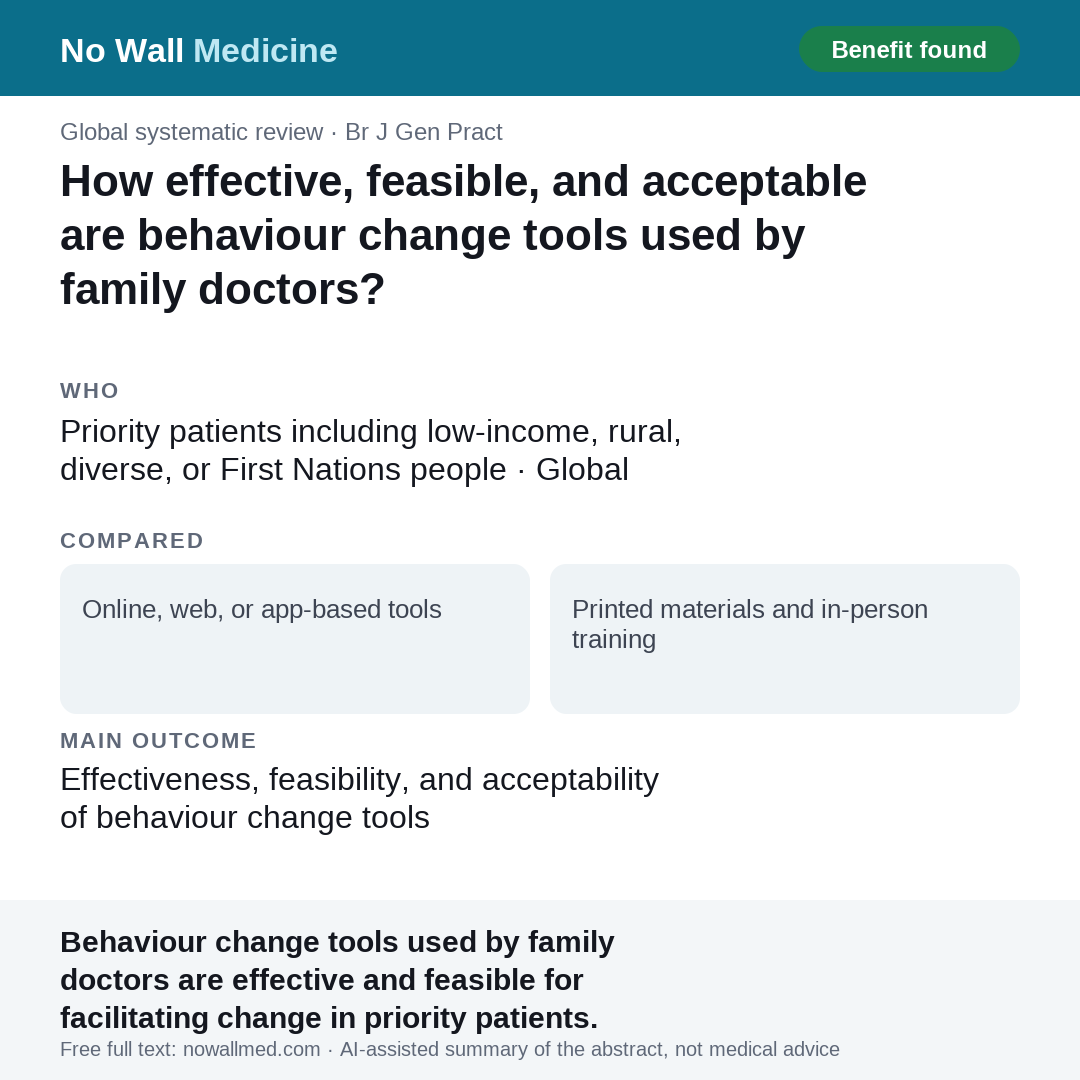
Clinical question: How effective, feasible, and acceptable are behaviour change tools used by family doctors?
Abstract
Background
Priority patients in primary care include people from low-income, rural, or culturally and linguistically diverse communities, and First Nations people. Aim
To describe the effectiveness, feasibility, and acceptability of behaviour change tools that have been tested by family doctors working with priority patients. Design and setting
A global systematic review. Method
Five databases were searched for studies published from 2000 to 2021, of any design, that tested the effectiveness or feasibility of tangible, publicly available behaviour change tools used by family doctors working with priority patients. The methodological quality of each study was appraised using the Mixed Methods Appraisal Tool. Results
Thirteen of 4931 studies screened met the eligibility criteria, and described 12 tools. The health-related behaviours targeted included smoking, diet and/or physical activity, alcohol and/or drug use, and suicidal ideation. Six tools had an online/web/app-based focus; the remaining six utilised only printed materials and/or in-person training. The effectiveness of the tools was assessed in 11 studies, which used diverse methods, with promising results for enabling behaviour change. The nine studies that assessed feasibility found that the tools were easy to use and enhanced the perceived quality of care. Conclusion
Many of the identified behaviour change tools were demonstrated to be effective at facilitating change in a target behaviour and/or feasible for use in practice. The tools varied across factors, such as the mode of delivery and the way the tool was intended to influence behaviour. There is clear opportunity to build on existing tools to enable family doctors to assist priority patients towards achieving healthier lifestyles.
Subject terms
Cite this article
Ball L, Brickley B, Williams LT, Advocat J, Rieger E, Ng R. Effectiveness, feasibility, and acceptability of behaviour change tools used by family doctors: a global systematic review. Br J Gen Pract. 2023. doi:10.3399/BJGP.2022.0328
Spotted a mistake? Suggest a correction
Top studies every Monday
The week’s key trials and guidelines in your specialties, plus any topics you follow. By email, free.
Get the weekly digest