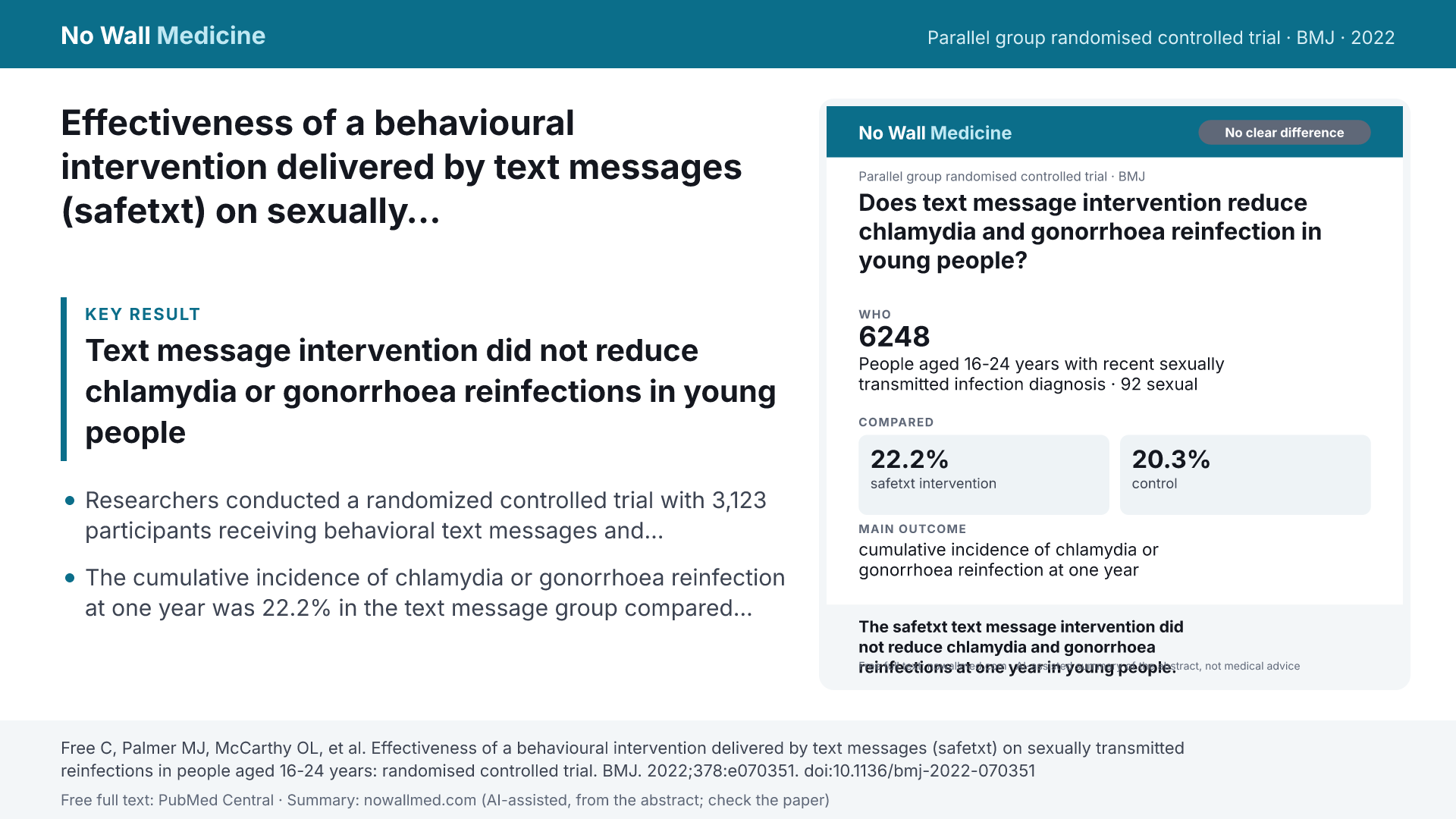
Text message intervention did not reduce chlamydia or gonorrhoea reinfections in young people
Effectiveness of a behavioural intervention delivered by text messages (safetxt) on sexually transmitted reinfections in people aged 16-24 years: randomised controlled trial
Parallel group randomised controlled trialNo clear difference
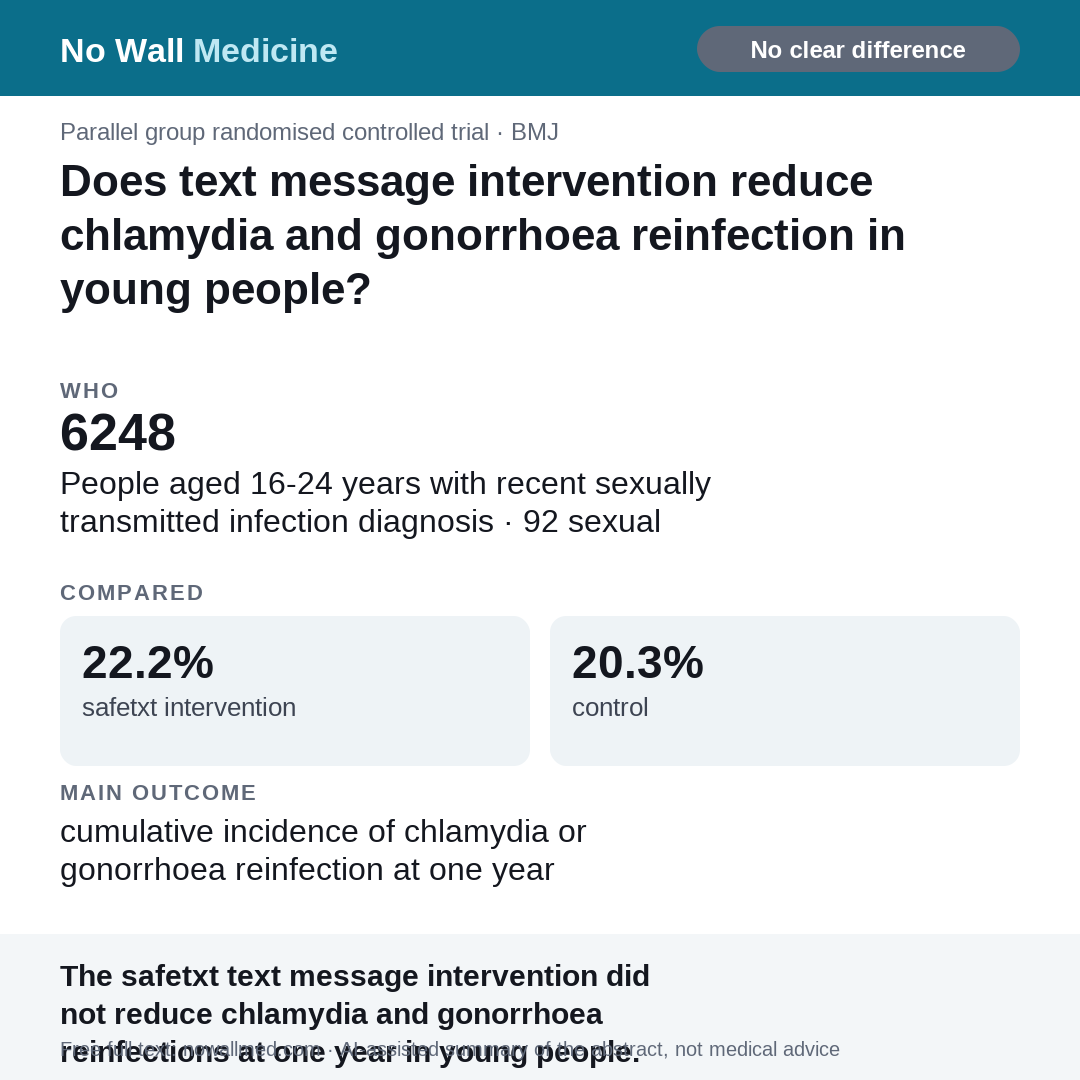
Does text message intervention reduce chlamydia and gonorrhoea reinfection in young people?
Who
6248
People aged 16-24 years with recent sexually transmitted infection diagnosis · 92 sexual health clinics in the United Kingdom
Compared
22.2%safetxt intervention (693/3123)
20.3%control (633/3125)
Main outcome
cumulative incidence of chlamydia or gonorrhoea reinfection at one year
Result: odds ratio 1.13 (95% confidence interval 0.98 to 1.31)
Bottom line: The safetxt text message intervention did not reduce chlamydia and gonorrhoea reinfections at one year in young people.
BMJ · 2022-09-28Download image
Clinical question: Does text message intervention reduce chlamydia and gonorrhoea reinfection in young people?
Why it matters: It was unknown if a series of text messages designed to improve safer sex behaviors could reduce the incidence of sexually transmitted infection reinfections.
Key points
- Researchers conducted a randomized controlled trial with 3,123 participants receiving behavioral text messages and 3,125 participants receiving monthly administrative text messages.
- The cumulative incidence of chlamydia or gonorrhoea reinfection at one year was 22.2% in the text message group compared to 20.3% in the control group.
- The risk of road traffic incidents and partner violence was similar between the two groups.
Headline and key points written with AI from the paper’s abstract, with every number checked against it. Read the paper before relying on them.
Was this summary helpful?
Abstract
Objective
To quantify the effects of a series of text messages (safetxt) delivered in the community on incidence of chlamydia and gonorrhoea reinfection at one year in people aged 16-24 years. Design
Parallel group randomised controlled trial. Setting
92 sexual health clinics in the United Kingdom. Participants
People aged 16-24 years with a diagnosis of, or treatment for, chlamydia, gonorrhoea, or non-specific urethritis in the past two weeks who owned a mobile phone. Interventions
3123 participants assigned to the safetxt intervention received a series of text messages to improve sex behaviours: four texts daily for days 1-3, one or two daily for days 4-28, two or three weekly for month 2, and 2-5 monthly for months 3-12. 3125 control participants received a monthly text message for one year asking for any change to postal or email address. It was hypothesised that safetxt would reduce the risk of chlamydia and gonorrhoea reinfection at one year by improving three key safer sex behaviours: partner notification at one month, condom use, and sexually transmitted infection testing before unprotected sex with a new partner. Care providers and outcome assessors were blind to allocation. Main outcome measures
The primary outcome was the cumulative incidence of chlamydia or gonorrhoea reinfection at one year, assessed by nucleic acid amplification tests. Safety outcomes were self-reported road traffic incidents and partner violence. All analyses were by intention to treat. Results
6248 of 20 476 people assessed for eligibility between 1 April 2016 and 23 November 2018 were randomised. Primary outcome data were available for 4675/6248 (74.8%). At one year, the cumulative incidence of chlamydia or gonorrhoea reinfection was 22.2% (693/3123) in the safetxt arm versus 20.3% (633/3125) in the control arm (odds ratio 1.13, 95% confidence interval 0.98 to 1.31). The number needed to harm was 64 (95% confidence interval number needed to benefit 334 to ∞ to number needed to harm 24) The risk of road traffic incidents and partner violence was similar between the groups. Conclusions
The safetxt intervention did not reduce chlamydia and gonorrhoea reinfections at one year in people aged 16-24 years. More reinfections occurred in the safetxt group. The results highlight the need for rigorous evaluation of health communication interventions. Trial registration
ISRCTN registry ISRCTN64390461.
Abstract reproduced under the article’s CC BY licence.
Subject terms
Cite this article
Free C, Palmer MJ, McCarthy OL, et al. Effectiveness of a behavioural intervention delivered by text messages (safetxt) on sexually transmitted reinfections in people aged 16-24 years: randomised controlled trial. BMJ. 2022. doi:10.1136/bmj-2022-070351
Spotted a mistake? Suggest a correction