Group behavioral intervention reduced internalizing symptoms in Syrian refugee adolescents
Effectiveness of a brief group behavioural intervention on psychological distress in young adolescent Syrian refugees: A randomised controlled trial
Single-blind, parallel, controlled trialBenefit found
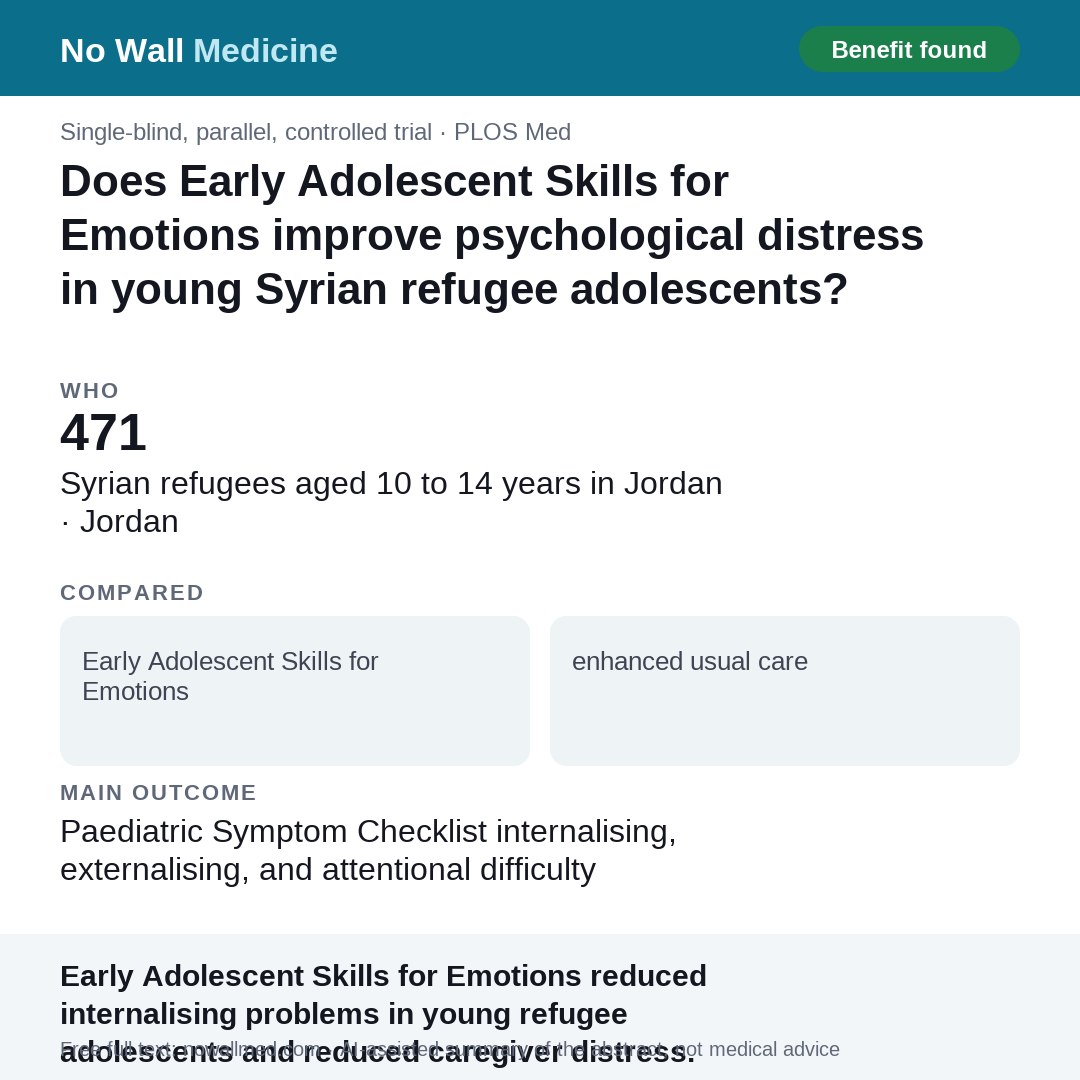
Does Early Adolescent Skills for Emotions improve psychological distress in young Syrian refugee adolescents?
Who
471
Syrian refugees aged 10 to 14 years in Jordan · Jordan
Compared
Early Adolescent Skills for Emotions
enhanced usual care
Main outcome
Paediatric Symptom Checklist internalising, externalising, and attentional difficulty scales
Result: estimated mean difference 0.69, 95% CI 0.19 to 1.19
Bottom line: Early Adolescent Skills for Emotions reduced internalising problems in young refugee adolescents and reduced caregiver distress.
Limitation: enhanced usual care was not matched to intervention in terms of facilitator attention or group involvement
PLOS Med · 2022-08-12Download image
Clinical question: Does Early Adolescent Skills for Emotions improve psychological distress in young Syrian refugee adolescents?
Why it matters: It is unknown if a scalable, nonspecialist delivered group program can effectively improve mental health for young adolescents in humanitarian crisis settings.
Key points
- The study randomized 471 Syrian refugee adolescents aged 10 to 14 years to either Early Adolescent Skills for Emotions or enhanced usual care.
- At 3 months, the group intervention resulted in a greater reduction in internalizing symptoms compared to usual care (estimated mean difference 0.69; p = 0.007).
- The intervention was not associated with differences in externalizing symptoms, attentional problems, depression, posttraumatic stress, well-being, functioning, or school belongingness.
Limitation the authors note: The enhanced usual care group was not matched to the intervention group in terms of facilitator attention or group involvement.
Headline and key points written with AI from the paper’s abstract, with every number checked against it. Read the paper before relying on them.
Was this summary helpful?
Subject terms
Cite this article
Bryant RA, Malik A, Aqel IS, Ghatasheh M, Habashneh R, Dawson KS. Effectiveness of a brief group behavioural intervention on psychological distress in young adolescent Syrian refugees: A randomised controlled trial. PLOS Med. 2022. doi:10.1371/journal.pmed.1004046
Spotted a mistake? Suggest a correction
Top studies every Monday
The week’s key trials and guidelines in your specialties, plus any topics you follow. By email, free.
Get the weekly digest