Background
Depression and anxiety are prevalent in working-aged adults. Although treatment provided by health professionals can improve symptoms and functioning, many people experiencing mental ill-health do not seek help. There have been very few effective interventions to improve help seeking in adults, with none implemented across diverse workplaces through online delivery. Objective
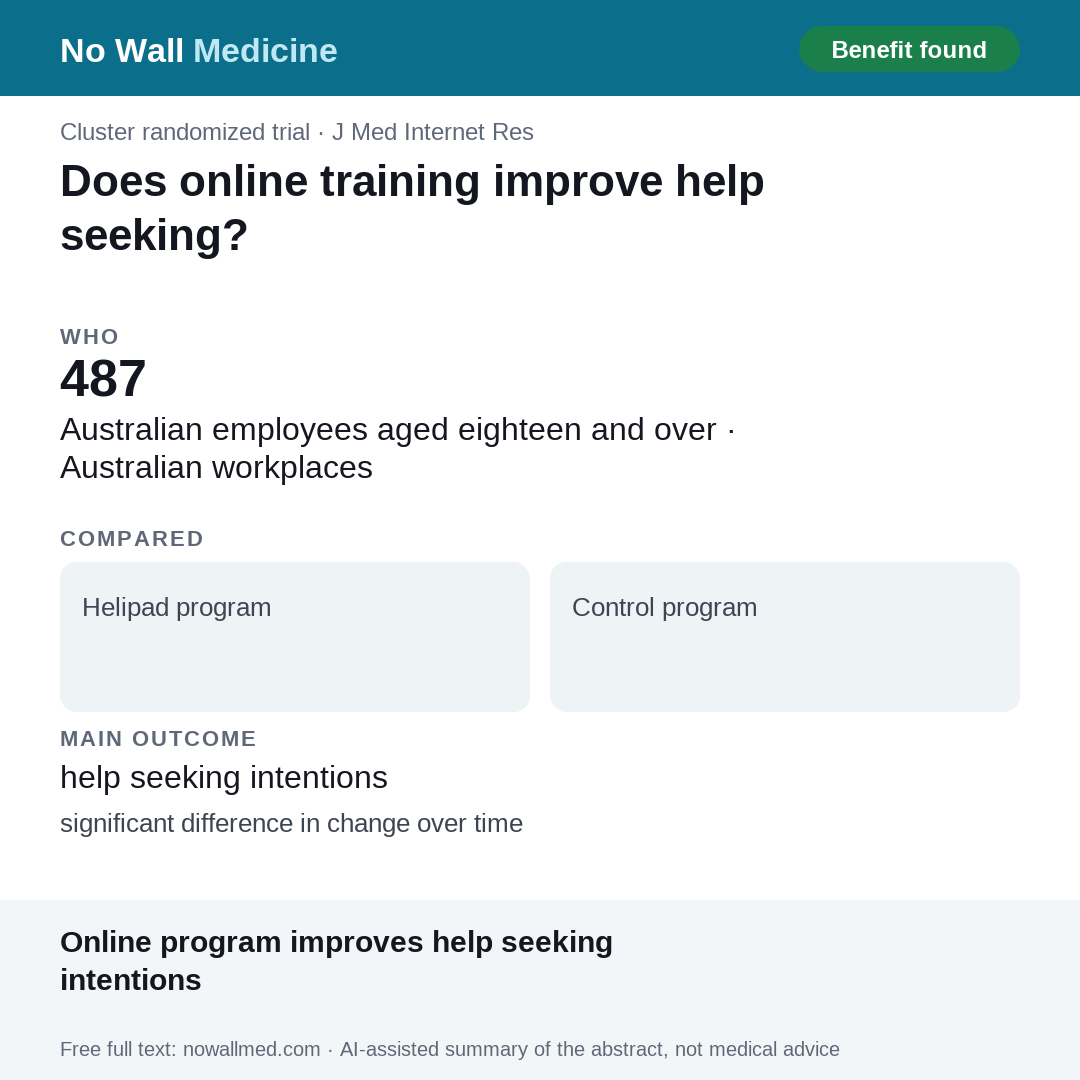
The primary aim of this trial was to test the effectiveness of a co-designed program for increasing professional help seeking intentions in Australian employees, relative to an active control condition. Methods
A triple-blinded, 2-arm cluster randomized controlled trial (N=487; control workplaces: n=26 and intervention workplaces: n=25) was conducted to assess the relative effectiveness of Helipad, a fully automated co-designed single-session interactive program (intervention condition) with a standard psychoeducation program (active control condition). Eligible workplaces (those with ≥50 employees and an employee assistance program; clusters) were recruited via advertising or invited directly by researchers. Eligible participants (employees in a participating Australian workplace, aged ≥18 y, living in Australia, fluent in reading and understanding English, and had access to a device and a reliable internet connection) completed a pretest, immediate posttest, and 6-month follow-up survey sent via email assessing help seeking intentions (primary outcome); mental illness stigma; mental health literacy; help seeking attitudes and behavior; work and activity functioning; quality of life; and symptoms of depression, anxiety, and general psychological distress. Results
A significant difference in change over time in professional help seeking intentions was found between the 2 conditions (F2,185.44=6.89; P=.001), with planned contrasts showing that the Helipad program was effective in increasing professional help seeking intentions compared with the control at the primary end point of immediate posttest (t359.35=-3.72; PConclusions
This study demonstrated that the co-designed online Helipad program was effective in improving the intentions of employees to seek help from a professional compared to an active control. The program also improved mental health literacy and help seeking attitudes, but these changes were not sustained and did not translate into observable differences in help seeking behaviors or mental health symptoms. This was the first trial of a co-designed intervention to improve mental health help seeking in general workplaces, with previous trials focusing primarily on specific high-risk work environments. Workplace programs that can be delivered at scale may lead to more appropriate engagement with professional mental health care to prevent poor mental health outcomes and increase productivity.
Topics
Humans; Male; Female; Adult; Workplace; Mental Disorders; Internet; Middle Aged; Australia; Help-Seeking Behavior; Patient Acceptance of Health Care; Internet-Based Intervention
ClinicalAge, a framework for modelling ageing trajectories from longitudinal electronic health records in the UK: a model development and validation study
A prognostic model for use at labour onset to estimate the risk of severe fetal compromise at birth: a retrospective, model development and validation study