Personalized text messages using reinforcement learning increased daily step counts in people with diabetes and depression
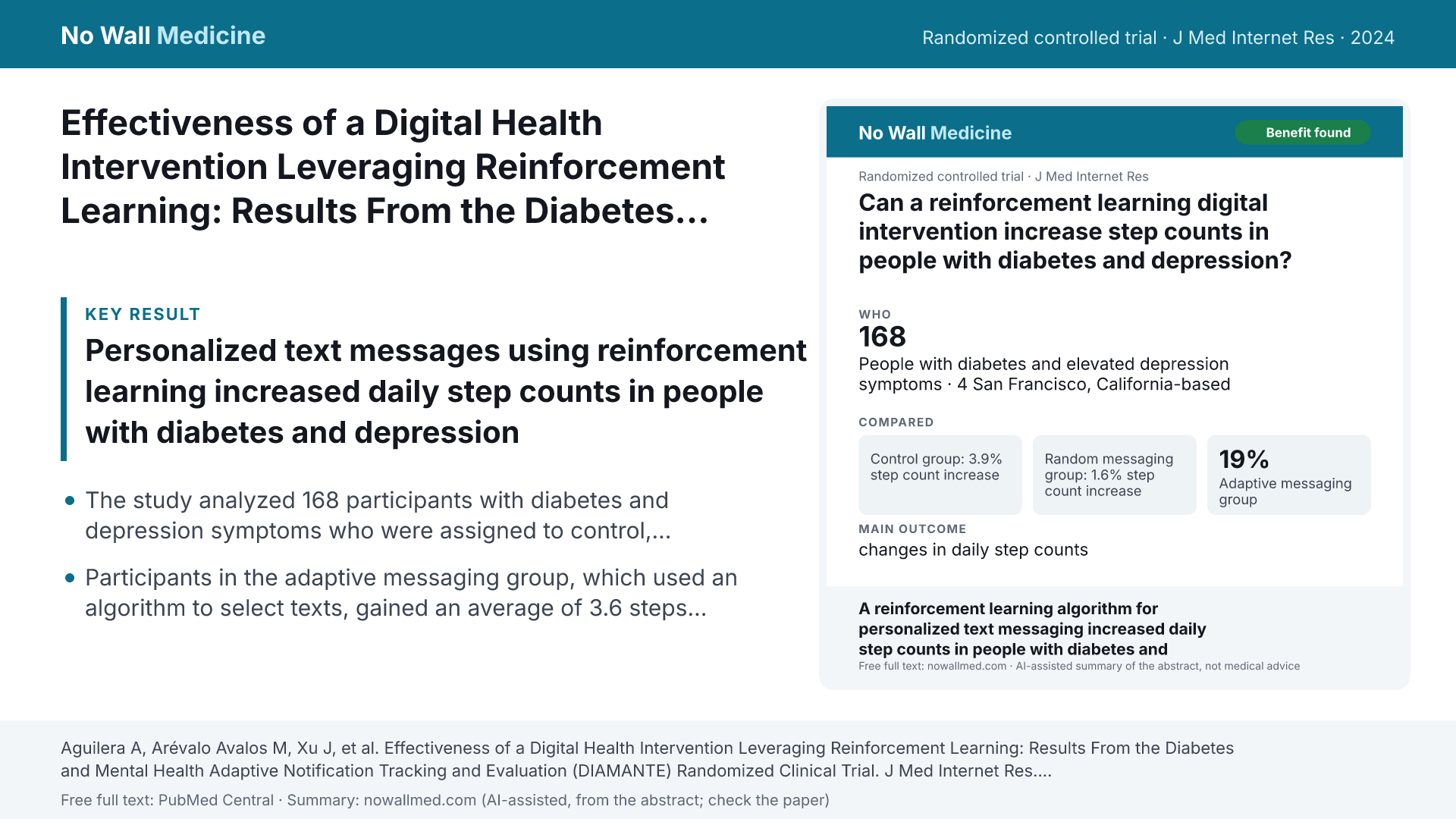
Effectiveness of a Digital Health Intervention Leveraging Reinforcement Learning: Results From the Diabetes and Mental Health Adaptive Notification Tracking and Evaluation (DIAMANTE) Randomized Clinical Trial
Randomized controlled trialBenefit found
Can a reinforcement learning digital intervention increase step counts in people with diabetes and depression?
Who
168
People with diabetes and elevated depression symptoms · 4 San Francisco, California-based public primary care clinics and web-based platforms
Compared
Control group: 3.9% step count increase
Random messaging group: 1.6% step count increase
19%Adaptive messaging group (606/3197)
Main outcome
changes in daily step counts
Result: average of 3.6 steps each day (95% CI 2.45-4.78)
Bottom line: A reinforcement learning algorithm for personalized text messaging increased daily step counts in people with diabetes and depression.
J Med Internet Res · 2024-10-08Download image
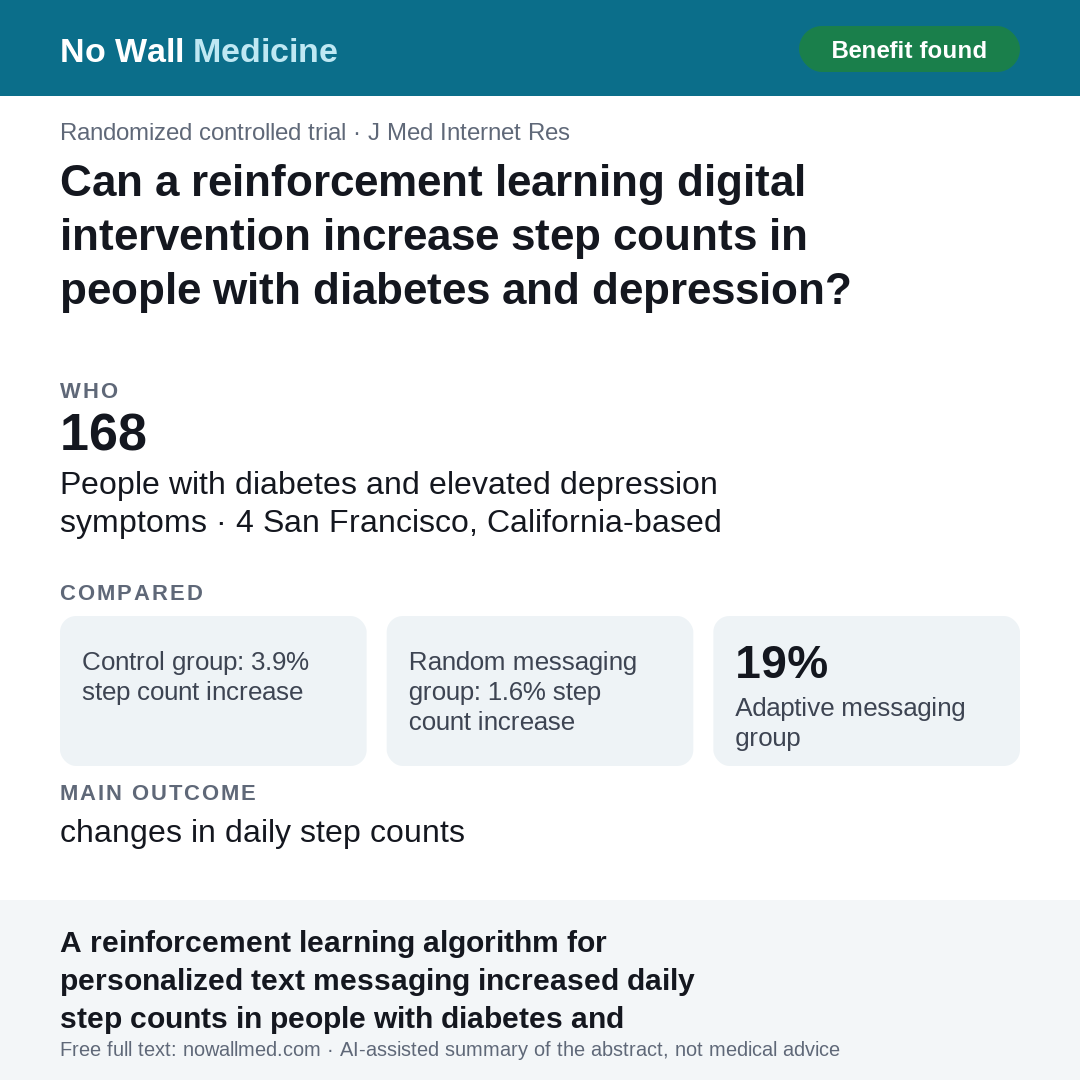
Clinical question: Can a reinforcement learning digital intervention increase step counts in people with diabetes and depression?
Why it matters: It was unknown if digital interventions using reinforcement learning algorithms to personalize text messages could increase physical activity in diverse populations with diabetes and depression.
Key points
- The study analyzed 168 participants with diabetes and depression symptoms who were assigned to control, random messaging, or adaptive messaging groups.
- Participants in the adaptive messaging group, which used an algorithm to select texts, gained an average of 3.6 steps each day over 24 weeks.
- The adaptive messaging group showed a 19% step count increase, compared to 1.6% in the random group and 3.9% in the control group.
Headline and key points written with AI from the paper’s abstract, with every number checked against it. Read the paper before relying on them.
Was this summary helpful?
Subject terms
Cite this article
Aguilera A, Arévalo Avalos M, Xu J, et al. Effectiveness of a Digital Health Intervention Leveraging Reinforcement Learning: Results From the Diabetes and Mental Health Adaptive Notification Tracking and Evaluation (DIAMANTE) Randomized Clinical Trial. J Med Internet Res. 2024. doi:10.2196/60834
Spotted a mistake? Suggest a correction