Effectiveness of a Pharmacist-Led Intervention to Reduce Acid Suppression Therapy for Stress Ulcer Prophylaxis in ICUs in China: A Multicenter, Stepped-Wedge, Cluster-Randomized Controlled Trial
Pragmatic, multicenter, stepped-wedge, cluster-randomized controlled trialBenefit found
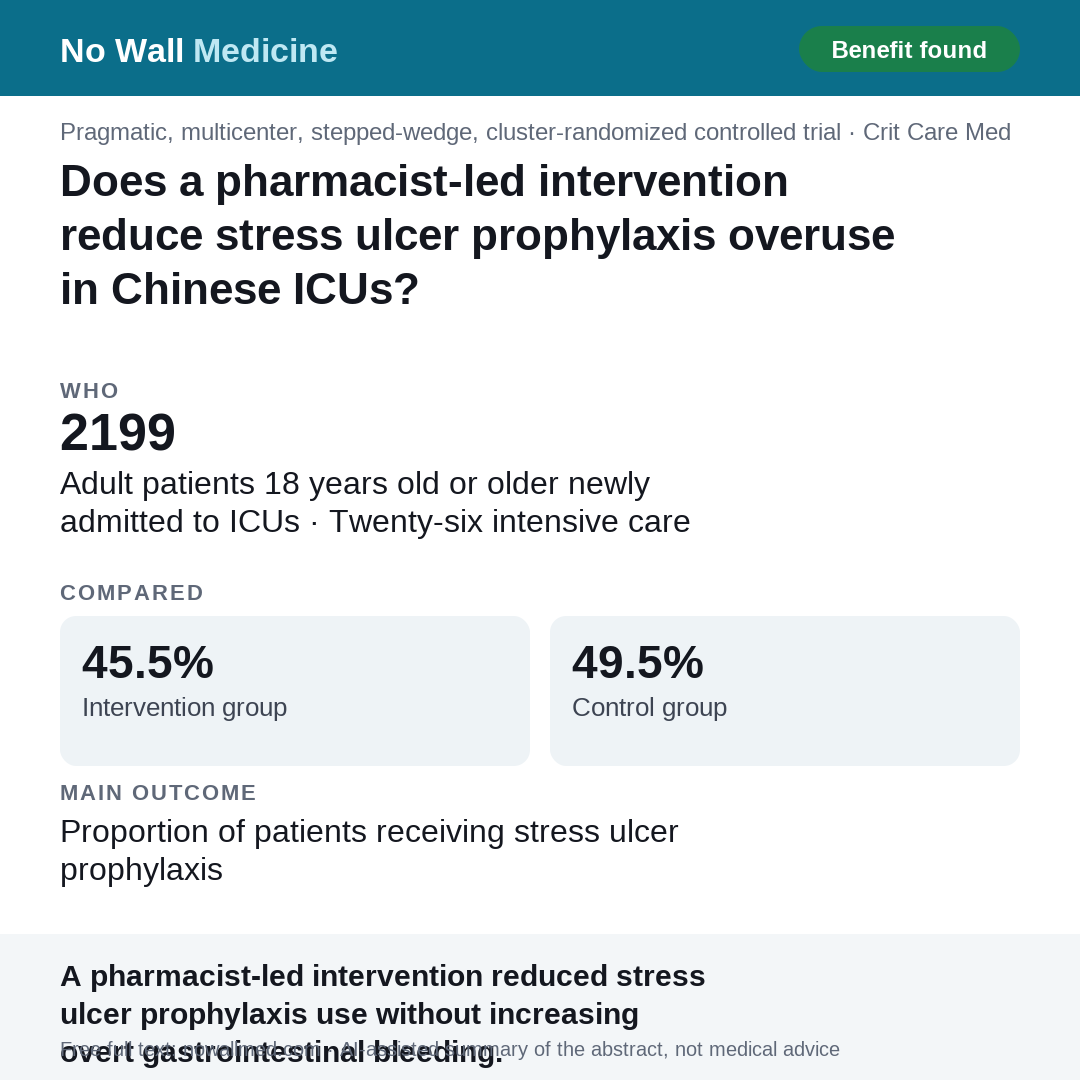
Does a pharmacist-led intervention reduce stress ulcer prophylaxis overuse in Chinese ICUs?
Who
2199
Adult patients 18 years old or older newly admitted to ICUs · Twenty-six intensive care units in China
Compared
45.5%Intervention group
49.5%Control group
Main outcome
Proportion of patients receiving stress ulcer prophylaxis
Result: odds ratio 0.81 (95% CI, 0.68-0.96)
Bottom line: A pharmacist-led intervention reduced stress ulcer prophylaxis use without increasing overt gastrointestinal bleeding.
Crit Care Med · 2025-01-30Download image
Clinical question: Does a pharmacist-led intervention reduce stress ulcer prophylaxis overuse in Chinese ICUs?
In absolute numbers
Intervention group: 45.5% · Control group: 49.5% → a difference of 4 percentage points, so about 25 people would need the treatment for 1 more to benefit (number needed to treat) over the trial’s follow-up.
Worked out by us from the two group results above, not reported by the authors. Check the paper for the exact outcome and timing.
Abstract
Objectives
This study aimed to evaluate the effectiveness of a pharmacist-led intervention in decreasing the overuse of stress ulcer prophylaxis (SUP) compared with the usual care for adult patients in Chinese ICUs. Design
Pragmatic, multicenter, stepped-wedge, cluster-randomized controlled trial. Setting
Twenty-six ICUs in China from October 2022 to March 2023. Patients
We enrolled 2199 patients 18 years old or older who were newly admitted to the participating ICUs. Interventions
Using the Medical Research Council framework for developing and evaluating complex intervention measures, a multidisciplinary team (Scenarios, Improving and Refining Interventions, Constructing, Refining and Testing Research Theories, Incorporating Stakeholders, Identifying Important Uncertainties, and Economics Considerations) designed a multifaceted intervention. Measurements and main results
The primary outcomes were the proportion of patients receiving SUP and that with overt gastrointestinal bleeding. We conducted intention-to-treat analyses using generalized linear mixed models to adjust for potential confounders (age, sex, and acute physiology and chronic health evaluation II score) with random effects for the site. The proportion of patients receiving SUP in the intervention group was lower than that in the control group (45.5% vs. 49.5%; odds ratio [OR], 0.81; 95% CI, 0.68-0.96; p = 0.017). The proportion of patients with overt gastrointestinal bleeding was similar (3.7% vs. 4.0%; OR, 1.05; 95% CI, 0.65-2.85; p = 0.81). Conclusions
The pharmacist-led intervention reduced the proportion of patients receiving SUP in the ICUs, without significantly affecting the proportion of patients with overt gastrointestinal bleeding. These findings will help guide ICU medical decision-making.
Subject terms
Cite this article
Li H, Zeng L, Xu P, Olsen K, Granholm A, Jin X. Effectiveness of a Pharmacist-Led Intervention to Reduce Acid Suppression Therapy for Stress Ulcer Prophylaxis in ICUs in China: A Multicenter, Stepped-Wedge, Cluster-Randomized Controlled Trial. Crit Care Med. 2025. doi:10.1097/CCM.0000000000006589
Spotted a mistake? Suggest a correction
Top studies every Monday
The week’s key trials and guidelines in your specialties, plus any topics you follow. By email, free.
Get the weekly digest