Effectiveness of a Pharmacist-Led Web-Based Medication Adherence Tool With Patient-Centered Communication: Results of a Clustered Randomized Controlled Trial
Cluster randomized controlled trialNo clear difference
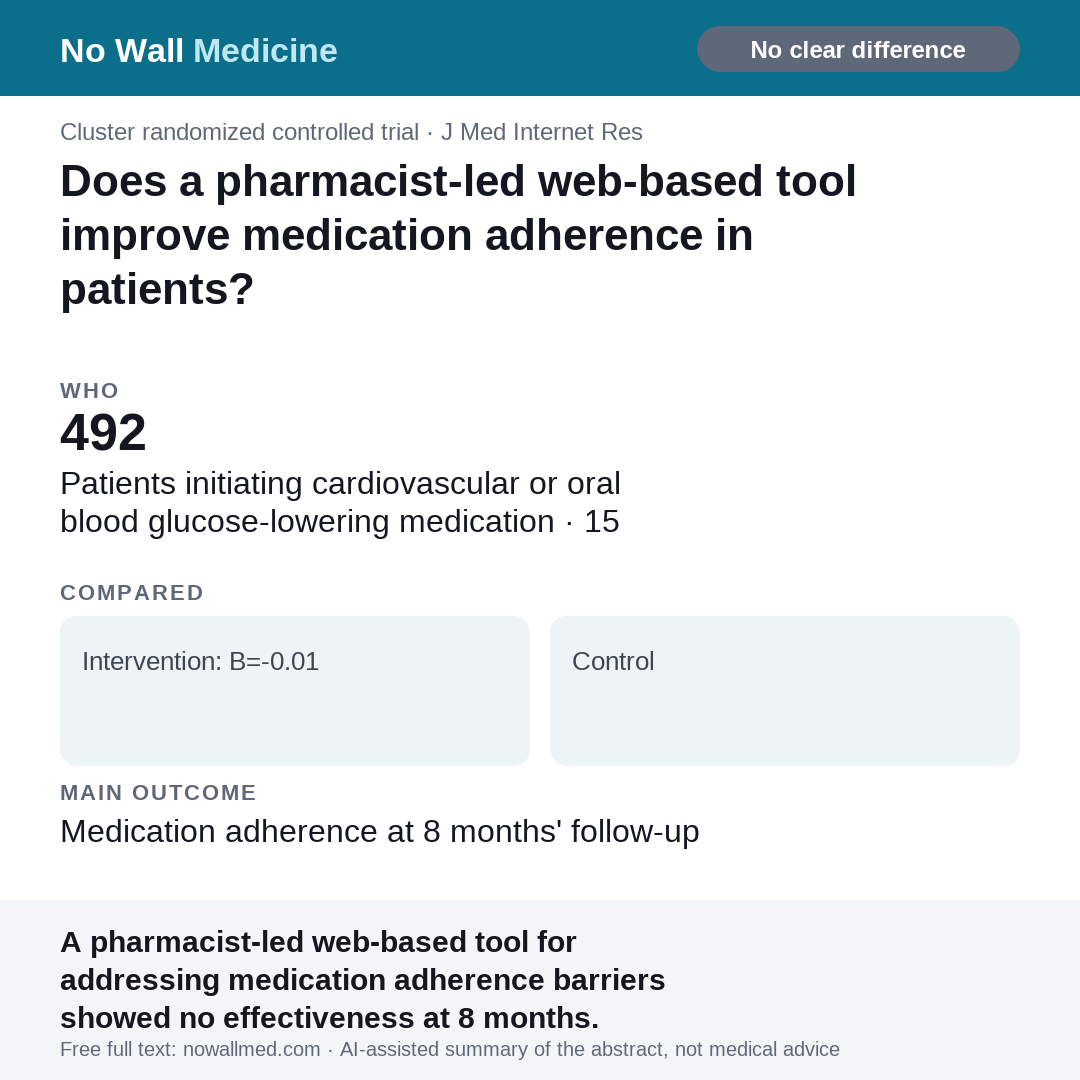
Does a pharmacist-led web-based tool improve medication adherence in patients?
Who
492
Patients initiating cardiovascular or oral blood glucose-lowering medication · 15 community pharmacies
Compared
Intervention: B=-0.01
Control
Main outcome
Medication adherence at 8 months' follow-up
Result: B=-0.01 (95% CI -0.59 to 0.57)
Bottom line: A pharmacist-led web-based tool for addressing medication adherence barriers showed no effectiveness at 8 months.
J Med Internet Res · 2022-04-07Download image
Clinical question: Does a pharmacist-led web-based tool improve medication adherence in patients?
Abstract
Background
Growing numbers of people use medication for chronic conditions; nonadherence is common, leading to poor disease control. A web-based tool to identify an increased risk for nonadherence with related potential individual barriers might facilitate tailored interventions and improve adherence. Objective
This study aims to assess the effectiveness of a newly developed tool aimed at improving medication adherence. Methods
We performed a cluster randomized controlled trial in patients initiating cardiovascular or oral blood glucose-lowering medication. Participants were recruited from community pharmacies. They completed an online questionnaire comprising assessments of their risk for medication nonadherence and subsequently of barriers to adherence. In pharmacies belonging to the intervention group, individual barriers displayed in a graphical profile on a tablet were discussed by pharmacists and patients with high nonadherence risk in face-to-face meetings and shared with their general practitioners and practice nurses. Tailored interventions were initiated by pharmacists. Barriers of control patients were not presented nor discussed and these patients received usual care. The primary outcome was the effectiveness of the intervention on medication adherence at 8 months' follow-up between patients with an increased nonadherence risk from the intervention and control groups, calculated from dispensing data. Results
Data from 492 participants in 15 community pharmacies were available for analyses (intervention 253, 7 pharmacies; control 239, 8 pharmacies). The intervention had no effect on medication adherence (B=-0.01; 95% CI -0.59 to 0.57; P=.96), nor in the post hoc per-protocol analysis (B=0.19; 95% CI -0.50 to 0.89; P=.58). Conclusions
This study showed no effectiveness of a risk stratification and tailored intervention addressing personal barriers for medication adherence. Various potential explanations for lack of effectiveness were identified. These explanations relate, for instance, to high medication adherence in the control group, study power, and fidelity. Process evaluation should elicit possible improvements and inform the redesign of intervention and implementation. Trial registration
The Netherlands National Trial Register NTR5186; https://tinyurl.com/5d8w99hk.
Subject terms
Cite this article
van Lieshout J, Lacroix J, van Halteren A, Teichert M. Effectiveness of a Pharmacist-Led Web-Based Medication Adherence Tool With Patient-Centered Communication: Results of a Clustered Randomized Controlled Trial. J Med Internet Res. 2022. doi:10.2196/16141
Spotted a mistake? Suggest a correction
Top studies every Monday
The week’s key trials and guidelines in your specialties, plus any topics you follow. By email, free.
Get the weekly digest