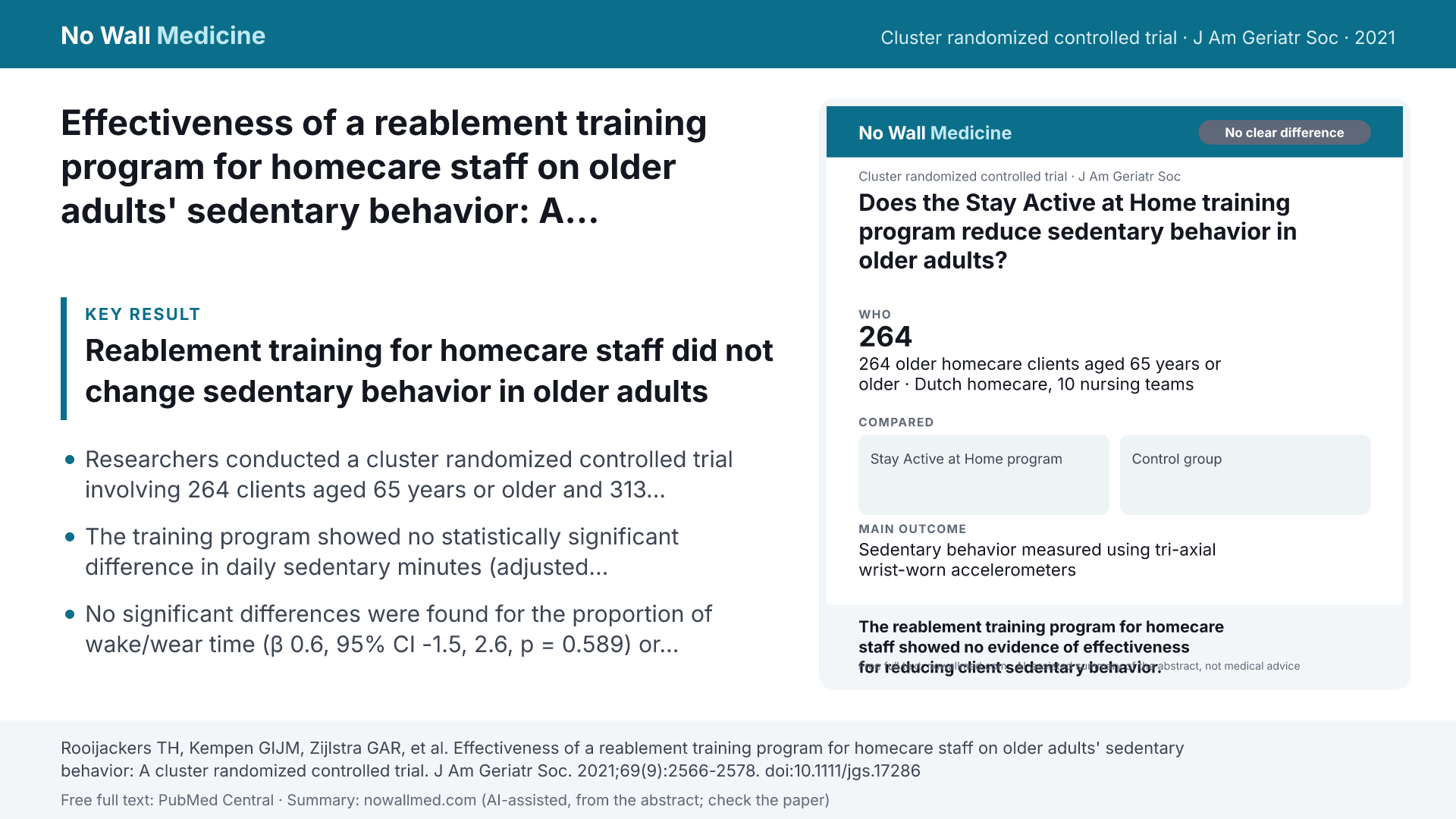
Effectiveness of a reablement training program for homecare staff on older adults' sedentary behavior: A cluster randomized controlled trial
Key result: Reablement training for homecare staff did not change sedentary behavior in older adults
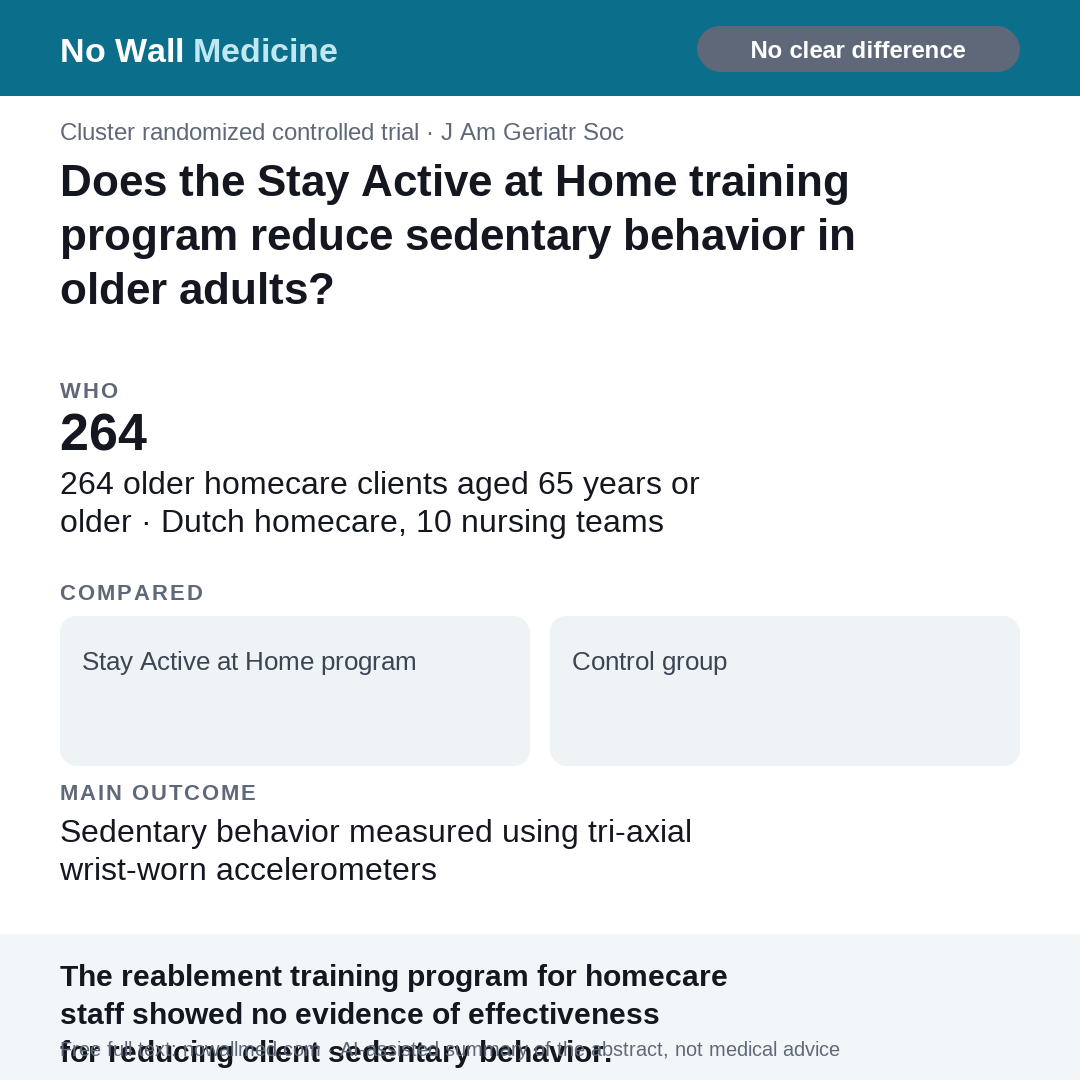
Cluster randomized controlled trialNo clear difference
Does the Stay Active at Home training program reduce sedentary behavior in older adults?
Who
264
264 older homecare clients aged 65 years or older · Dutch homecare, 10 nursing teams
Compared
Stay Active at Home program
Control group
Main outcome
Sedentary behavior measured using tri-axial wrist-worn accelerometers
Result: adjusted mean difference: β 18.5 (95% confidence interval [-22.4, 59.3])
Bottom line: The reablement training program for homecare staff showed no evidence of effectiveness for reducing client sedentary behavior.
J Am Geriatr Soc · 2021-06-07Download image
Key points
- Researchers conducted a cluster randomized controlled trial involving 264 clients aged 65 years or older and 313 homecare staff members.
- The training program showed no statistically significant difference in daily sedentary minutes (adjusted mean difference: β 18.5, 95% CI -22.4, 59.3, p = 0.374).
- No significant differences were found for the proportion of wake/wear time (β 0.6, 95% CI -1.5, 2.6, p = 0.589) or most secondary outcomes.
Discussion prompts
- Would these patients look like yours? Who was left out?
- Is the main outcome one that matters to patients?
- Is the difference large enough to change what you do?
Cite: Rooijackers TH, Kempen GIJM, Zijlstra GAR, et al. Effectiveness of a reablement training program for homecare staff on older adults' sedentary behavior: A cluster randomized controlled trial. J Am Geriatr Soc. 2021. doi:10.1111/jgs.17286
Free full text: PubMed Central · Summary and visual abstract: nowallmed.com/a/effectiveness-of-a-reablement-training-program-for-homecare-staff-on-1hvu0c7/ (AI-assisted from the abstract; check the paper before relying on it).