Interactive safety education in rural China was associated with fewer unintentional injuries in preschoolers
Effectiveness of a standardised and interactive intervention to prevent preschooler unintentional injury in rural China: a cluster randomised controlled trial
Single-blinded cluster randomised controlled trialBenefit found
Does a standardised interactive intervention prevent unintentional injury in rural Chinese preschoolers?
Who
2518
2518 preschoolers aged 3-6 years old in rural China · 12 preschools in rural China
Compared
Control group
Intervention group: aOR=0.78
Main outcome
unintentional injury incidence rate
Result: aOR=0.78 (95% CI: 0.64 to 0.94)
Bottom line: The interactive intervention decreased unintentional injury incidence and increased safety knowledge among rural Chinese preschoolers.
BMJ Glob Health · 2025-07-07Download image
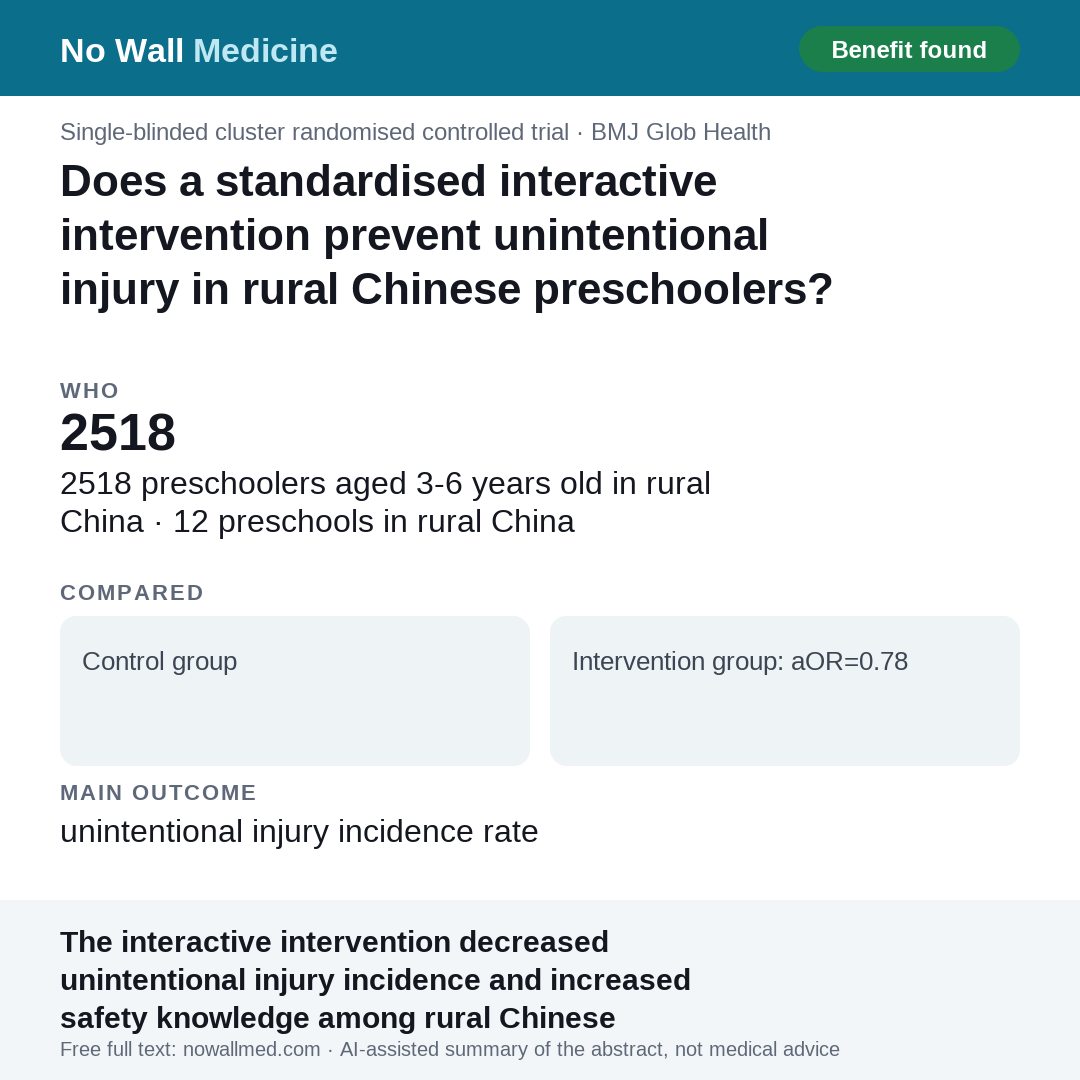
Clinical question: Does a standardised interactive intervention prevent unintentional injury in rural Chinese preschoolers?
Why it matters: Previous interactive education programs for preventing child injuries have been difficult to implement effectively in rural areas.
Key points
- Researchers conducted a 9-month cluster randomized controlled trial involving 2518 preschoolers aged 3-6 years across 12 rural Chinese preschools.
- The intervention group using a Safety Experience Room had a lower unintentional injury incidence rate with an adjusted odds ratio of 0.78 (95% CI: 0.64 to 0.94).
- The intervention group also showed higher proportions of correct answers to 18 injury prevention questions, with adjusted odds ratios ranging from 1.78 to 22.10.
Headline and key points written with AI from the paper’s abstract, with every number checked against it. Read the paper before relying on them.
Abstract
Introduction
Previous interactive education interventions for child injury prevention are suboptimal for implementation in rural areas. This study evaluated the effectiveness of a standardised school-based interactive education intervention to prevent unintentional injury for rural preschoolers. Methods
A 9-month single-blinded cluster randomised controlled trial was conducted in rural China, involving 12 preschools with 2518 preschoolers aged 3-6 years old. The control group received routine education, and the intervention group added the standardised Safety Experience Room intervention. The primary outcome was unintentional injury incidence rate among preschoolers during the 9-month period. The secondary outcome was the proportion of preschoolers correctly answering questions about the prevention knowledge of road traffic injury, falls and drowning. Principal data analyses were conducted using an intention-to-treat approach. Adjusted ORs (aORs) with 95% CIs were calculated based on generalised linear mixed models and bootstrapped SEs with 1000 replications. Sensitivity analyses were employed based on the full analysis set to assess the impact of missing values on principal findings. Results
Compared with the control group, the intervention group had a significantly lower unintentional injury incidence rate (aOR=0.78, 95% CI: 0.64 to 0.94) and higher proportions of correct answers to the 18 injury prevention questions (with aORs ranging from 1.78 to 22.10) after adjusting for socio-demographic factors and baseline values of the outcome variables. Sensitivity analyses supported the principal findings. Conclusion
The 9-month interactive intervention decreased unintentional injury incidence and substantially increased preschooler's safety knowledge in rural China, offering an effective option for implementing or integrating in multifactorial interventions in resource-limited areas. Trial registration number
Chinese Clinical Trial Registry, CHiCTR2000038025.
Abstract reproduced under the article’s CC BY NC licence.
Topics
Cite this article
He J, Wang W, Schwebel DC, Li J, Zhao M, Li W. Effectiveness of a standardised and interactive intervention to prevent preschooler unintentional injury in rural China: a cluster randomised controlled trial. BMJ Glob Health. 2025. doi:10.1136/bmjgh-2025-019050
Spotted a mistake? Suggest a correction