Template improved reporting completeness in randomised trial protocols by 0.61 points
Effectiveness of a structured template to improve completeness of reporting randomised trial protocols: randomised controlled trial
Randomised controlled trialBenefit found
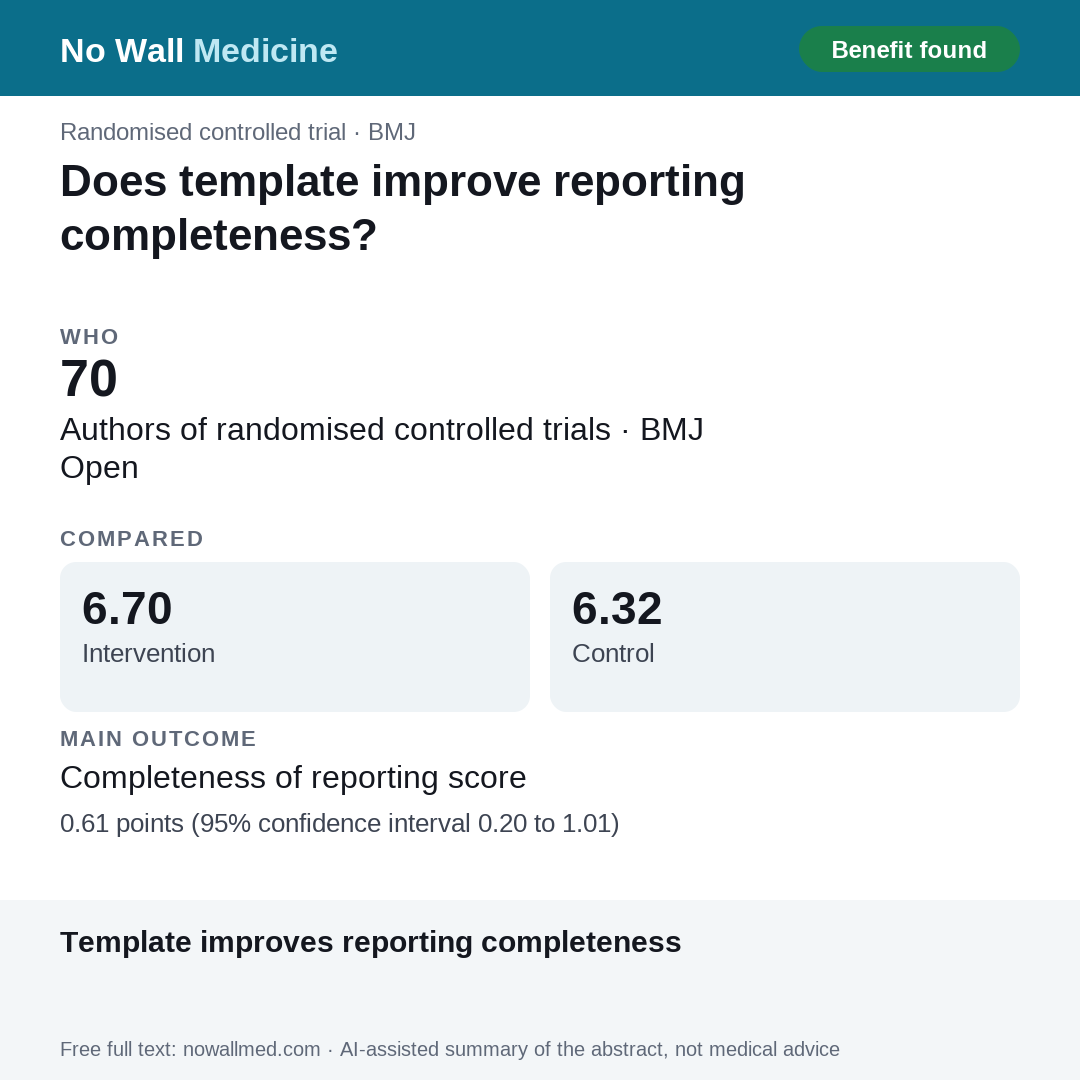
Does template improve reporting completeness?
Who
70
Authors of randomised controlled trials · BMJ Open
Compared
6.70Intervention (1.23)
6.32Control (0.94)
Main outcome
Completeness of reporting score
Result: 0.61 points (95% confidence interval 0.20 to 1.01)
Bottom line: Template improves reporting completeness
Limitation: Data on harms not collected
BMJ · 2026-10-20Download image
Clinical question: Does template improve reporting completeness?
Key points
- 70 manuscripts were randomly allocated to intervention or control groups for comparison.
- Completeness of reporting scores improved from 5.42 to 6.70 in the intervention group.
- Most authors found the template easy to use and helpful, despite some reporting it as time consuming.
Headline and key points written with AI from the paper’s abstract, with every number checked against it. Read the paper before relying on them.
Abstract
Objective
To evaluate whether providing authors with a manuscript template structured according to the Standard Protocol Items: Recommendations for Interventional Trials (SPIRIT) 2025 reporting guideline for use during revision improves the completeness of reporting in randomised trial protocols. Design
Randomised controlled trial. Setting
BMJ Open. Population
70 of 74 manuscripts screened between 29 April and 27 May 2025 that reported randomised controlled trial protocols with a decision of minor or major revision after the first round of peer review were randomly allocated (1:1) using an R generated sequence. Authors were not informed of the study. Interventions
Handling editors asked the intervention group authors to use a SPIRIT based manuscript template when preparing their first revision. The template included structured subheadings corresponding to SPIRIT 2025 items, along with guidance on reporting. Editorial decisions were not conditional on use of the template. Control group manuscripts underwent standard peer review. Main outcome measures
The primary outcome was completeness of reporting score in the revised manuscript (adjusted for baseline), calculated as the mean of 11 SPIRIT items that are frequently inadequately reported (each scored 0, 0.5, or 1) and linearly rescaled to a 0-10 score. After submission of their first revision, authors in the intervention group completed an online survey. The survey included both fixed response and open ended questions designed to capture the authors' perceptions of ease of use, helpfulness, and any challenges encountered when using the template. Secondary outcomes included mean completeness of reporting scores for each item, median time to submission of the revised manuscript, and authors' experiences of using the template. Outcome assessors, but not editors or investigators, were masked. Results
Of the 70 manuscripts randomised (35 in each group), all were analysed, with no loss to follow-up. In the intervention group, completeness of reporting in randomised trial protocols improved by 0.61 points (95% confidence interval 0.20 to 1.01) compared with the control group, with mean (standard deviation) scores increasing from 5.42 (1.07) to 6.70 (1.23) and 5.77 (1.19) to 6.32 (0.94), respectively. The largest improvements were observed for recruitment, data collection methods, and access to data. Median time to submission of the first revision was similar between the intervention and control groups (27.10 v 29.86 days, respectively). Data on harms were not systematically collected. Among 14 of 35 survey respondents (40%), many (8/13, 62%) reported the template as time consuming and some (5/13, 39%) as burdensome. Most respondents, however, found it easy to use (10/13, 77%), helpful for improving the manuscript (9/13, 69%), and reassuring for adherence to SPIRIT (13/13, 100%). Conclusions
Providing authors of randomised controlled trials with a SPIRIT based template during manuscript revision modestly improved the completeness of reporting in the trial protocols without extending revision times. Trial registration
Open Science Framework 10.17605/OSF.IO/C4YQZ.
Abstract reproduced under the article’s CC BY NC licence.
Topics
Cite this article
Blanco D, Chen D, Cadellans-Arróniz A, Donadio MVF, Edouard P, Iatropoulos S. Effectiveness of a structured template to improve completeness of reporting randomised trial protocols: randomised controlled trial. BMJ. 2026. doi:10.1136/bmj-2026-100917
Spotted a mistake? Suggest a correction