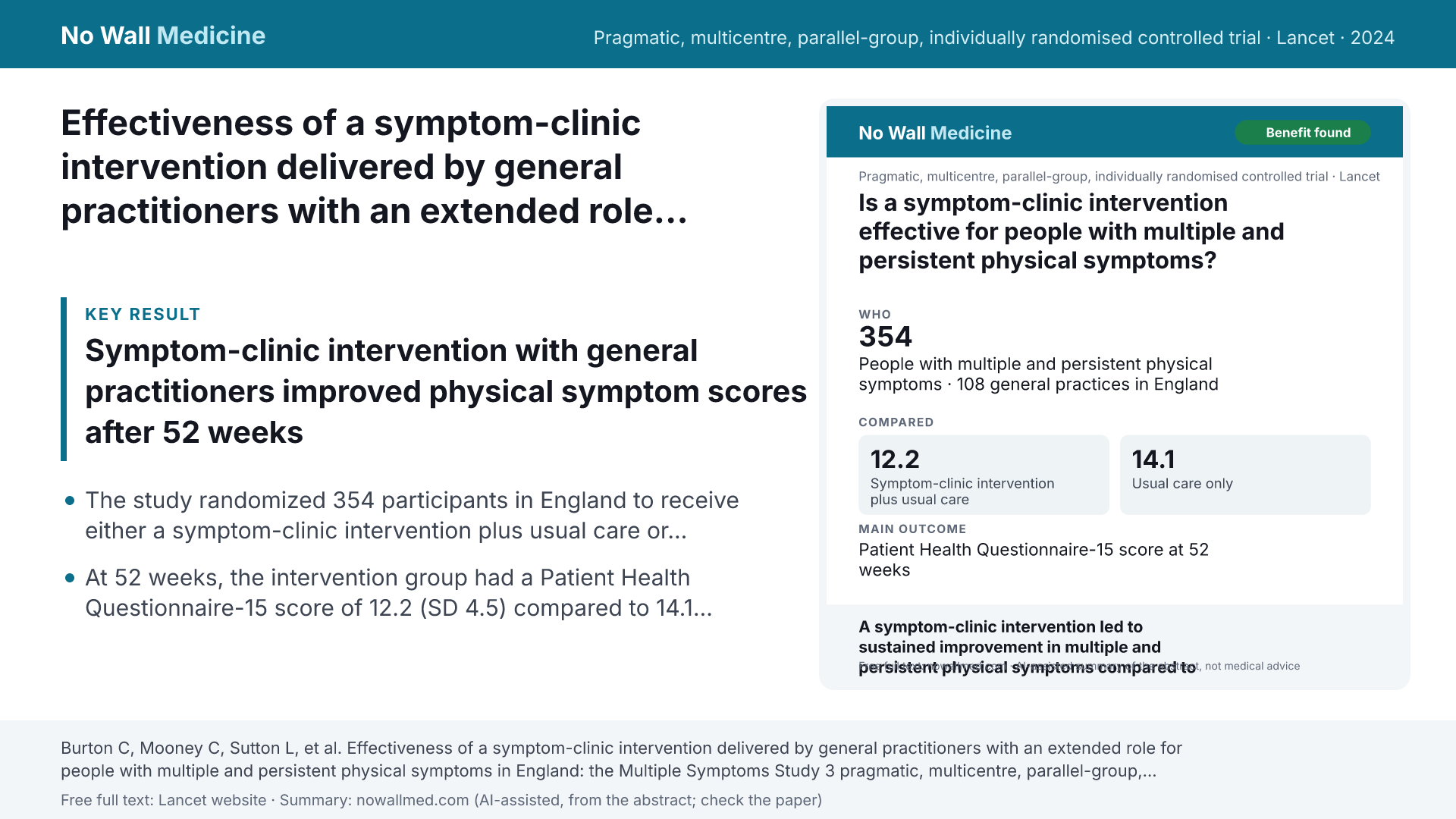
Symptom-clinic intervention with general practitioners improved physical symptom scores after 52 weeks
Effectiveness of a symptom-clinic intervention delivered by general practitioners with an extended role for people with multiple and persistent physical symptoms in England: the Multiple Symptoms Study 3 pragmatic, multicentre, parallel-group, individually randomised controlled trial
Pragmatic, multicentre, parallel-group, individually randomised controlled trialBenefit found
Is a symptom-clinic intervention effective for people with multiple and persistent physical symptoms?
Who
354
People with multiple and persistent physical symptoms · 108 general practices in England
Compared
12.2Symptom-clinic intervention plus usual care (4.5)
14.1Usual care only (3.7)
Main outcome
Patient Health Questionnaire-15 score at 52 weeks
Result: -1.82 (95% CI -2.67 to -0.97)
Bottom line: A symptom-clinic intervention led to sustained improvement in multiple and persistent physical symptoms compared to usual care.
Funded by: UK National Institute for Health and Care Research
Lancet · 2024-06-16Download image
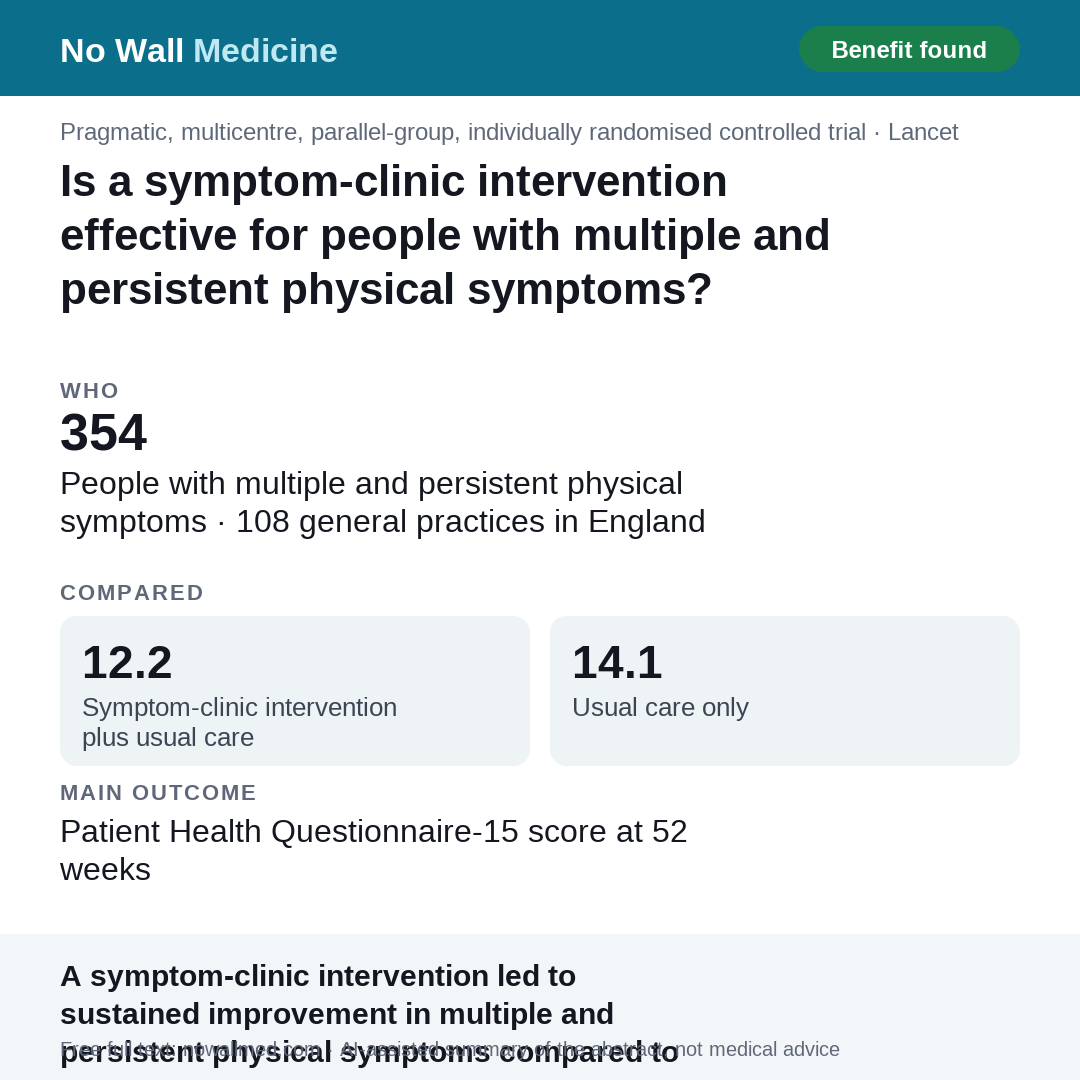
Clinical question: Is a symptom-clinic intervention effective for people with multiple and persistent physical symptoms?
Why it matters: People with multiple and persistent physical symptoms often experience impaired quality of life and poor experiences with healthcare services.
Key points
- The study randomized 354 participants in England to receive either a symptom-clinic intervention plus usual care or usual care only.
- At 52 weeks, the intervention group had a Patient Health Questionnaire-15 score of 12.2 (SD 4.5) compared to 14.1 (SD 3.7) in the usual care group.
- The adjusted difference between groups was -1.82 (95% CI -2.67 to -0.97), and there were no statistically significant differences in serious adverse events.
Headline and key points written with AI from the paper’s abstract, with every number checked against it. Read the paper before relying on them.
Was this summary helpful?
Abstract
Background
People with multiple and persistent physical symptoms have impaired quality of life and poor experiences of health care. We aimed to evaluate the effectiveness of a community-based symptom-clinic intervention in people with multiple and persistent physical symptoms, hypothesising that this symptoms clinic plus usual care would be superior to usual care only. Methods
The Multiple Symptoms Study 3 was a pragmatic, multicentre, parallel-group, individually randomised controlled trial conducted in 108 general practices in the UK National Health Service in four regions of England between Dec 6, 2018, and June 30, 2023. Participants were individually randomised (1:1) to the symptom-clinic intervention plus usual care or to usual care only via a computer-generated, pseudo-random list stratified by trial centre. Allocation was done by the trial statistician and concealed with a centralised, web-based randomisation system; masking participants was not possible due to the nature of the intervention. The symptom-clinic intervention was a sequence of up to four medical consultations that aimed to elicit a detailed clinical history, fully hear and validate the participant, offer rational explanations for symptoms, and assist the participant to develop ways of managing their symptoms; it was delivered by general practitioners with an extended role. The primary outcome was Patient Health Questionnaire-15 (PHQ-15) score 52 weeks after randomisation, analysed by intention to treat. The trial is registered on the ISRCTN registry (ISRCTN57050216). Findings
354 participants were randomly assigned; 178 (50%) were assigned to receive the community-based symptoms clinic plus usual care and 176 (50%) were assigned to receive usual care only. At the primary-outcome point of 52 weeks, PHQ-15 scores were 14·1 (SD 3·7) in the group receiving usual care and 12·2 (4·5) in the group receiving the intervention. The adjusted between-group difference of -1·82 (95% CI -2·67 to -0·97) was statistically significantly in favour of the intervention group (p<0·0001). There were 39 adverse events in the group receiving usual care and 36 adverse events in the group receiving the intervention. There were no statistically significant between-group differences in the proportion of participants who had non-serious adverse events (-0·03, 95% CI -0·11 to 0·05) or serious adverse events (0·02, -0·02 to 0·07). No serious adverse event was deemed to be related to the trial intervention. Interpretation
Our symptom-clinic intervention, which focused on explaining persistent symptoms to participants in order to support self-management, led to sustained improvement in multiple and persistent physical symptoms. Funding
UK National Institute for Health and Care Research.
Abstract reproduced under the article’s CC BY licence.
Subject terms
Cite this article
Burton C, Mooney C, Sutton L, et al. Effectiveness of a symptom-clinic intervention delivered by general practitioners with an extended role for people with multiple and persistent physical symptoms in England: the Multiple Symptoms Study 3 pragmatic, multicentre, parallel-group, individually randomised controlled trial. Lancet. 2024. doi:10.1016/S0140-6736(24)00700-1
Spotted a mistake? Suggest a correction