Online school programme shows no significant long-term differences in mental health or substance use
Effectiveness of a universal, school-based, online programme for the prevention of anxiety, depression, and substance misuse among adolescents in Australia: 72-month outcomes from a cluster-randomised controlled trial
Cluster-randomised controlled trialMixed results
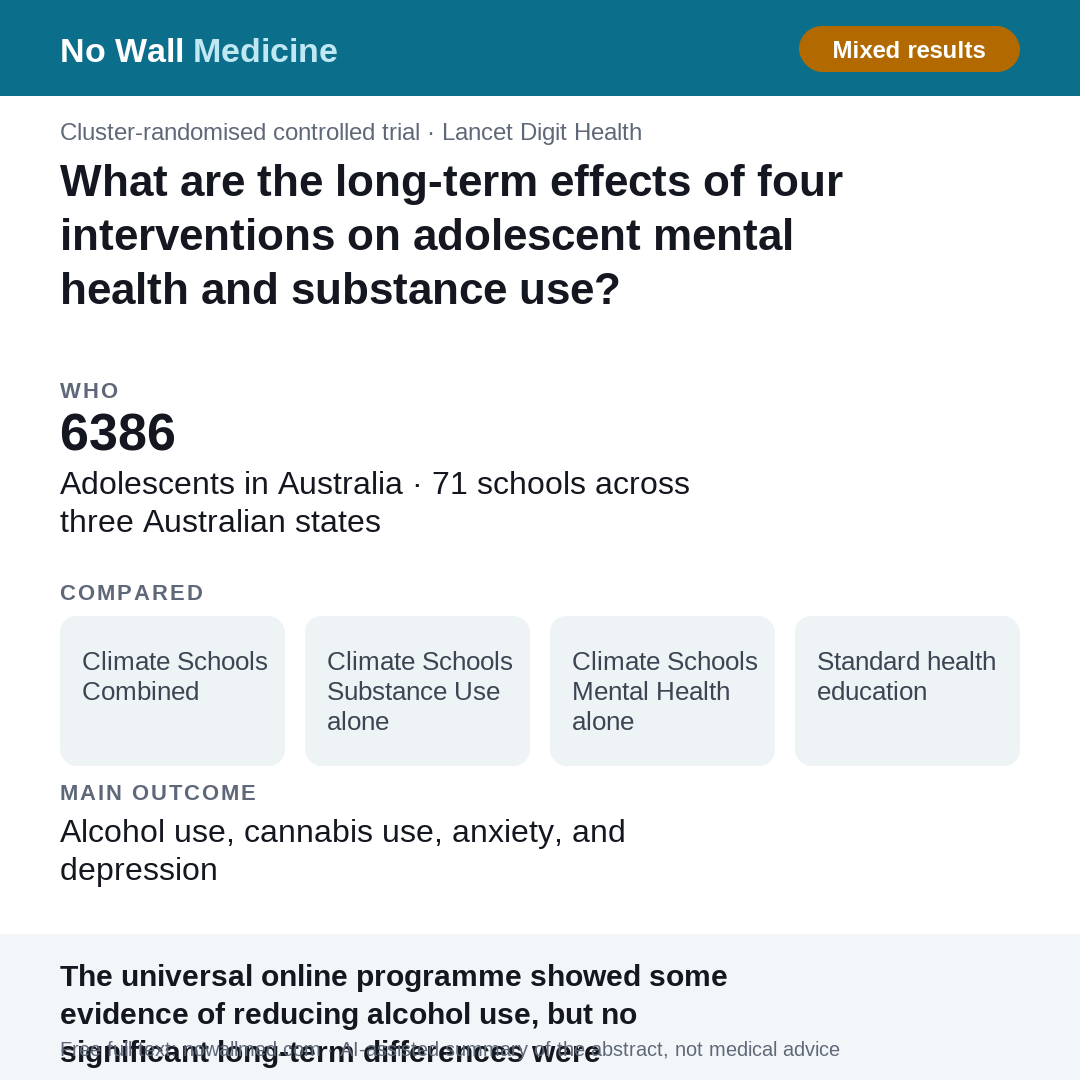
What are the long-term effects of four interventions on adolescent mental health and substance use?
Who
6386
Adolescents in Australia · 71 schools across three Australian states
Compared
Climate Schools Combined
Climate Schools Substance Use alone
Climate Schools Mental Health alone
Standard health education
Main outcome
Alcohol use, cannabis use, anxiety, and depression
Bottom line: The universal online programme showed some evidence of reducing alcohol use, but no significant long-term differences were observed for other outcomes.
Limitation: Significant baseline differences between groups and substantial attrition warrant caution in interpretation.
Funded by: Australian National Health and Medical Research Council
Lancet Digit Health · 2024-04-27Download image
Clinical question: What are the long-term effects of four interventions on adolescent mental health and substance use?
Why it matters: It was unknown if a universal online school programme delivered in early adolescence provides lasting effects on mental health and substance use into early adulthood.
Key points
- The study followed 6386 students across 71 schools assigned to standard education, substance use prevention, mental health prevention, or a combined online programme.
- At 72-month follow-up, no significant long-term differences were observed for alcohol use disorder, cannabis use, cannabis use disorder, anxiety, or depression.
- While the combined programme group reported slower year-by-year increases in weekly alcohol use and heavy episodic drinking, no difference in predicted probability of drinking was observed at 72 months.
Limitation the authors note: The authors noted that significant baseline differences between groups and substantial attrition, or loss of participants over time, warrant caution in interpretation.
Headline and key points written with AI from the paper’s abstract, with every number checked against it. Read the paper before relying on them.
Abstract
Background
The CSC study found that the universal delivery of a school-based, online programme for the prevention of mental health and substance use disorders among adolescents resulted in improvements in mental health and substance use outcomes at 30-month follow-up. We aimed to compare the long-term effects of four interventions-Climate Schools Combined (CSC) mental health and substance use, Climate Schools Substance Use (CSSU) alone, Climate Schools Mental Health (CSMH) alone, and standard health education-on mental health and substance use outcomes among adolescents at 72-month follow-up into early adulthood. Methods
This long-term study followed up adolescents from a multicentre, cluster-randomised trial conducted across three states in Australia (New South Wales, Queensland, and Western Australia) enrolled between Sept 1, 2013, and Feb 28, 2014, for up to 72 months after baseline assessment. Adolescents (aged 18-20 years) from the original CSC study who accepted contact at 30-month follow-up and provided informed consent at 60-month follow-up were eligible. The interventions were delivered in school classrooms through an online delivery format and used a mixture of peer cartoon storyboards and classroom activities that were focused on alcohol, cannabis, anxiety, and depression. Participants took part in two web-based assessments at 60-month and 72-month follow-up. Primary outcomes were alcohol use, cannabis use, anxiety, and depression, measured by self-reported surveys and analysed by intention to treat (ie, in all students who were eligible at baseline). This trial is registered with the Australian New Zealand Clinical Trials Registry (ACTRN12613000723785), including the extended follow-up study. Findings
Of 6386 students enrolled from 71 schools, 1556 (24·4%) were randomly assigned to education as usual, 1739 (27·2%) to CSSU, 1594 (25·0%) to CSMH, and 1497 (23·4%) to CSC. 311 (22·2%) of 1401 participants in the control group, 394 (26·4%) of 1495 in the CSSU group, 477 (37·%) of 1289 in the CSMH group, and 400 (32·5%) of 1232 in the CSC group completed follow-up at 72 months. Adolescents in the CSC group reported slower year-by-year increases in weekly alcohol use (odds ratio 0·78 [95% CI 0·66-0·92]; p=0·0028) and heavy episodic drinking (0·69 [0·58-0·81]; p<0·0001) than did the control group. However, significant baseline differences between groups for drinking outcomes, and no difference in the predicted probability of weekly or heavy episodic drinking between groups were observed at 72 months. Sensitivity analyses increased uncertainty around estimates. No significant long-term differences were observed in relation to alcohol use disorder, cannabis use, cannabis use disorder, anxiety, or depression. No adverse events were reported during the trial. Interpretation
We found some evidence that a universal online programme for the prevention of anxiety, depression, and substance use delivered in early adolescence is effective in reducing the use and harmful use of alcohol into early adulthood. However, confidence in these findings is reduced due to baseline differences, and we did not see a difference in the predicted probability of drinking between groups at 72-month follow-up. These findings suggest that a universal prevention programme in adolescence is not sufficient to have lasting effects on mental health and substance use disorders in the long term. In addition to baseline differences, substantial attrition warrants caution in interpretation and the latter factor highlights the need for future long-term follow-up studies to invest in strategies to increase engagement. Funding
Australian National Health and Medical Research Council.
Abstract reproduced under the article’s CC BY licence.
Topics
Cite this article
Teesson M, Birrell L, Slade T, Mewton LR, Olsen N, Hides L. Effectiveness of a universal, school-based, online programme for the prevention of anxiety, depression, and substance misuse among adolescents in Australia: 72-month outcomes from a cluster-randomised controlled trial. Lancet Digit Health. 2024. doi:10.1016/S2589-7500(24)00046-3
Spotted a mistake? Suggest a correction
Top studies every Monday
The week’s key trials and guidelines in your specialties, plus any topics you follow. By email, free.
Get the weekly digest