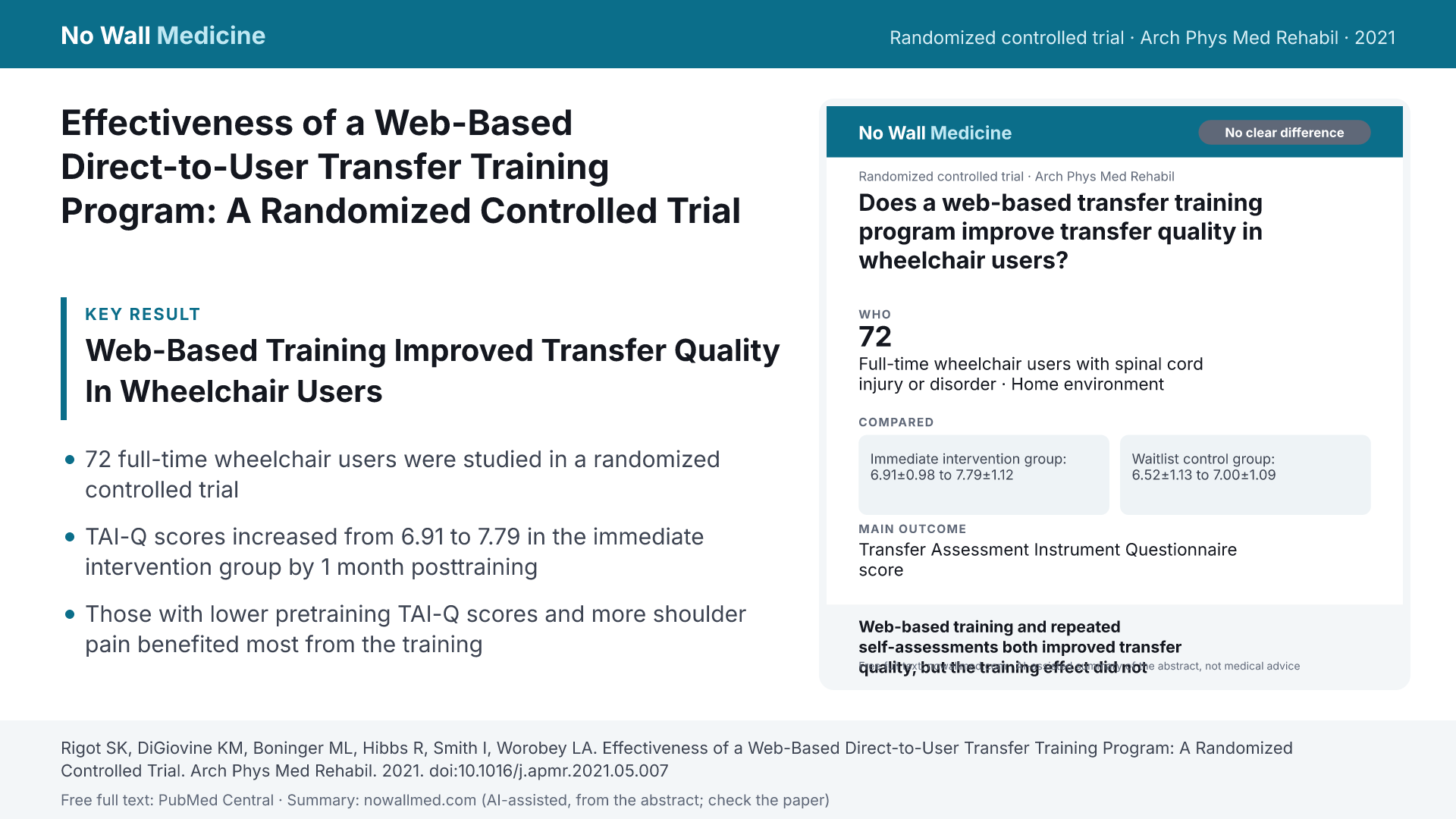
Effectiveness of a Web-Based Direct-to-User Transfer Training Program: A Randomized Controlled Trial
Key result: Web-Based Training Improved Transfer Quality In Wheelchair Users
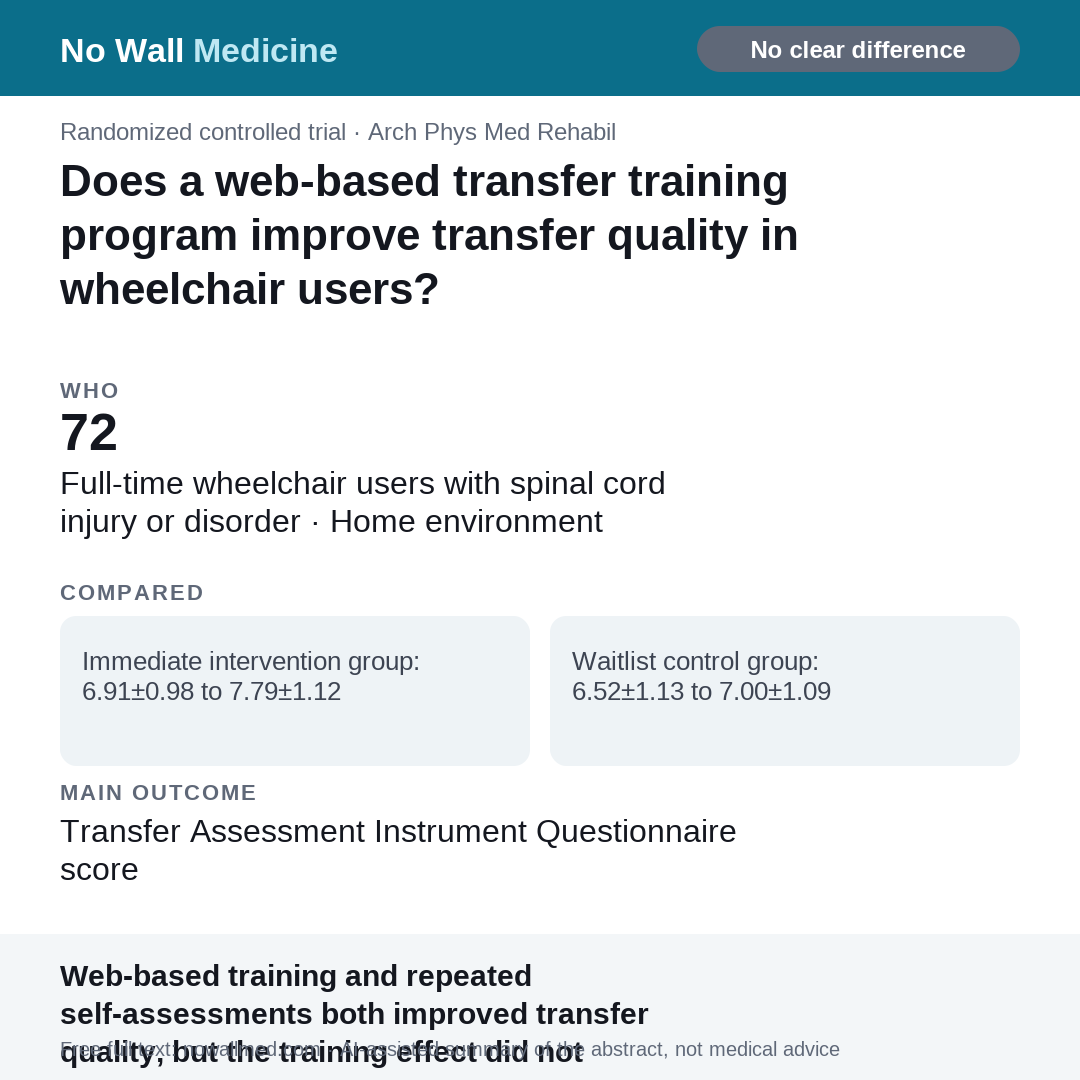
Randomized controlled trialNo clear difference
Does a web-based transfer training program improve transfer quality in wheelchair users?
Who
72
Full-time wheelchair users with spinal cord injury or disorder · Home environment
Compared
Immediate intervention group: 6.91±0.98 to 7.79±1.12
Waitlist control group: 6.52±1.13 to 7.00±1.09
Main outcome
Transfer Assessment Instrument Questionnaire score
Bottom line: Web-based training and repeated self-assessments both improved transfer quality, but the training effect did not significantly exceed the control.
Limitation: Potential learning effects secondary to self-assessment with the Transfer Assessment Instrument Questionnaire
Arch Phys Med Rehabil · 2021-06-04Download image
Key points
- 72 full-time wheelchair users were studied in a randomized controlled trial.
- TAI-Q scores increased from 6.91 to 7.79 in the immediate intervention group by 1 month posttraining.
- Those with lower pretraining TAI-Q scores and more shoulder pain benefited most from the training.
Why it matters: It was unknown whether web-based transfer training could improve transfer quality in wheelchair users
Discussion prompts
- Would these patients look like yours? Who was left out?
- Is the main outcome one that matters to patients?
- Is the difference large enough to change what you do?
Cite: Rigot SK, DiGiovine KM, Boninger ML, Hibbs R, Smith I, Worobey LA. Effectiveness of a Web-Based Direct-to-User Transfer Training Program: A Randomized Controlled Trial. Arch Phys Med Rehabil. 2021. doi:10.1016/j.apmr.2021.05.007
Free full text: PubMed Central · Summary and visual abstract: nowallmed.com/a/effectiveness-of-a-web-based-direct-to-user-transfer-training-program-mfenwa/ (AI-assisted from the abstract; check the paper before relying on it).