Web-based education improved women's health literacy regarding exposure to phthalate chemicals over six months
Effectiveness of a Web-Based Educational eHealth Platform on Women's Health Literacy About Phthalate Exposure: Randomized Controlled Trial
Double-blind randomized controlled trialBenefit found
Does an eHealth platform improve women's phthalate-related health literacy?
Who
114
Women in an outpatient department · Regional teaching hospital in Taipei, Taiwan
Compared
eHealth platform-based education program: +9.93 points
Conventional paper-based education
Main outcome
Total phthalate-related health literacy
Result: adjusted mean difference 7.15, 95% CI 2.96-11.34
Bottom line: An eHealth educational intervention significantly improved women's overall and domain-specific phthalate-related health literacy over 6 months.
J Med Internet Res · 2026-09-01Download image
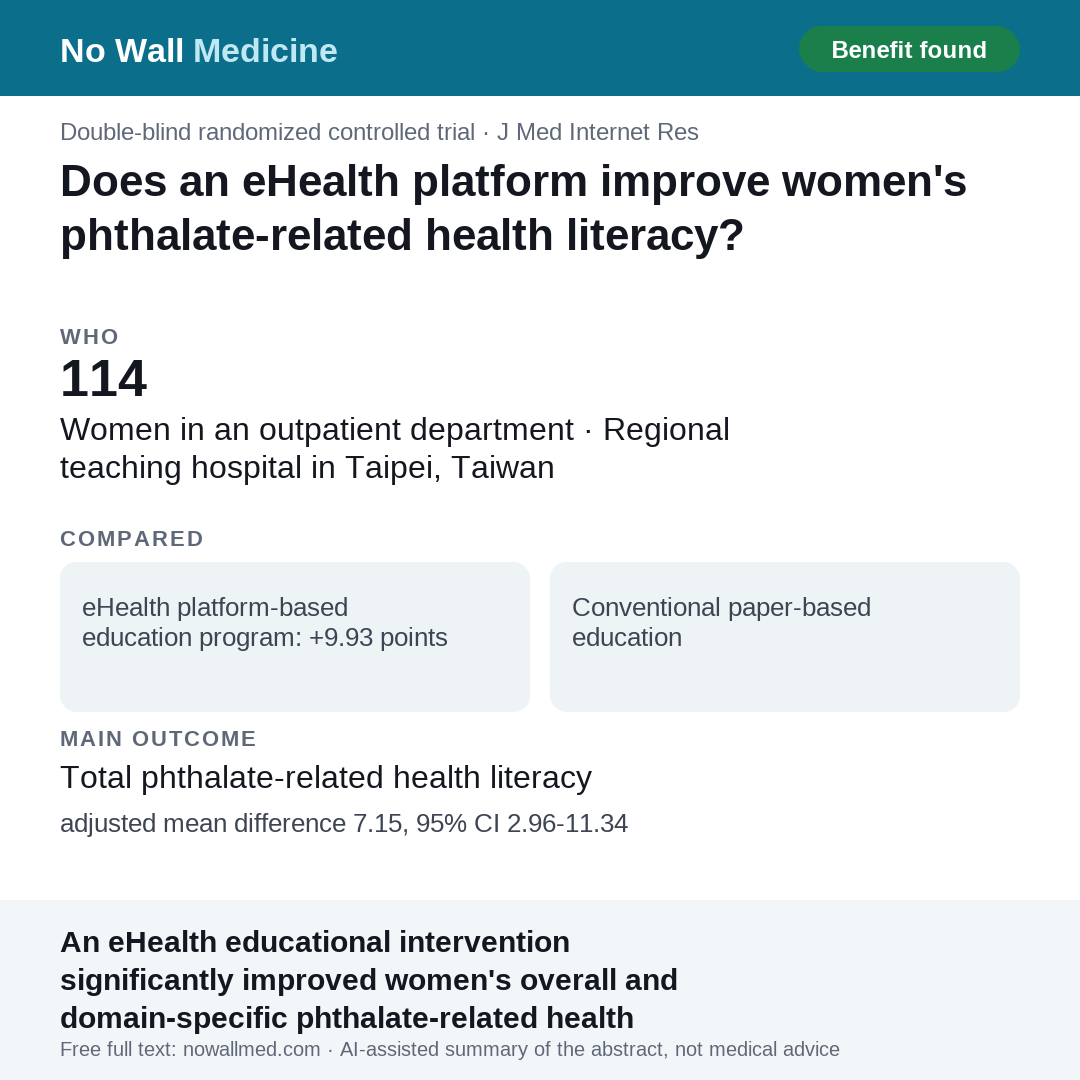
Clinical question: Does an eHealth platform improve women's phthalate-related health literacy?
Why it matters: Conventional health education provides limited opportunities for repeated, interactive, and individually tailored learning regarding exposure to phthalates, which are environmental chemicals that disrupt hormones.
Key points
- Researchers studied 114 women in Taiwan, comparing a 6-month web-based education platform to conventional paper-based education.
- The web-based group showed a significantly greater increase in total health literacy than the control group by 7.15 points after adjusting for baseline scores.
- High engagement with the digital platform was associated with significantly higher scores in overall health literacy and all specific domains.
Headline and key points written with AI from the paper’s abstract, with every number checked against it. Read the paper before relying on them.
Topics
Cite this article
Shih YL, Wu SC, Li PS, Hsieh CJ, Liu CY. Effectiveness of a Web-Based Educational eHealth Platform on Women's Health Literacy About Phthalate Exposure: Randomized Controlled Trial. J Med Internet Res. 2026. doi:10.2196/87063
Spotted a mistake? Suggest a correction