Conversational agents show small to moderate effects in reducing depression, anxiety, and stress symptoms
Effectiveness of AI and rule-based conversational agents for depression, anxiety and stress: A meta-analysis
Systematic review and meta-analysis of 48 randomized controlled trialsBenefit found
Are artificial intelligence and rule-based conversational agents effective for depression, anxiety, and stress?
Who
28,071
Participants with depression, anxiety, and stress
Compared
Conversational agent interventions
Control
Main outcome
Symptoms of depression, anxiety, and stress
Result: SMD: -0.27 for depression, -0.20 for anxiety, and -0.26 for stress
Bottom line: Conversational agents provide small-to-moderate significant effects in minimizing symptoms of depression, anxiety, and stress.
Limitation: Some studies had issues due to missing data or selective reporting.
NPJ Digit Med · 2026-05-29Download image
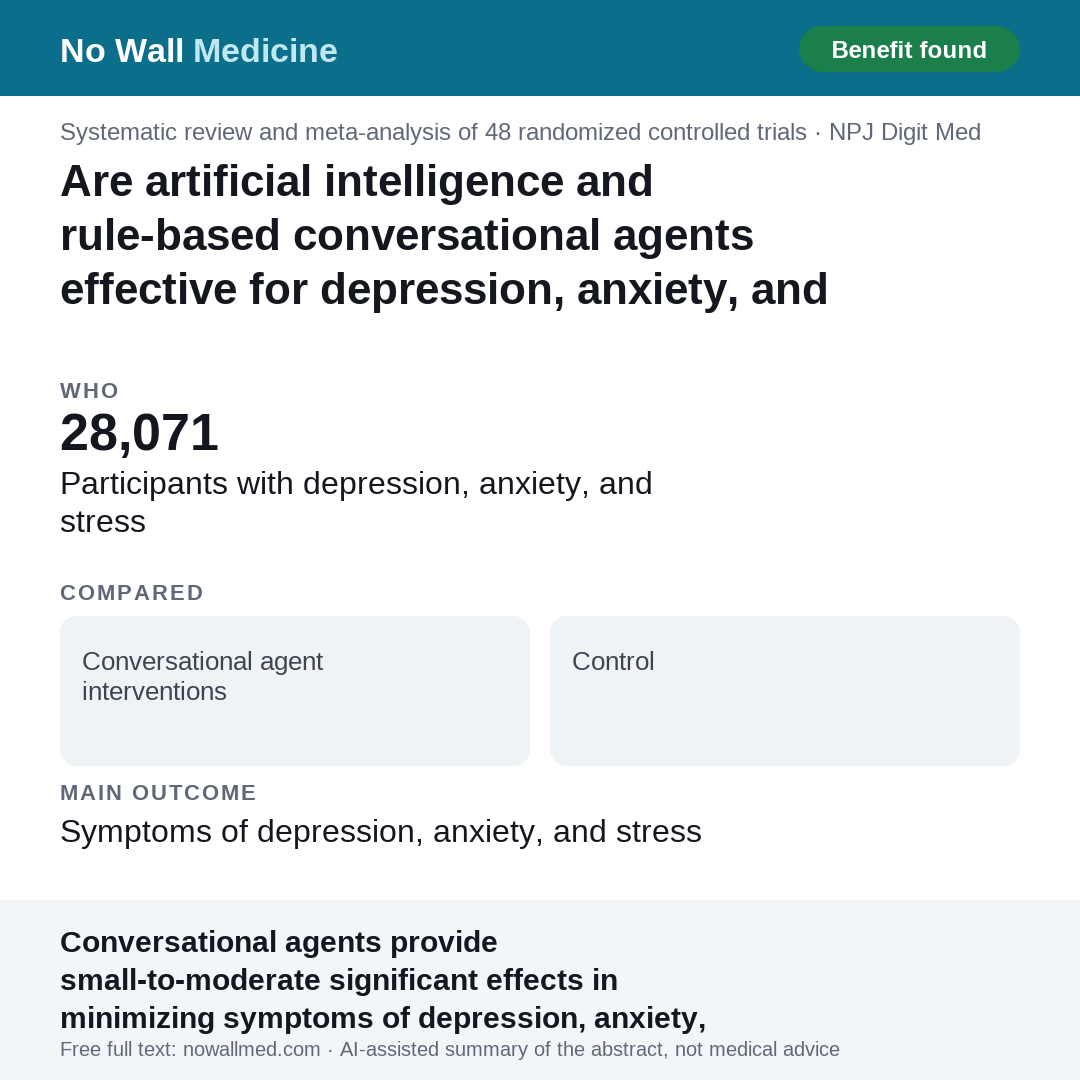
Clinical question: Are artificial intelligence and rule-based conversational agents effective for depression, anxiety, and stress?
Why it matters: Depression, anxiety, and stress are significant global health burdens that are worsened by restricted access to care.
Key points
- Researchers analyzed 48 randomized controlled trials involving 28,071 participants to evaluate conversational agents, which are digital tools like artificial intelligence or rule-based systems.
- The analysis found significant effects in reducing symptoms of depression (SMD: -0.27), anxiety (SMD: -0.20), and stress (SMD: -0.26).
- Subgroup analyses indicated that these digital tools had greater effects in clinical populations and during shorter-duration interventions.
Limitation the authors note: Some studies had issues due to missing data or selective reporting.
Headline and key points written with AI from the paper’s abstract, with every number checked against it. Read the paper before relying on them.
Spotted a mistake? Suggest a correction