AI conversational agents showed moderate effect on depressive symptoms in young people
Effectiveness of AI-Driven Conversational Agents in Improving Mental Health Among Young People: Systematic Review and Meta-Analysis
Systematic review and meta-analysisMixed results
Are artificial intelligence conversational agents effective for mental health among young people?
Who
1974
Young people aged 12-25 years
Compared
Artificial intelligence conversational agents
Control conditions
Main outcome
Depressive symptoms, anxiety, stress, mental well-being, and affect
Result: Hedges g=0.61 (95% CI 0.35-0.86) for depressive symptoms
Bottom line: Artificial intelligence conversational agents effectively reduce depressive symptoms but show no significant effect on anxiety, stress, or well-being.
Limitation: Heterogeneity in therapeutic orientations and lack of follow-up measures.
J Med Internet Res · 2025-05-14Download image
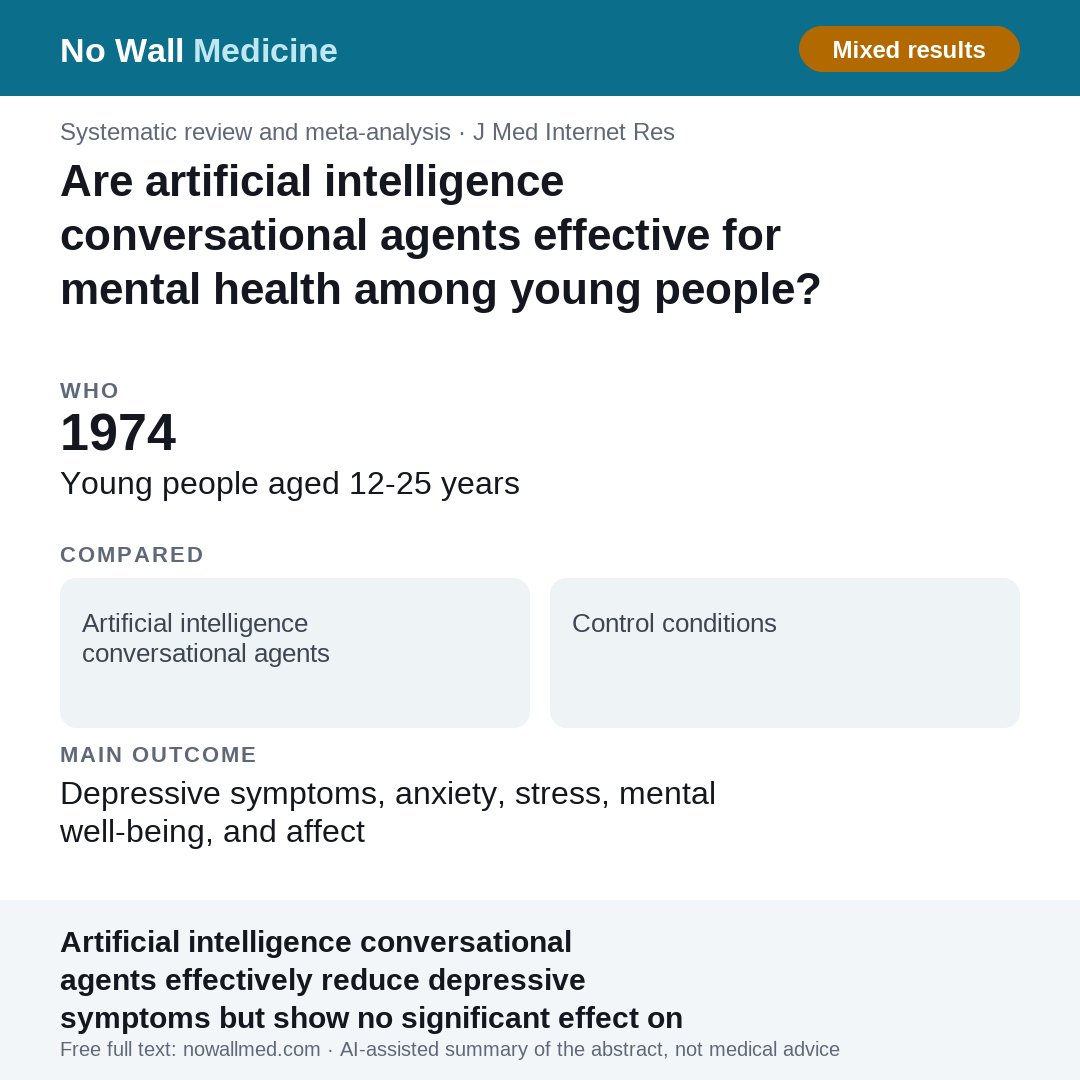
Clinical question: Are artificial intelligence conversational agents effective for mental health among young people?
Why it matters: Evidence is limited regarding how effective artificial intelligence conversational agents are for different mental health conditions in adolescents and young adults.
Key points
- Researchers analyzed 15 randomized controlled trials involving 1974 participants aged 12-25 years to evaluate artificial intelligence conversational agents.
- The agents had a moderate-to-large effect on depressive symptoms (Hedges g=0.61, 95% CI 0.35-0.86) but no significant effect on anxiety, stress, or well-being.
- Subgroup analysis showed the agents were particularly effective for depressive symptoms in subclinical populations (Hedges g=0.74, 95% CI 0.50-0.98).
Limitation the authors note: The reviewed evidence had heterogeneity in therapeutic orientations of the conversational agents and a lack of follow-up measures.
Headline and key points written with AI from the paper’s abstract, with every number checked against it. Read the paper before relying on them.
Topics
Cite this article
Feng Y, Hang Y, Wu W, Song X, Xiao X, Dong F. Effectiveness of AI-Driven Conversational Agents in Improving Mental Health Among Young People: Systematic Review and Meta-Analysis. J Med Internet Res. 2025. doi:10.2196/69639
Spotted a mistake? Suggest a correction
Top studies every Monday
The week’s key trials and guidelines in your specialties, plus any topics you follow. By email, free.
Get the weekly digest