Short-term online mindfulness training reduced depressive symptoms in adults in China
Effectiveness of an Internet-Based, Self-Guided, Short-Term Mindfulness Training (ISSMT) Program for Relieving Depressive Symptoms in the Adult Population in China: Single-Blind, Randomized Controlled Trial
Single-blind, randomized controlled trialBenefit found
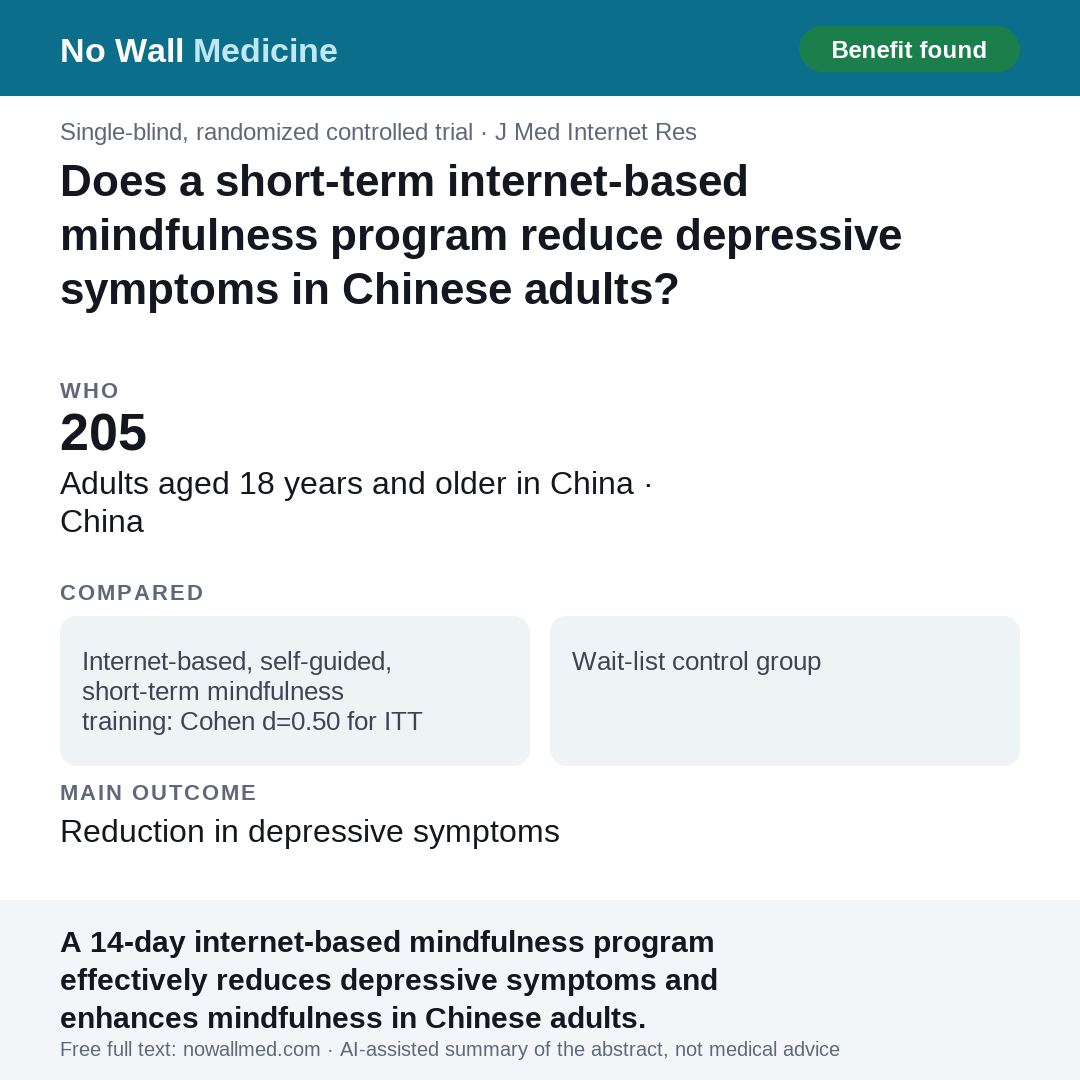
Does a short-term internet-based mindfulness program reduce depressive symptoms in Chinese adults?
Who
205
Adults aged 18 years and older in China · China
Compared
Internet-based, self-guided, short-term mindfulness training: Cohen d=0.50 for ITT
Wait-list control group
Main outcome
Reduction in depressive symptoms
Result: Cohen d=0.50 for ITT
Bottom line: A 14-day internet-based mindfulness program effectively reduces depressive symptoms and enhances mindfulness in Chinese adults.
Limitation: Future research should focus on personalizing programs and incorporating advanced technologies.
J Med Internet Res · 2025-02-13Download image
Clinical question: Does a short-term internet-based mindfulness program reduce depressive symptoms in Chinese adults?
Why it matters: It is unknown if short-term online mindfulness interventions can effectively reduce depressive symptoms, as most existing research focuses on traditional 8-week programs.
Key points
- Researchers studied 205 adults who were randomized to receive either a 14-day internet-based, self-guided mindfulness program or were placed on a wait-list control group.
- The mindfulness program was associated with improvements in mindfulness (Cohen d=0.44 for intention-to-treat; Cohen d=0.55 for per-protocol) and reductions in depressive symptoms (Cohen d=0.50 for intention-to-treat; Cohen d=0.53 for per-protocol).
- Participants reported high acceptance of the 14-day training format, which had a dropout rate of <40%.
Headline and key points written with AI from the paper’s abstract, with every number checked against it. Read the paper before relying on them.
Topics
Cite this article
Zhu T, Zhang L, Weng W, Gan R, Sun L, Wei Y. Effectiveness of an Internet-Based, Self-Guided, Short-Term Mindfulness Training (ISSMT) Program for Relieving Depressive Symptoms in the Adult Population in China: Single-Blind, Randomized Controlled Trial. J Med Internet Res. 2025. doi:10.2196/55583
Spotted a mistake? Suggest a correction
Top studies every Monday
The week’s key trials and guidelines in your specialties, plus any topics you follow. By email, free.
Get the weekly digest