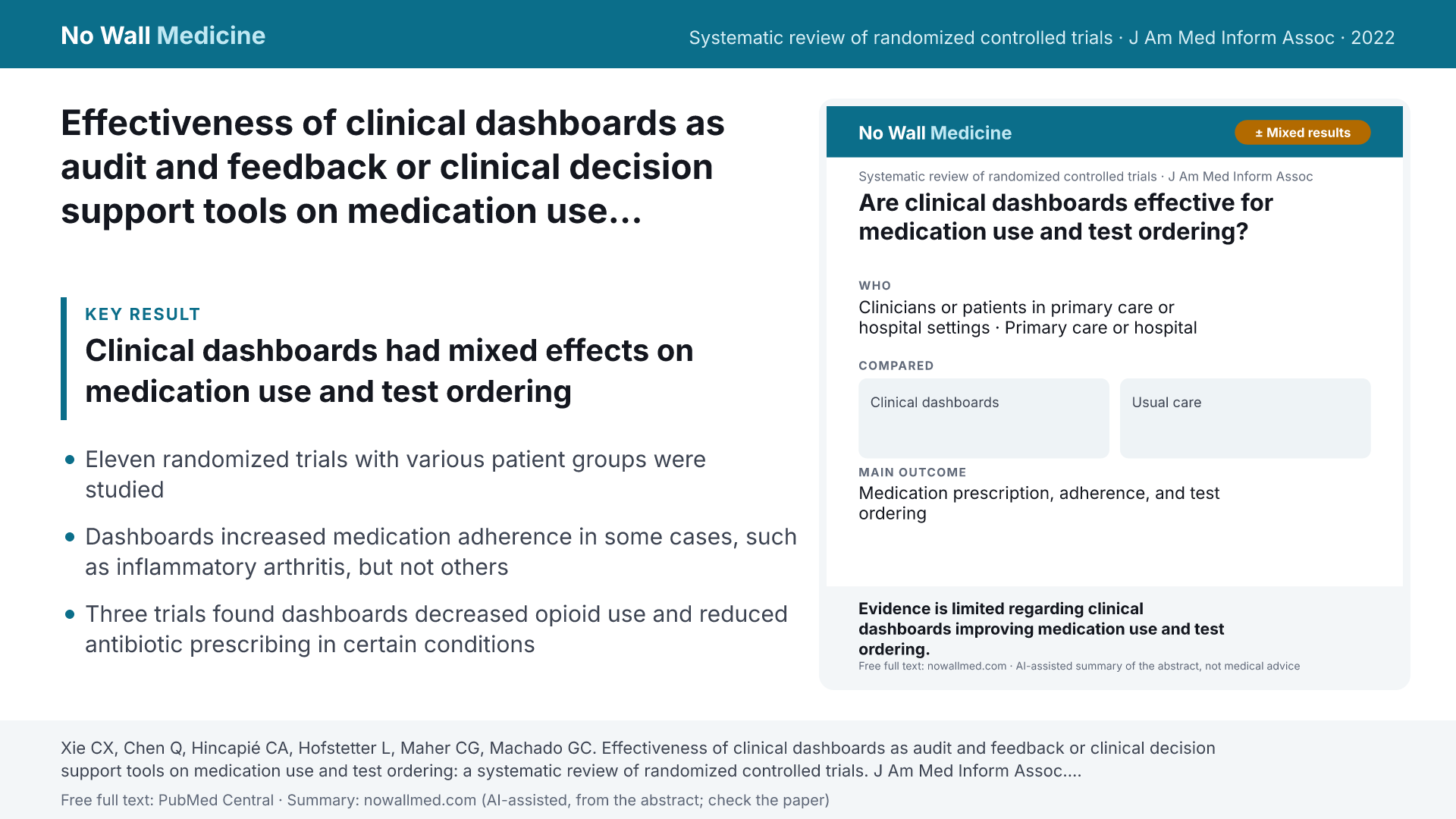
Effectiveness of clinical dashboards as audit and feedback or clinical decision support tools on medication use and test ordering: a systematic review of randomized controlled trials
Key result: Clinical dashboards had mixed effects on medication use and test ordering
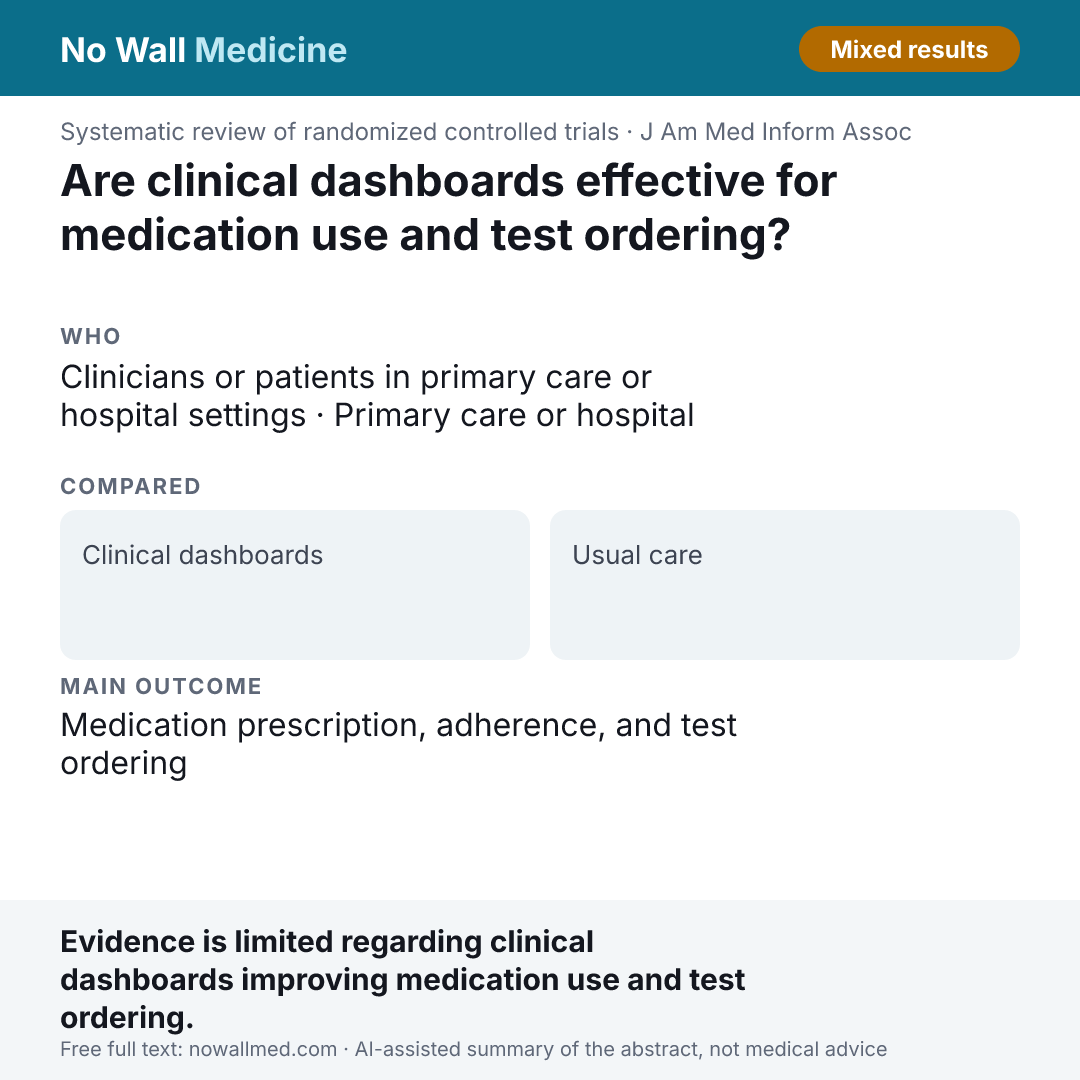
Systematic review of randomized controlled trialsMixed results
Are clinical dashboards effective for medication use and test ordering?
Who
Clinicians or patients in primary care or hospital settings · Primary care or hospital settings
Compared
Clinical dashboards
Usual care
Main outcome
Medication prescription, adherence, and test ordering
Bottom line: Evidence is limited regarding clinical dashboards improving medication use and test ordering.
Limitation: Limited evidence from the included randomized trials.
J Am Med Inform Assoc · 2022-06-12 · Save PNG
Key points
- Eleven randomized trials with various patient groups were studied.
- Dashboards increased medication adherence in some cases, such as inflammatory arthritis, but not others.
- Three trials found dashboards decreased opioid use and reduced antibiotic prescribing in certain conditions.
Limitation the authors note: Conflicting evidence and limited number of trials were noted
Discussion prompts
- Would these patients look like yours? Who was left out?
- Is the main outcome one that matters to patients?
- Is the difference large enough to change what you do?
Cite: Xie CX, Chen Q, Hincapié CA, Hofstetter L, Maher CG, Machado GC. Effectiveness of clinical dashboards as audit and feedback or clinical decision support tools on medication use and test ordering: a systematic review of randomized controlled trials. J Am Med Inform Assoc. 2022;29(10):1773-1785. doi:10.1093/jamia/ocac094
Free full text: PubMed Central · Summary and visual abstract: nowallmed.com/a/effectiveness-of-clinical-dashboards-as-audit-and-feedback-or-1e7eur2/ (AI-assisted from the abstract; check the paper before relying on it).