Combined biopsychosocial interventions reduce pain and disability in adults with chronic low back pain
Effectiveness of Combined Biopsychosocial Interventions for Chronic Low Back Pain: A Systematic Review and Meta-analysis of Randomized Controlled Trials
Systematic review and meta-analysis of 28 randomized controlled trialsBenefit found
Are combined biopsychosocial interventions effective for reducing pain and disability in chronic low back pain?
Who
2521
Adults with nonspecific chronic low back pain
Compared
Combined biopsychosocial interventions
Usual care, waiting-list, or unimodal interventions
Main outcome
Pain and functional disability
Result: SMD -0.60 (95% CI, -0.81 to -0.38) for short term pain
Bottom line: Combined biopsychosocial interventions reduce pain and disability in chronic low back pain, particularly in the short term.
Limitation: Heterogeneity ranged from moderate to high and evidence certainty was moderate to low.
Arch Phys Med Rehabil · 2026-07-16Download image
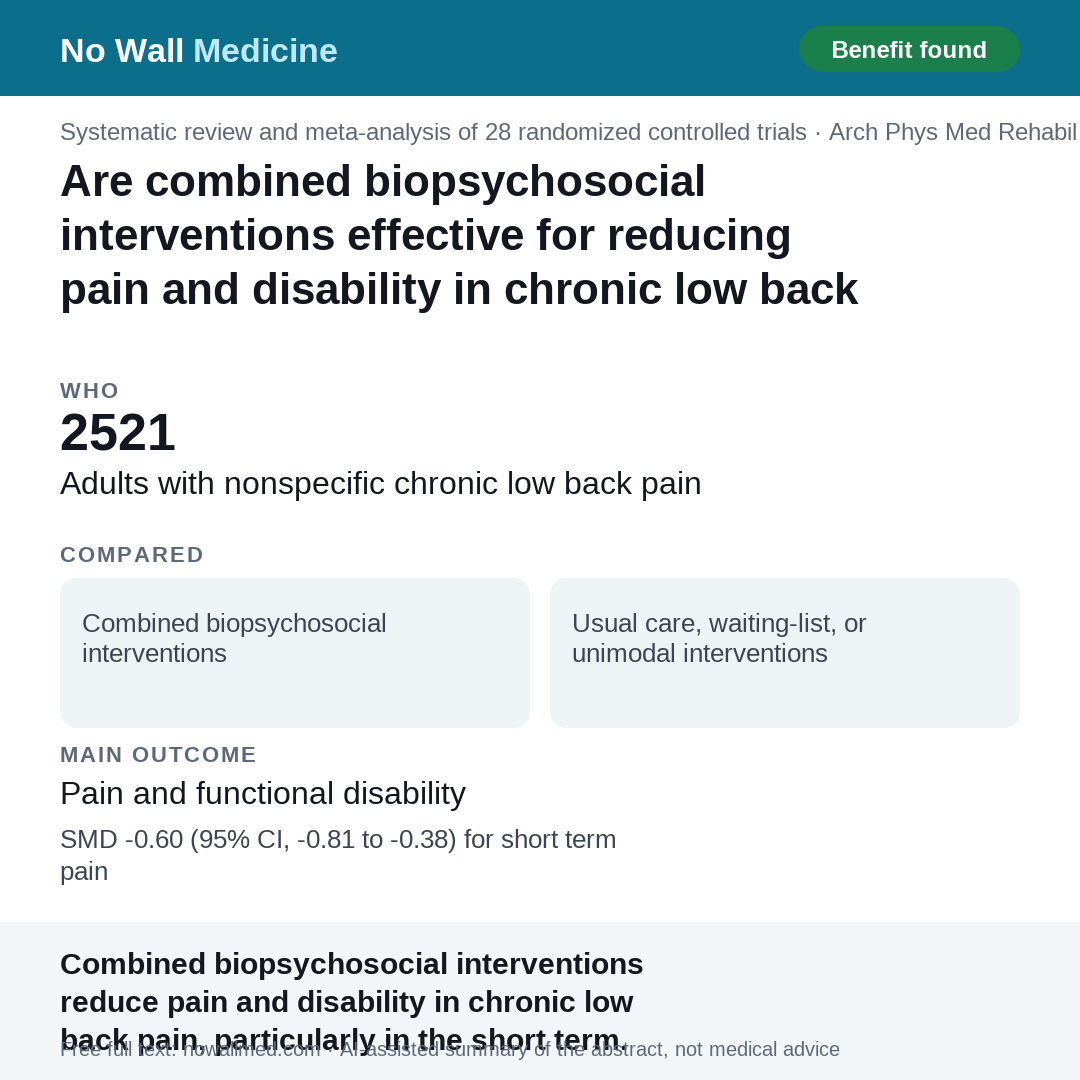
Clinical question: Are combined biopsychosocial interventions effective for reducing pain and disability in chronic low back pain?
Why it matters: It is unclear how effective combining exercise, education, and psychological strategies is compared to usual care or single-method treatments for chronic low back pain.
Key points
- Researchers analyzed 28 randomized controlled trials involving 2521 participants with nonspecific chronic low back pain lasting 12 weeks or longer.
- Combined treatments significantly reduced pain at short term (SMD=-0.60) and medium term (SMD=-0.49) and reduced disability at short term (SMD=-0.74) and medium term (SMD=-0.45).
- Kinesiophobia, or fear of movement, decreased in the short term but showed no significant change in the medium term.
Limitation the authors note: The researchers noted moderate to high heterogeneity across studies and low certainty of evidence for medium term kinesiophobia outcomes.
Headline and key points written with AI from the paper’s abstract, with every number checked against it. Read the paper before relying on them.
Cite this article
Segateli L, Fonsati LB, de Oliveira MA, Batista do Nascimento G, Junior PRR, Navega MT. Effectiveness of Combined Biopsychosocial Interventions for Chronic Low Back Pain: A Systematic Review and Meta-analysis of Randomized Controlled Trials. Arch Phys Med Rehabil. 2026. doi:10.1016/j.apmr.2026.07.007
Spotted a mistake? Suggest a correction