General practitioner-led geriatric assessments were associated with fewer unplanned hospital admissions in older patients
Effectiveness of comprehensive geriatric assessment adapted to primary care when provided by a nurse or a general practitioner: the CEpiA cluster-randomised trial
Open-label, pragmatic, three-arm, cluster-randomised controlled trialMixed results
Does comprehensive geriatric assessment adapted for primary care improve composite outcomes?
Who
634
Patients aged 70 years or over with chronic health conditions · 39 general practices in France
Compared
Systematic nurse-led comprehensive geriatric assessment
General practitioner-led comprehensive geriatric assessment
Standard care
Main outcome
All-cause mortality, emergency department visits, unplanned hospital admissions, and institutionalisation
Result: adjusted odds ratio 0.60 (95% CI 0.39-0.93) for GP-led vs control
Bottom line: General practitioner-led comprehensive geriatric assessment may reduce unplanned hospital admissions, but no significant effect on mortality or quality of life.
BMC Med · 2024-09-27Download image
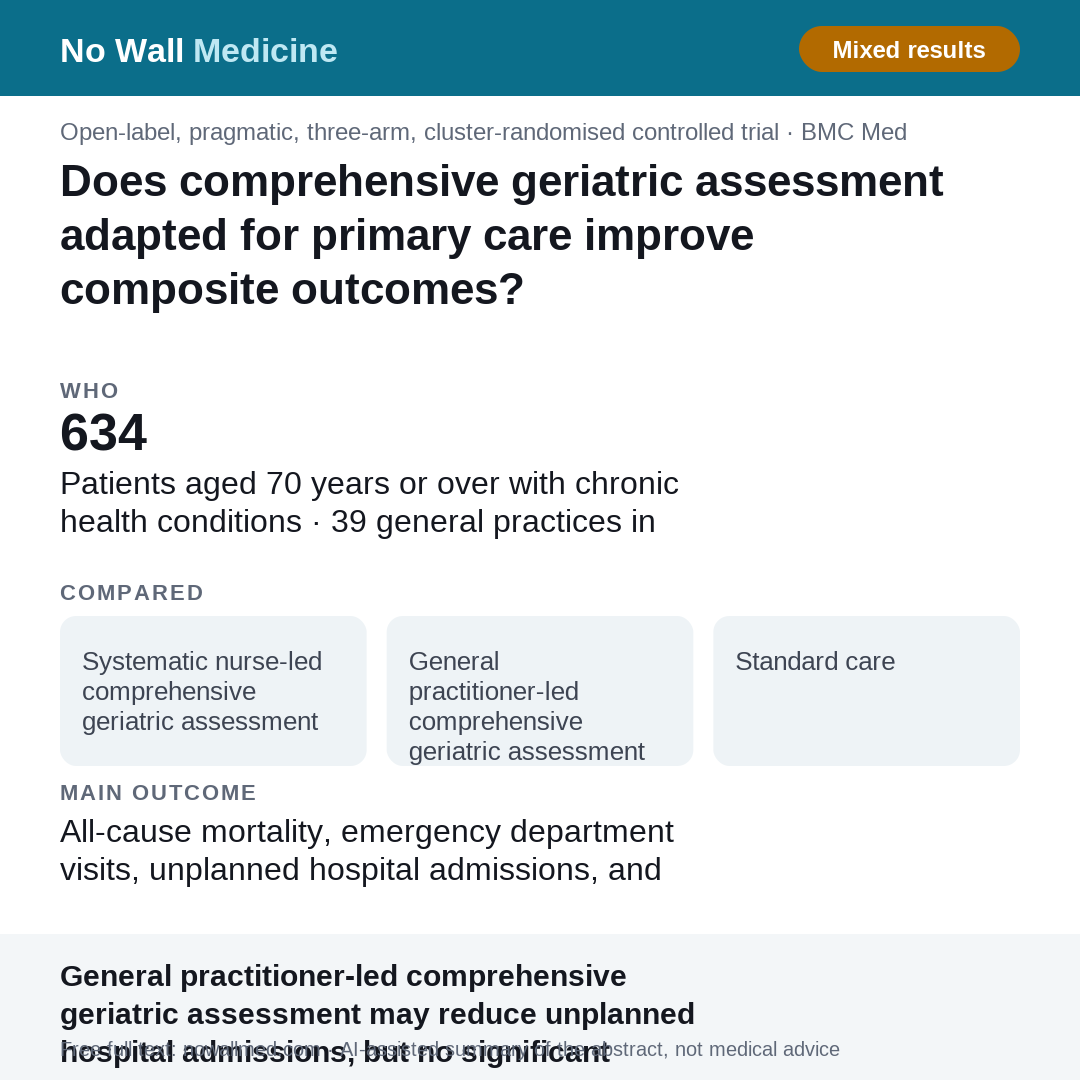
Clinical question: Does comprehensive geriatric assessment adapted for primary care improve composite outcomes?
Why it matters: The benefits of comprehensive geriatric assessment, which is a multidimensional diagnostic process, are well established in hospital settings but less certain in primary care.
Key points
- Researchers studied 634 patients aged 70 years or older in 39 French general practices, comparing nurse-led assessments, general practitioner-led assessments, and standard care.
- General practitioner-led assessments were associated with a lower risk of unplanned hospital admission compared to standard care (aOR = 0.57 [0.36-0.92], P = 0.020).
- No statistically significant differences were found for mortality, quality of life, or functional status between the nurse-led assessment group and the control group.
Headline and key points written with AI from the paper’s abstract, with every number checked against it. Read the paper before relying on them.
Was this summary helpful?
Subject terms
Cite this article
Orcel V, Banh L, Bastuji-Garin S, Renard V, Boutin E, Gouja A. Effectiveness of comprehensive geriatric assessment adapted to primary care when provided by a nurse or a general practitioner: the CEpiA cluster-randomised trial. BMC Med. 2024. doi:10.1186/s12916-024-03613-7
Spotted a mistake? Suggest a correction
Top studies every Monday
The week’s key trials and guidelines in your specialties, plus any topics you follow. By email, free.
Get the weekly digest