Conservative management was as effective as gallbladder surgery for pain in adults with gallstones
Effectiveness of conservative management versus laparoscopic cholecystectomy in the prevention of recurrent symptoms and complications in adults with uncomplicated symptomatic gallstone disease (C-GALL trial): pragmatic, multicentre randomised controlled trial
Parallel group, pragmatic randomised, superiority trialNo clear difference
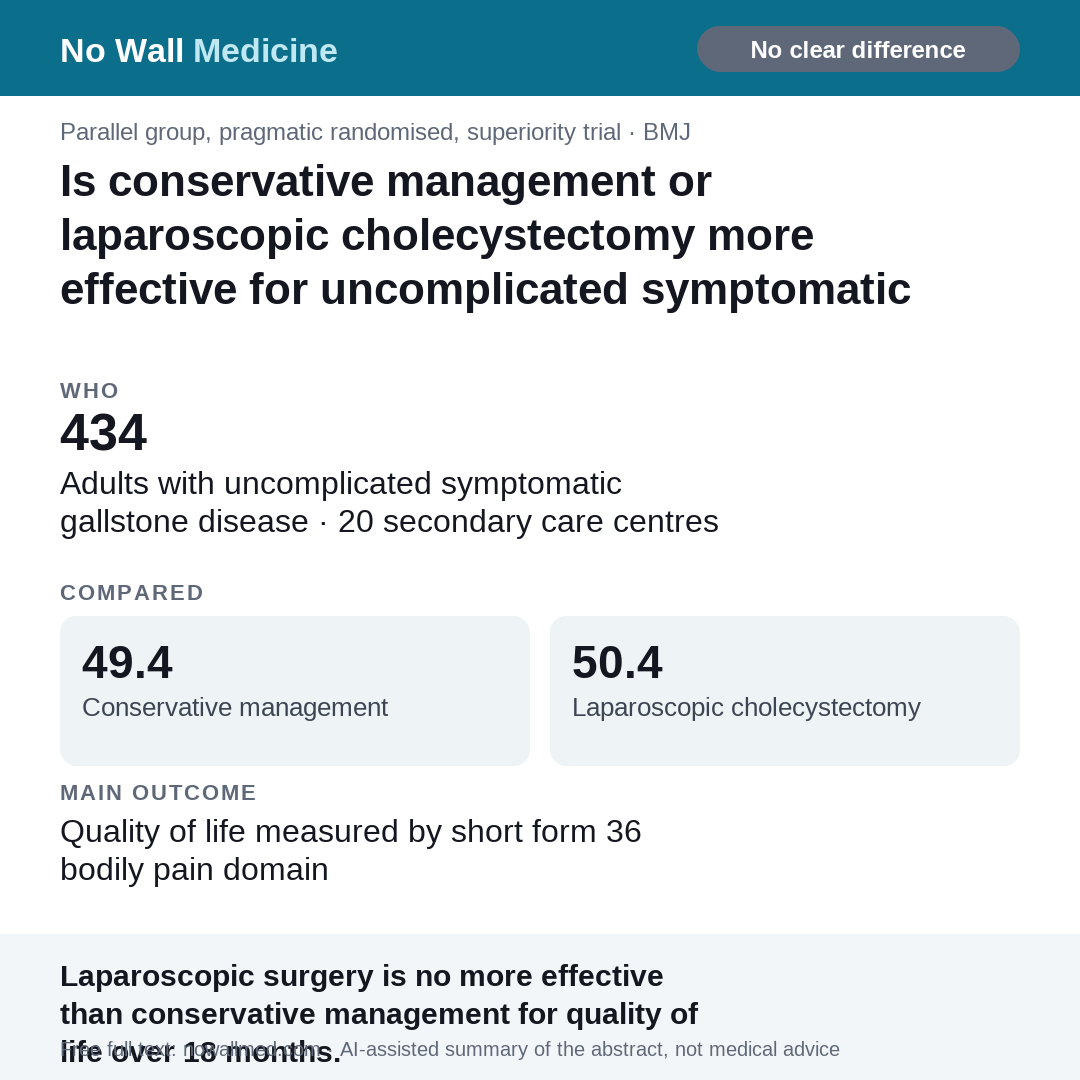
Is conservative management or laparoscopic cholecystectomy more effective for uncomplicated symptomatic gallstone disease?
Who
434
Adults with uncomplicated symptomatic gallstone disease · 20 secondary care centres in the UK
Compared
49.4Conservative management (standard deviation 11.7)
50.4Laparoscopic cholecystectomy (11.6)
Main outcome
Quality of life measured by short form 36 bodily pain domain
Result: mean difference 0.0, 95% confidence interval -1.7 to 1.7
Bottom line: Laparoscopic surgery is no more effective than conservative management for quality of life over 18 months.
BMJ · 2023-12-06Download image
Clinical question: Is conservative management or laparoscopic cholecystectomy more effective for uncomplicated symptomatic gallstone disease?
Why it matters: It is unclear whether surgical removal of the gallbladder is more effective than conservative management for preventing symptoms and complications in adults with uncomplicated symptomatic gallstone disease.
Key points
- Researchers conducted a trial with 434 adults with uncomplicated symptomatic gallstone disease, comparing conservative management to laparoscopic cholecystectomy, which is surgical removal of the gallbladder.
- The primary outcome of quality of life related to bodily pain over 18 months did not differ between the conservative management group and the surgery group (P=1.00).
- Conservative management was less costly with a mean difference of -£1033, while quality adjusted life years, a measure of health outcomes, did not differ.
Limitation the authors note: The authors state that costs, complications, and benefits will continue to be incurred in both groups beyond 18 months, suggesting a need for longer term follow-up.
Headline and key points written with AI from the paper’s abstract, with every number checked against it. Read the paper before relying on them.
Abstract
Objective
To assess the clinical and cost effectiveness of conservative management compared with laparoscopic cholecystectomy for the prevention of symptoms and complications in adults with uncomplicated symptomatic gallstone disease. Design
Parallel group, pragmatic randomised, superiority trial. Setting
20 secondary care centres in the UK. Participants
434 adults (>18 years) with uncomplicated symptomatic gallstone disease referred to secondary care, assessed for eligibility between August 2016 and November 2019, and randomly assigned (1:1) to receive conservative management or laparoscopic cholecystectomy. Interventions
Conservative management or surgical removal of the gallbladder. Main outcome measures
The primary patient outcome was quality of life, measured by area under the curve, over 18 months using the short form 36 (SF-36) bodily pain domain, with higher scores (range 0-100) indicating better quality of life. Other outcomes included costs to the NHS, quality adjusted life years (QALYs), and incremental cost effectiveness ratio. Results
Of 2667 patients assessed for eligibility, 434 were randomised: 217 to the conservative management group and 217 to the laparoscopic cholecystectomy group. By 18 months, 54 (25%) participants in the conservative management arm and 146 (67%) in the cholecystectomy arm had received surgery. The mean SF-36 norm based bodily pain score was 49.4 (standard deviation 11.7) in the conservative management arm and 50.4 (11.6) in the cholecystectomy arm. The SF-36 bodily pain area under the curve up to 18 months did not differ (mean difference 0.0, 95% confidence interval -1.7 to 1.7; P=1.00). Conservative management was less costly (mean difference -£1033, (-$1334; -€1205), 95% credible interval -£1413 to -£632) and QALYs did not differ (mean difference -0.019, 95% credible interval -0.06 to 0.02). Conclusions
In the short term (≤18 months), laparoscopic surgery is no more effective than conservative management for adults with uncomplicated symptomatic gallstone disease, and as such conservative management should be considered as an alternative to surgery. From an NHS perspective, conservative management may be cost effective for uncomplicated symptomatic gallstone disease. As costs, complications, and benefits will continue to be incurred in both groups beyond 18 months, future research should focus on longer term follow-up to establish effectiveness and lifetime cost effectiveness and to identify the cohort of patients who should be routinely offered surgery. Trial registration
ISRCTN registry ISRCTN55215960.
Abstract reproduced under the article’s CC BY licence.
Topics
Cite this article
Ahmed I, Hudson J, Innes K, Hernández R, Gillies K, Bruce R. Effectiveness of conservative management versus laparoscopic cholecystectomy in the prevention of recurrent symptoms and complications in adults with uncomplicated symptomatic gallstone disease (C-GALL trial): pragmatic, multicentre randomised controlled trial. BMJ. 2023. doi:10.1136/bmj-2023-075383
Spotted a mistake? Suggest a correction