Non-pharmacological interventions showed potential benefits for various muscular dystrophy types in a meta-analysis
Effectiveness of conservative non-pharmacological interventions in people with muscular dystrophies: a systematic review and meta-analysis
NeurologyAdult and pediatric
Systematic review and meta-analysisBenefit found
Are conservative non-pharmacological interventions effective for people with muscular dystrophies?
Who
957
People with muscular dystrophies
Compared
Conservative non-pharmacological interventions
Usual care
Main outcome
Physical management effectiveness
Bottom line: Low-quality evidence suggests strength training may improve function, balance, and well-being in muscular dystrophies.
Limitation: Most studies were mostly at high risk of bias.
J Neurol Neurosurg Psychiatry · 2024-04-12Download image
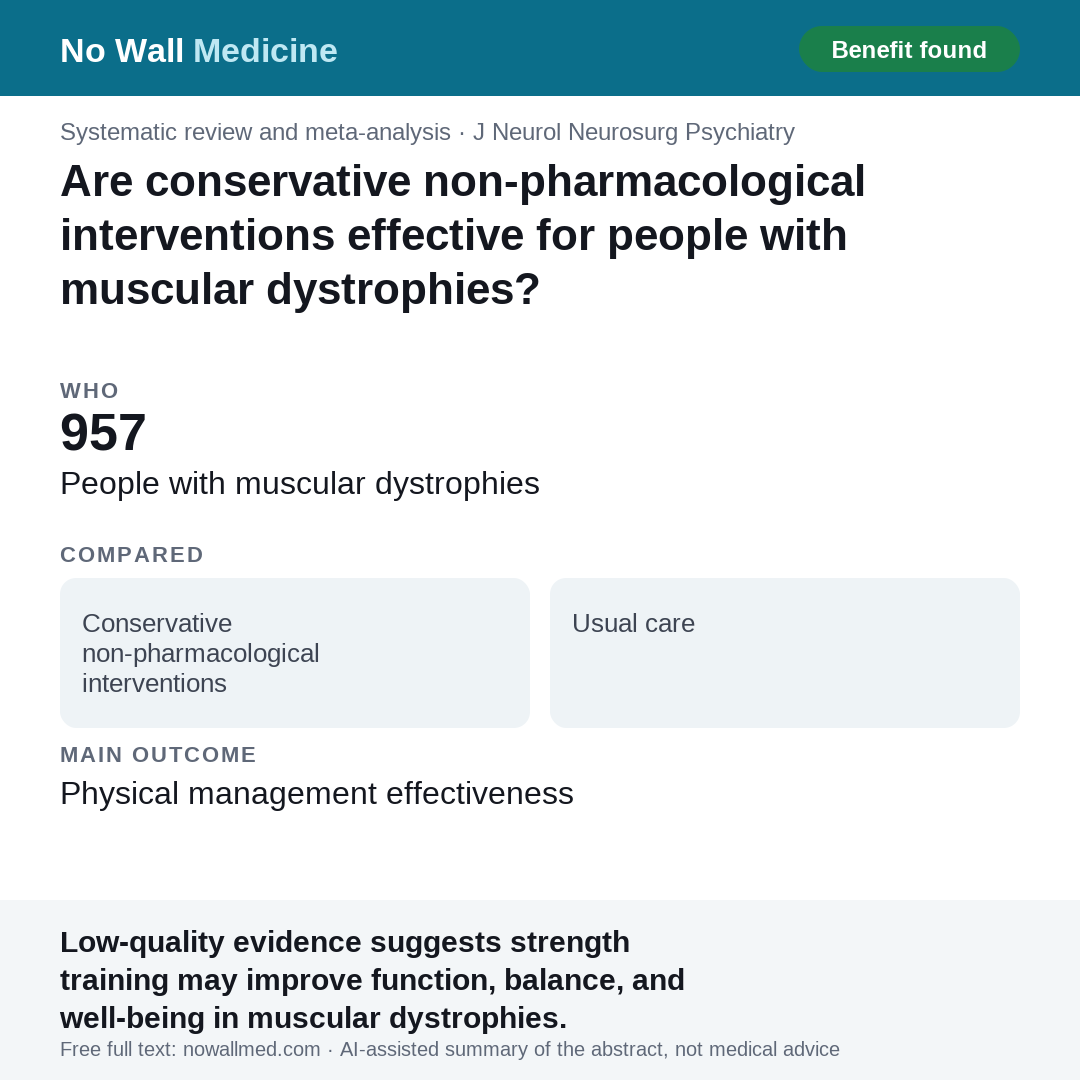
Clinical question: Are conservative non-pharmacological interventions effective for people with muscular dystrophies?
Why it matters: Evidence regarding the effectiveness of conservative non-pharmacological treatments for managing muscular dystrophies is currently limited and inconclusive.
Key points
- Researchers analyzed 39 studies involving 957 participants to evaluate non-drug physical management for muscular dystrophies.
- In children with Duchenne muscular dystrophy, trunk-oriented strength exercises were more effective than usual care for distal upper-limb function, sitting, and dynamic reaching balance (ES range: 0.87 to 2.29).
- For adults with Facioscapulohumeral dystrophy, vibratory proprioceptive assistance and neuromuscular electrical stimulation were associated with improved muscle contraction and reduced pain (ES range: 1.58 to 2.33).
Limitation the authors note: The included studies were mostly at high risk of bias and provided low-quality evidence.
Headline and key points written with AI from the paper’s abstract, with every number checked against it. Read the paper before relying on them.
Abstract
Introduction
Management of muscular dystrophies (MD) relies on conservative non-pharmacological treatments, but evidence of their effectiveness is limited and inconclusive. Objective
To investigate the effectiveness of conservative non-pharmacological interventions for MD physical management. Methods
This systematic review and meta-analysis followed Preferred Reporting Items for Systematic Reviews and Meta-Analyses (PRISMA) guidelines and searched Medline, CINHAL, Embase, AMED and Cochrane Central Register of Controlled Trial (inception to August 2022). Effect size (ES) and 95% Confidence Interval (CI) quantified treatment effect. Results
Of 31,285 identified articles, 39 studies (957 participants), mostly at high risk of bias, were included. For children with Duchenne muscular dystrophy (DMD), trunk-oriented strength exercises and usual care were more effective than usual care alone in improving distal upper-limb function, sitting and dynamic reaching balance (ES range: 0.87 to 2.29). For adults with Facioscapulohumeral dystrophy (FSHD), vibratory proprioceptive assistance and neuromuscular electrical stimulation respectively improved maximum voluntary isometric contraction and reduced pain intensity (ES range: 1.58 to 2.33). For adults with FSHD, Limb-girdle muscular dystrophy (LGMD) and Becker muscular dystrophy (BMD), strength-training improved dynamic balance (sit-to-stand ability) and self-perceived physical condition (ES range: 0.83 to 1.00). A multicomponent programme improved perceived exertion rate and gait in adults with Myotonic dystrophy type 1 (DM1) (ES range: 0.92 to 3.83). Conclusions
Low-quality evidence suggests that strength training, with or without other exercise interventions, may improve perceived exertion, distal upper limb function, static and dynamic balance, gait and well-being in MD. Although more robust and larger studies are needed, current evidence supports the inclusion of strength training in MD treatment, as it was found to be safe.
Abstract reproduced under the article’s CC BY NC licence.
Topics
Cite this article
Leone E, Pandyan A, Rogers A, Kulshrestha R, Hill J, Philp F. Effectiveness of conservative non-pharmacological interventions in people with muscular dystrophies: a systematic review and meta-analysis. J Neurol Neurosurg Psychiatry. 2024. doi:10.1136/jnnp-2023-331988
Spotted a mistake? Suggest a correction
Top studies every Monday
The week’s key trials and guidelines in your specialties, plus any topics you follow. By email, free.
Get the weekly digest