Effectiveness of different intervention designs for improving physical activity in adults with cardiometabolic conditions over time: a systematic review and network meta-analysis of randomised controlled trials
Systematic review and network meta-analysisBenefit found
Which physical activity intervention designs are most effective for adults with cardiometabolic conditions?
Who
8952
Adults with cardiometabolic conditions
Compared
Behaviour-change: MD = 3287, 95% CrI 1576 to 4997 steps per day
Multi-component: MD = 2939, 95% CrI 1714 to 4164 steps per day
Education: MD = 2054, 95% CrI 369 to 3740 steps per day
Motivational/goal-setting: MD = 1344, 95% CrI 243 to 2445 steps per day
Main outcome
Steps per day
Bottom line: Multi-component interventions were most effective at improving physical activity across all primary measures for people with cardiometabolic conditions.
BMC Med · 2025-07-22Download image
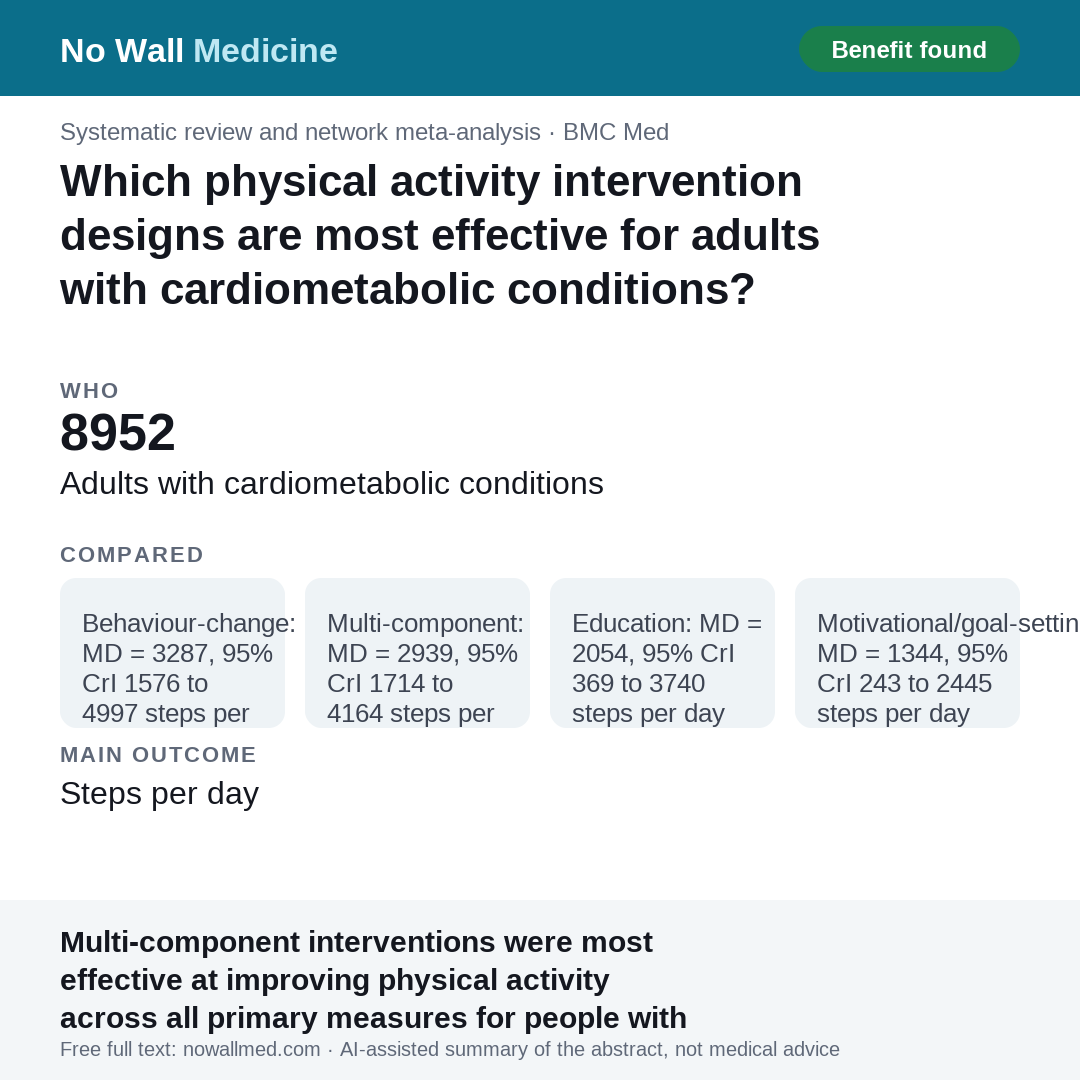
Clinical question: Which physical activity intervention designs are most effective for adults with cardiometabolic conditions?
Abstract
Background
An active lifestyle can lessen the risk of cardiometabolic conditions and improve overall life quality. To support lifestyle change and help healthcare providers deliver optimal physical activity interventions, we aimed to compare the effectiveness of four different physical activity intervention designs (education, behaviour-change, motivational/goal-setting and multi-component) against usual care/minimal intervention in increasing physical activity among adults with cardiometabolic conditions. Methods
A systematic review and network meta-analysis of randomised controlled trials (RCTs) were conducted. Four databases were searched (January 2000-February 2025). Primary outcomes
steps per day, moderate-vigorous physical activity (MVPA) and combined physical activity. Secondary outcomes
sedentary time, HbA1c, BMI, weight loss, SBP, DBP, cholesterol, LDL-C and HDL-C. Steps per day were analysed via time-course model-based meta-analysis. Bayesian random-effects network meta-analysis estimated mean differences (MD)/standardised mean differences (SMD) and 95% credible intervals (CrIs). Evidence quality was assessed using CINeMA. Results
Sixty-two trials comprising 8952 participants were included, 51 were analysed in the meta-analysis. Behaviour-change (MD = 3287, 95% CrI 1576 to 4997 steps per day), multi-component (MD = 2939, 95% CrI 1714 to 4164), education (MD = 2054, 95% CrI 369 to 3740) and motivational/goal-setting (MD = 1344, 95% CrI 243 to 2445) interventions were significantly more effective than usual care in increasing steps per day. Overall, combined physical activity interventions excluding minimal interventions and when compared to usual care only, increased steps per day significantly from baseline by 143 (95% CrI 114 to 182; median 18 weeks), with the highest number of steps per day predicted at around 75 weeks from baseline (MD = 738, 95% CrI 581 to 893). Only multi-component interventions were consistently found to significantly increase physical activity across all primary measures-steps per day, MVPA and combined physical activity-compared to usual care or minimal care. In terms of secondary outcomes, motivational (MD = - 0.28%, CrI = - 0.46 to - 0.10%) and multi-component interventions were associated with significant HbA1c reductions (MD = - 0.24%, CrI = - 0.47 to - 0.02%) compared to usual care; no significant effects were found on other secondary outcomes. Conclusions
Multi-component interventions were most effective at improving physical activity levels among people with cardiometabolic conditions. The crucial next step for patients, clinicians and policymakers is to enhance the understanding of how to tailor and implement these interventions effectively for sustained improvements in long-term physical activity levels. Trial registration
PROSPERO number CRD42023405306.
Topics
Cite this article
Hodkinson A, Sulochana HR, Kontopantelis E, Adeniji C, van Marwijk H, McMillan B. Effectiveness of different intervention designs for improving physical activity in adults with cardiometabolic conditions over time: a systematic review and network meta-analysis of randomised controlled trials. BMC Med. 2025. doi:10.1186/s12916-025-04240-6
Spotted a mistake? Suggest a correction
Top studies every Monday
The week’s key trials and guidelines in your specialties, plus any topics you follow. By email, free.
Get the weekly digest