Digital health interventions improved medication adherence and retention in people living with HIV
Effectiveness of Digital Health Interventions for Improving Antiretroviral Therapy Outcomes in People With HIV: Meta-Analysis and Trial Sequential Analysis of Randomized Controlled Trials
Meta-analysis and trial sequential analysis of 64 randomized controlled trialsBenefit found
Are digital health interventions effective for improving antiretroviral therapy outcomes in people living with HIV?
Who
22286
People living with HIV receiving antiretroviral therapy
Compared
Digital health interventions: RR 1.13 (95% CI 1.04-1.23) for subjective adherence
Standard of care
Main outcome
Viral suppression, CD4+ cell count, adherence, and retention
Result: RR 1.04 (95% CI 1.01-1.07) for viral suppression
Bottom line: Digital health interventions may improve adherence, retention, and viral suppression, but high uncertainty and low certainty of evidence remain.
Limitation: Wide prediction intervals, high risk of bias, small-study effects, and low to very low certainty of evidence.
J Med Internet Res · 2026-07-23Download image
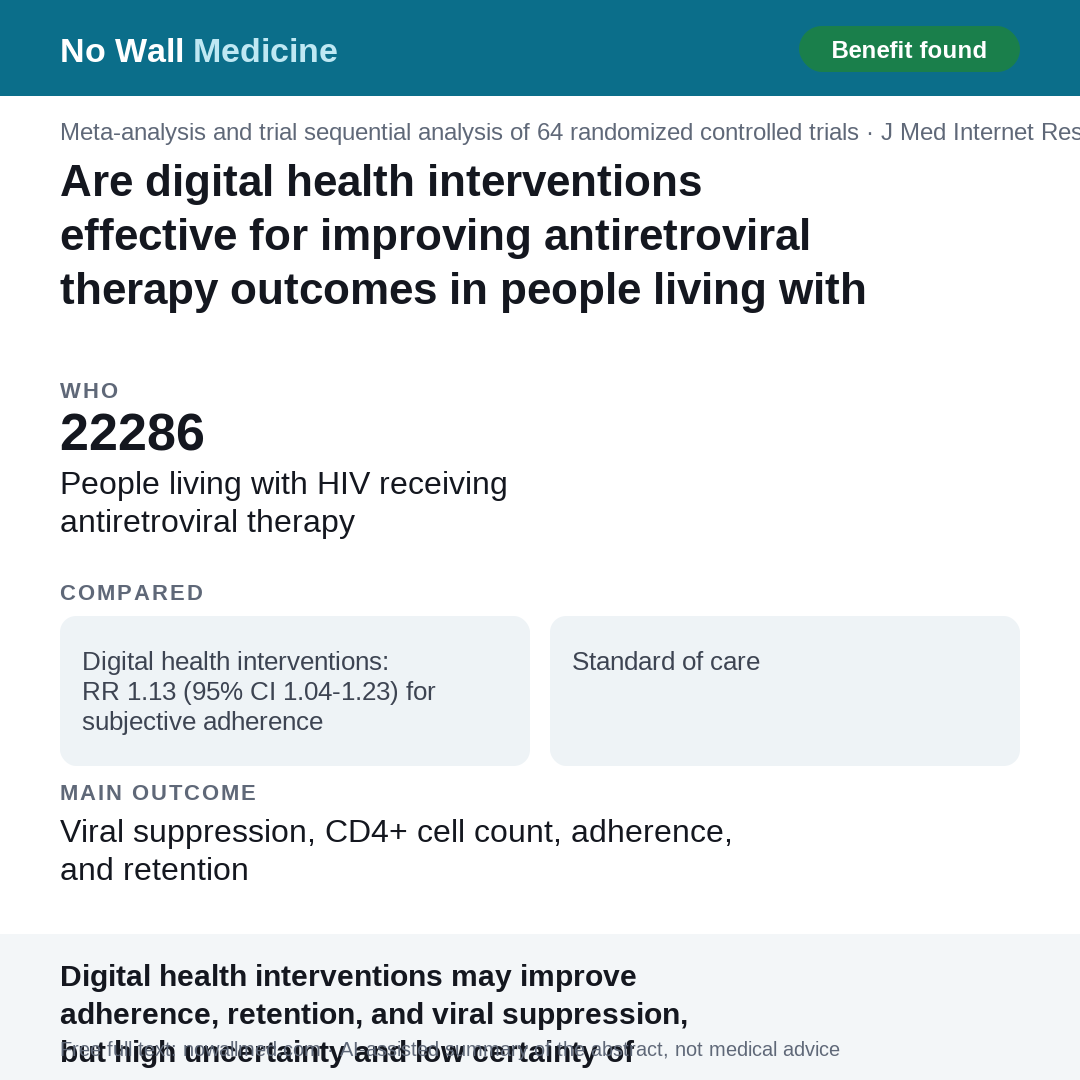
Clinical question: Are digital health interventions effective for improving antiretroviral therapy outcomes in people living with HIV?
Why it matters: Existing systematic reviews have largely focused on single intervention types or limited outcomes and have rarely used analytical approaches to assess the robustness of findings.
Key points
- Researchers analyzed 64 randomized controlled trials involving 22,286 participants to evaluate digital health tools like mobile apps and text messages.
- Digital tools improved subjective adherence with a risk ratio of 1.13 and retention with a risk ratio of 1.06 compared to standard care.
- Viral suppression showed modest improvement with a risk ratio of 1.04, but no significant effect was found for CD4+ cell count or objective adherence.
Limitation the authors note: The authors noted a high risk of bias, small-study effects, and low to very low certainty of evidence based on GRADE assessment.
Headline and key points written with AI from the paper’s abstract, with every number checked against it. Read the paper before relying on them.
Topics
Spotted a mistake? Suggest a correction