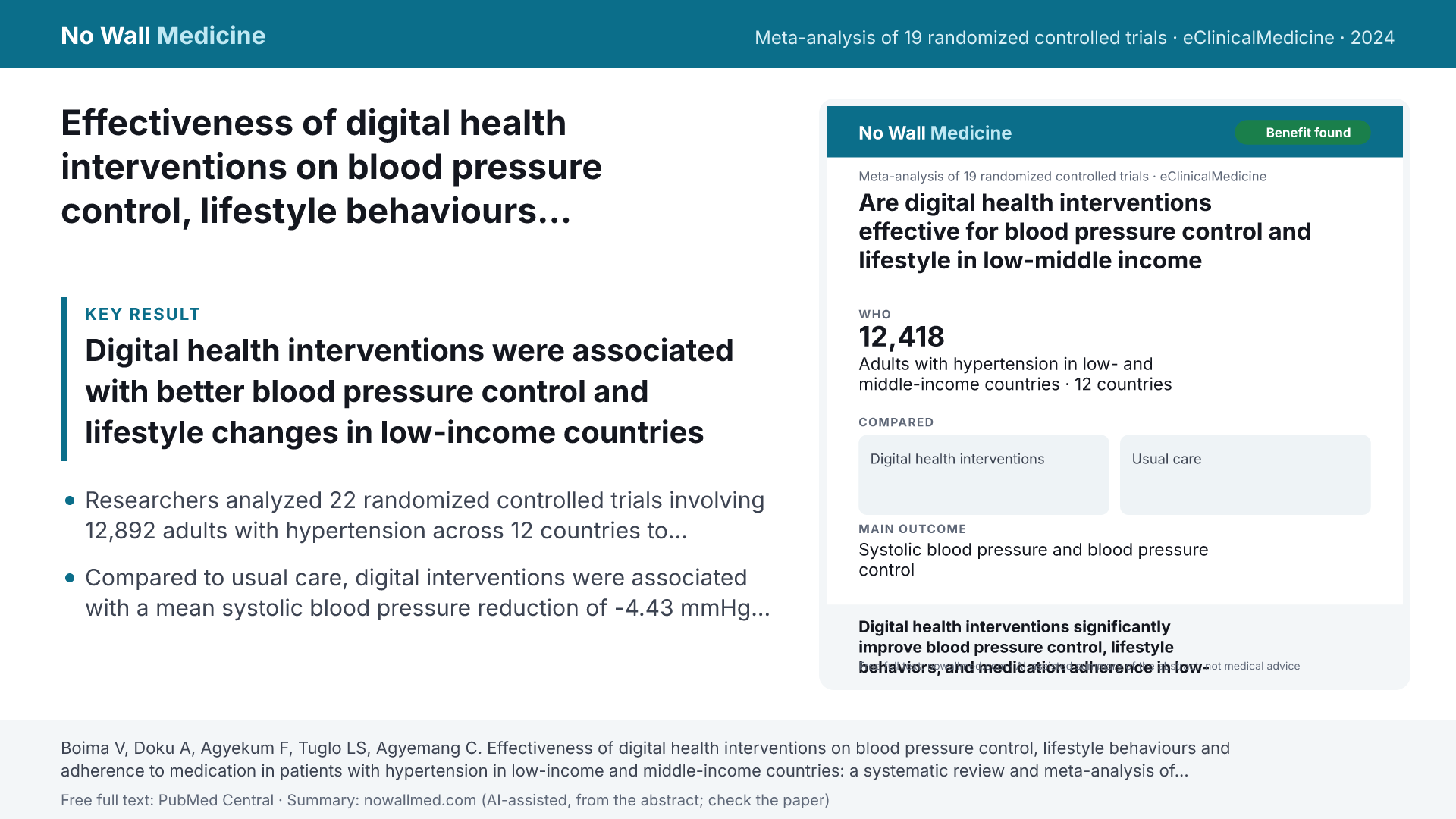
Digital health interventions were associated with better blood pressure control and lifestyle changes in low-income countries
Effectiveness of digital health interventions on blood pressure control, lifestyle behaviours and adherence to medication in patients with hypertension in low-income and middle-income countries: a systematic review and meta-analysis of randomised controlled trials
Meta-analysis of 19 randomized controlled trialsBenefit found
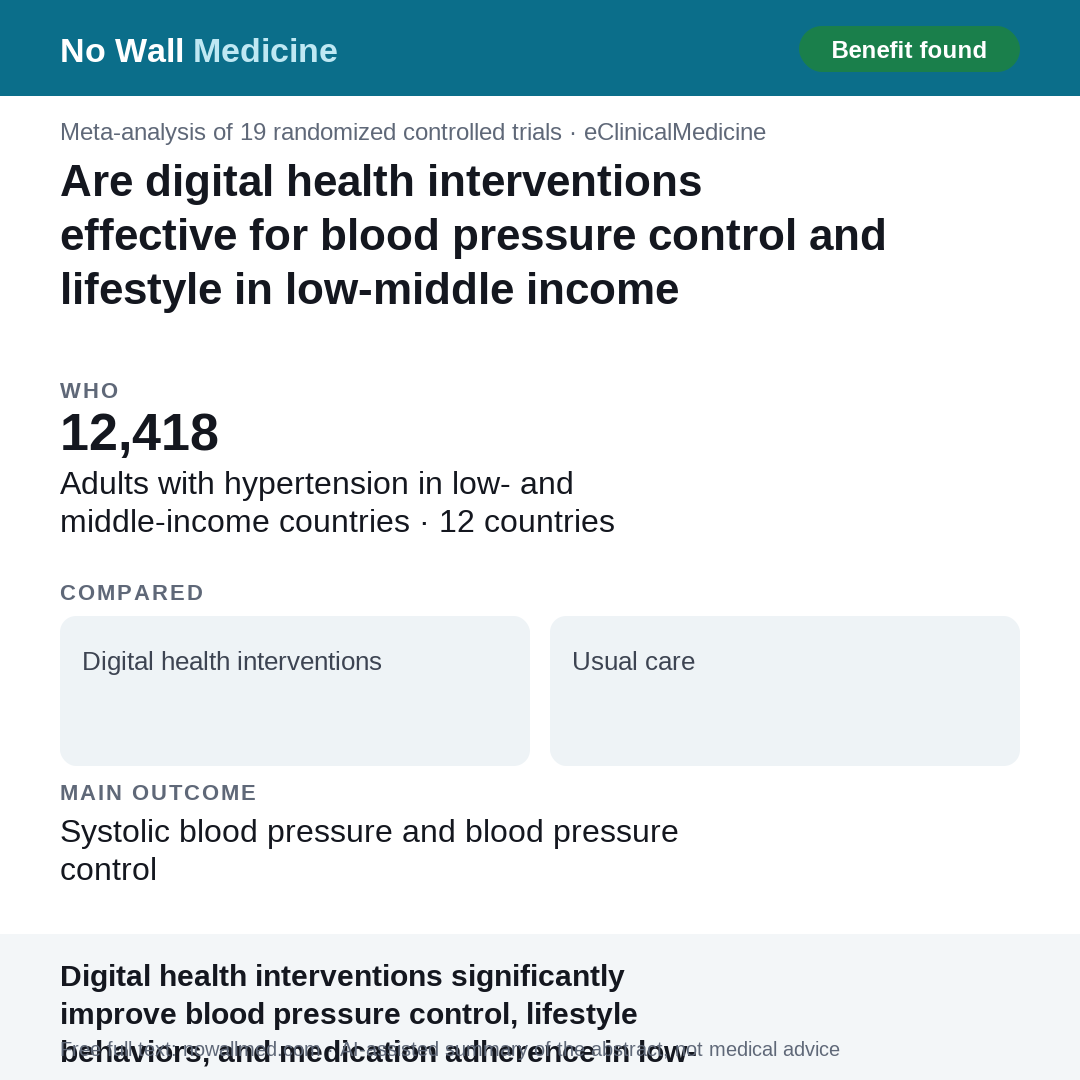
Are digital health interventions effective for blood pressure control and lifestyle in low-middle income countries?
Who
12,418
Adults with hypertension in low- and middle-income countries · 12 countries
Compared
Digital health interventions
Usual care
Main outcome
Systolic blood pressure and blood pressure control
Result: mean difference -4.43 mmHg (95% CI -6.19 to -2.67) and odds ratio 2.20 (95% CI 1.64-2.94)
Bottom line: Digital health interventions significantly improve blood pressure control, lifestyle behaviors, and medication adherence in low- and middle-income countries.
Limitation: High heterogeneity between studies and only two studies from Africa were included.
eClinicalMedicine · 2024-02-01Download image
Clinical question: Are digital health interventions effective for blood pressure control and lifestyle in low-middle income countries?
Why it matters: The effectiveness and application of digital health interventions for blood pressure control, lifestyle, and medication adherence in low- and middle-income countries had not been systematically evaluated.
Key points
- Researchers analyzed 22 randomized controlled trials involving 12,892 adults with hypertension across 12 countries to evaluate digital health tools.
- Compared to usual care, digital interventions were associated with a mean systolic blood pressure reduction of -4.43 mmHg and an odds ratio for blood pressure control of 2.20.
- Digital tools were associated with significant changes in low salt diets, physical activity, smoking reduction, and medication adherence.
Limitation the authors note: The authors observed high heterogeneity between included studies and noted that only two studies from Africa were included.
Headline and key points written with AI from the paper’s abstract, with every number checked against it. Read the paper before relying on them.
Was this summary helpful?
Cite this article
Boima V, Doku A, Agyekum F, Tuglo LS, Agyemang C. Effectiveness of digital health interventions on blood pressure control, lifestyle behaviours and adherence to medication in patients with hypertension in low-income and middle-income countries: a systematic review and meta-analysis of randomised controlled trials. eClinicalMedicine. 2024. doi:10.1016/j.eclinm.2024.102432
Spotted a mistake? Suggest a correction