Digital platform use was associated with fewer medication errors during transition from hospital to primary care
Effectiveness of digital platform in reducing unintentional medication discrepancies at transition of care from hospital discharge to primary healthcare settings: a randomised controlled trial
Two-arm, parallel, non-blinded, randomised controlled trialBenefit found
Does the MedBook Portal reduce unintentional medication discrepancies after hospital discharge?
Who
307
Adult patients aged 18 years or older from general medical wards · Four public hospitals and ten public primary health clinics, Malaysia
Compared
3.4%MedBook Portal group
18.8%Standard Care group
Main outcome
Incidence rate of prescription with unintentional medication discrepancies
Result: adjusted odds ratio 0.134 (95% CI 0.049-0.336)
Bottom line: The MedBook Portal effectively reduces unintentional medication discrepancies during transition of care from hospital discharge to primary health clinics.
BMC Prim Care · 2025-07-02Download image
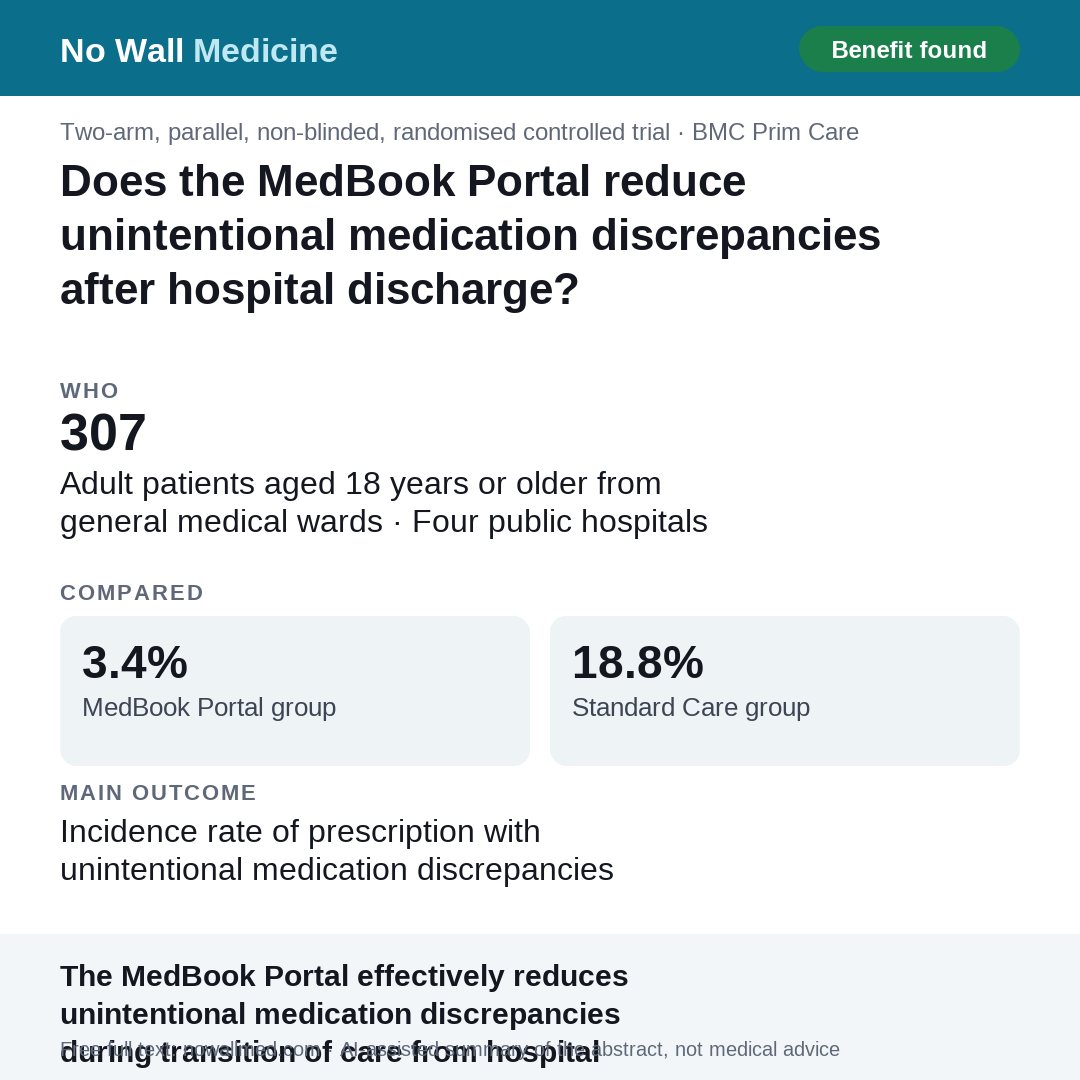
Clinical question: Does the MedBook Portal reduce unintentional medication discrepancies after hospital discharge?
Why it matters: Medication changes during transitions between healthcare settings often lead to unintentional medication discrepancies, which are errors in prescribing or administering medicine.
In absolute numbers
MedBook Portal group: 3.4% · Standard Care group: 18.8% → a difference of 15.4 percentage points, so about 7 people would need the treatment for 1 more to benefit (number needed to treat) over the trial’s follow-up.
Worked out by us from the two group results above, not reported by the authors. Check the paper for the exact outcome and timing.
Key points
- Researchers studied 307 adult patients in Malaysia who were transitioning from hospital discharge to primary health clinics.
- The incidence of prescriptions with unintentional medication discrepancies was 3.4% in the MedBook Portal group compared to 18.8% in the standard care group.
- Drug omission was the most common type of medication discrepancy, occurring in 54.4% of cases.
Headline and key points written with AI from the paper’s abstract, with every number checked against it. Read the paper before relying on them.
Topics
Cite this article
Phang YY, Kuan JW, Oh AL, Ting CY, Osman NA, Moses S. Effectiveness of digital platform in reducing unintentional medication discrepancies at transition of care from hospital discharge to primary healthcare settings: a randomised controlled trial. BMC Prim Care. 2025. doi:10.1186/s12875-025-02904-z
Spotted a mistake? Suggest a correction