Digital self-management interventions were associated with lower mortality and fewer hospitalizations in heart failure patients
Effectiveness of eHealth Self-management Interventions in Patients With Heart Failure: Systematic Review and Meta-analysis
Systematic review and meta-analysis of 24 trialsBenefit found
Are eHealth self-management interventions effective in patients with heart failure?
Who
9634
Adult patients with heart failure
Compared
eHealth self-management
Usual care
Main outcome
All-cause mortality, cardiovascular mortality, and readmissions
Result: odds ratio 0.83 (95% CI 0.71-0.98)
Bottom line: eHealth self-management interventions reduce mortality and readmissions in patients with heart failure.
Limitation: The clinical effects are affected by multiple aspects and more high-quality studies are needed.
J Med Internet Res · 2022-09-26Download image
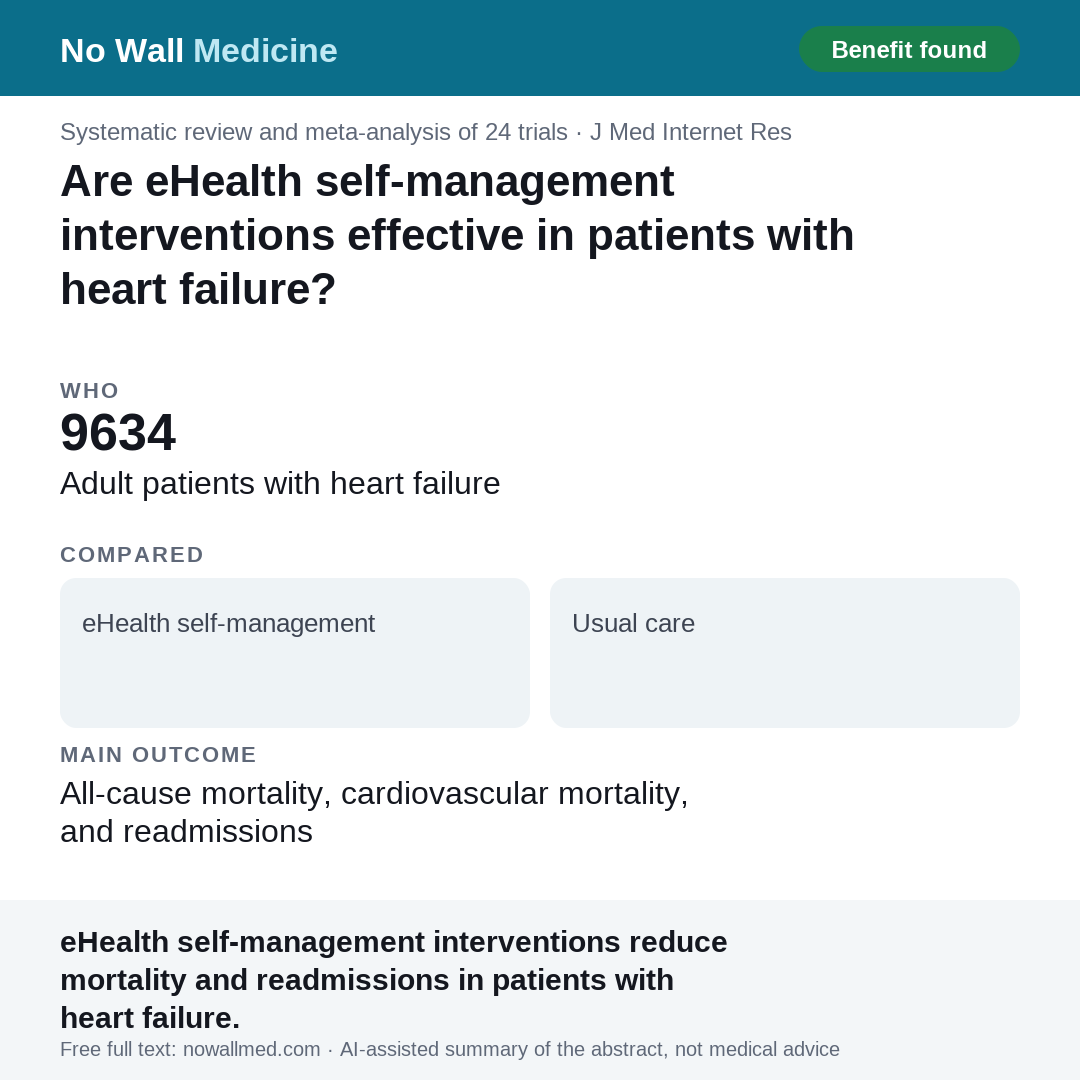
Clinical question: Are eHealth self-management interventions effective in patients with heart failure?
Why it matters: It was unknown how effective digital health self-management interventions are for improving clinical outcomes in patients with heart failure.
Key points
- Researchers analyzed 24 randomized controlled trials involving 9634 participants to compare digital health self-management against usual care.
- Digital interventions were associated with lower all-cause mortality (OR 0.83), lower cardiovascular mortality (OR 0.74), and fewer all-cause readmissions (OR 0.82).
- The interventions were associated with higher medication adherence (OR 1.82) and improved self-care behaviors (standardized mean difference -1.34).
Limitation the authors note: The certainty of evidence for several outcomes was rated as low or very low quality by the authors.
Headline and key points written with AI from the paper’s abstract, with every number checked against it. Read the paper before relying on them.
Was this summary helpful?
Subject terms
Cite this article
Liu S, Li J, Wan DY, Li R, Qu Z, Hu Y. Effectiveness of eHealth Self-management Interventions in Patients With Heart Failure: Systematic Review and Meta-analysis. J Med Internet Res. 2022. doi:10.2196/38697
Spotted a mistake? Suggest a correction
Top studies every Monday
The week’s key trials and guidelines in your specialties, plus any topics you follow. By email, free.
Get the weekly digest