Electrocautery, topical cidofovir, and topical sinecatechins showed similar efficacy for anal precancerous lesions
Effectiveness of Electrocautery, Topical Cidofovir, and Topical Sinecatechins for the Treatment of Anal High-Grade Squamous Intraepithelial Lesions in Persons With HIV: An Open-Label, Randomized Controlled Trial
Open-label, randomized controlled trialNo clear difference
Which treatment is most effective for anal high-grade squamous intraepithelial lesions in HIV?
Who
100
Persons with human immunodeficiency virus and anal high-grade squamous intraepithelial lesions · Hospital Vall d'Hebron (Spain)
Compared
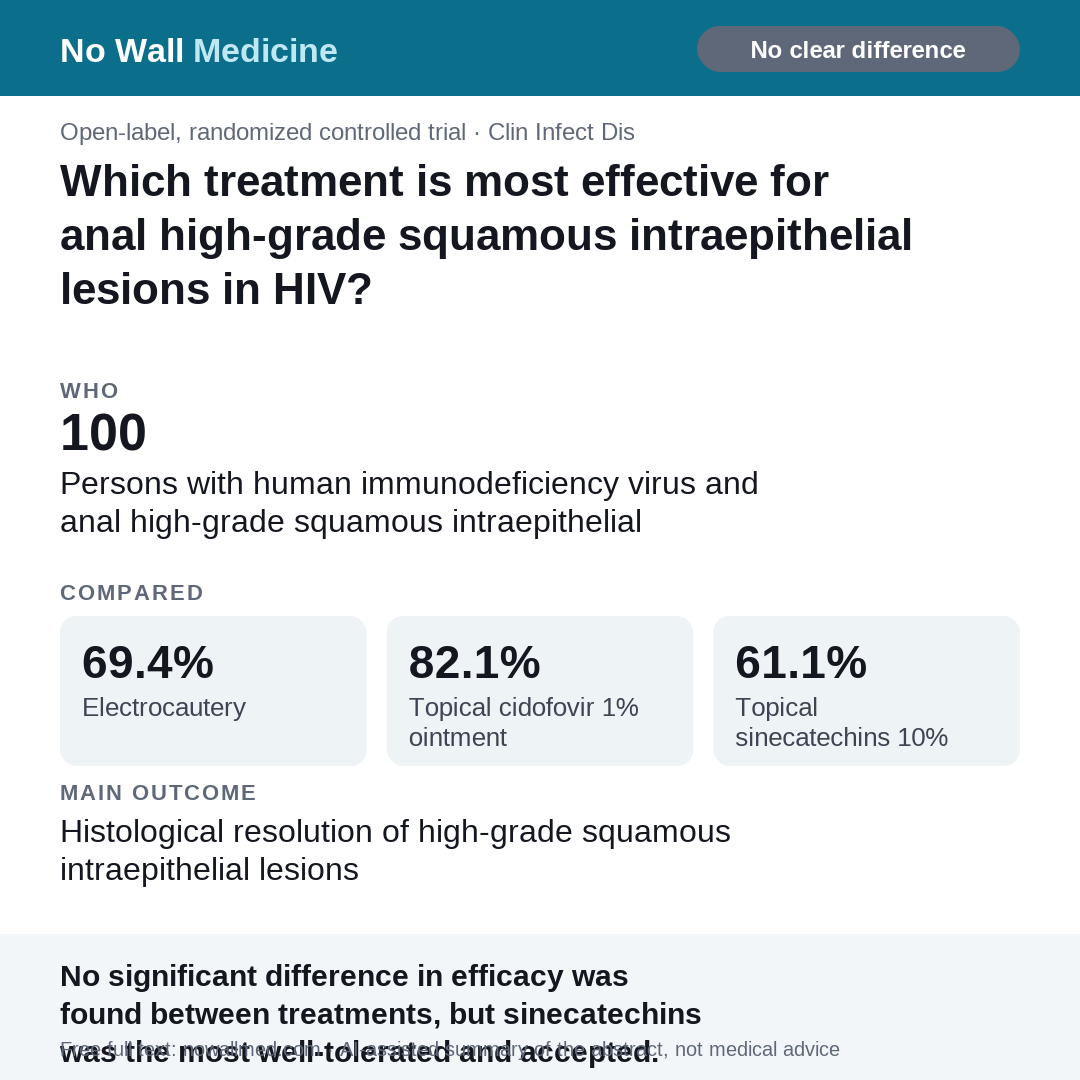
69.4%Electrocautery (95% CI: 54.4%-84.5%)
82.1%Topical cidofovir 1% ointment (95% CI: 67.9%-96.3%)
61.1%Topical sinecatechins 10% (95% CI: 45.2%-77%)
Main outcome
Histological resolution of high-grade squamous intraepithelial lesions
Bottom line: No significant difference in efficacy was found between treatments, but sinecatechins was the most well-tolerated and accepted.
Clin Infect Dis · 2025-03-04Download image
Clinical question: Which treatment is most effective for anal high-grade squamous intraepithelial lesions in HIV?
Why it matters: It is unknown which treatment is most effective for managing premalignant anal lesions in people living with human immunodeficiency virus.
Key points
- Researchers studied 100 people with human immunodeficiency virus and anal high-grade squamous intraepithelial lesions, comparing electrocautery, topical cidofovir 1% ointment, and topical sinecatechins 10%.
- The response rates for histological resolution were 69.4% for electrocautery, 82.1% for cidofovir, and 61.1% for sinecatechins, but no statistically significant difference was found between groups.
- Side effects were reported by 97.2% of the electrocautery group, 85.7% of the cidofovir group, and 33% of the sinecatechins group.
Headline and key points written with AI from the paper’s abstract, with every number checked against it. Read the paper before relying on them.
Was this summary helpful?
Subject terms
Cite this article
Burgos J, Curran A, Garcia J, Campany D, Descalzo V, Suanzes P. Effectiveness of Electrocautery, Topical Cidofovir, and Topical Sinecatechins for the Treatment of Anal High-Grade Squamous Intraepithelial Lesions in Persons With HIV: An Open-Label, Randomized Controlled Trial. Clin Infect Dis. 2025. doi:10.1093/cid/ciaf086
Spotted a mistake? Suggest a correction
Top studies every Monday
The week’s key trials and guidelines in your specialties, plus any topics you follow. By email, free.
Get the weekly digest